

This article was automatically translated from the original Turkish version.
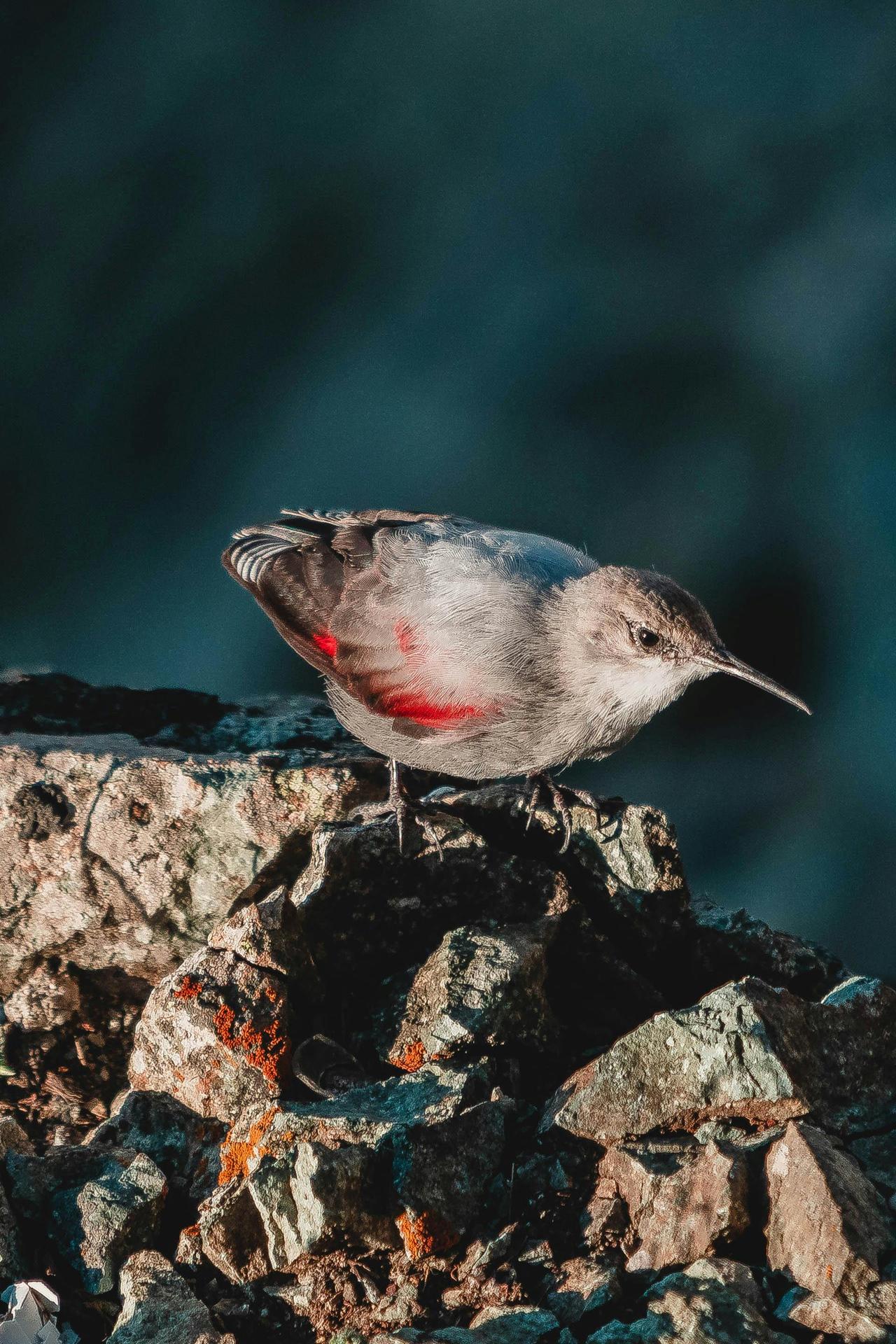
Wallcreeper (Tichodroma muraria) is a songbird distinguished by its long slender bill and colorful wings, which inhabit rocky surfaces and steep terrain. It is of medium size, recognized by its gray body and striking red-black wing patterns visible during flight. It typically moves by climbing on rocks and walls, a behavior that sets it apart from other birds.
The wallcreeper belongs to the order Passeriformes, the songbirds. Its scientific name is Tichodroma muraria. It is a polytypic species. The nominate subspecies T. m. muraria is found in southern Europe and northern and western Iran, while T. m. nepalensis ranges from Turkmenistan through eastern Iran to China. In Türkiye, this species is largely resident but undertakes short-distance altitudinal migration.
The wallcreeper (Tichodroma muraria) is a medium-sized bird measuring 16–17 cm in length, with a wingspan of 27–32 cm and a weight of 17–19 grams. It is notable for its broad rounded wings and short square tail. Its overall body color is gray, but the carmine-red areas on the wings, combined with black and white spotting, constitute its most distinctive feature. The flight feathers are dark gray with reddish tones along the outer edges and sooty black tips; four outer primaries bear prominent white spots.
The head, crown, and nape are gray, while the forehead, area between eye and bill, cheeks, and ear coverts are black. The eyes are dark brown, the bill is long, slender, slightly curved, and black. The legs and feet are black, with long toes and strong sharp talons adapted for gripping vertical surfaces; the hind toe is longer and less curved than the others.
The underparts, including the chin, throat, and breast, are black especially during the breeding season, while other lower regions are dark gray. The underwing coverts and axillaries are pale red-pink. Females differ from males by a grayish-white area on the throat and upper breast, accompanied by variable-sized black spots. Outside the breeding season, both sexes become paler gray and the black throat patch is less conspicuous. Juveniles resemble non-breeding adults with smoother gray plumage and brownish throats.
The wallcreeper (Tichodroma muraria) is a species highly adapted to rocky habitats, spending most of its life on cliffs and rock faces. It moves by short, jerky hops along surfaces, and also exhibits sideways sliding, crawling, and walking. On vertical surfaces, it can launch upward with a single powerful wingbeat. Although its flight appears undulating and irregular, it is strong and agile, capable of sudden maneuvers reminiscent of butterflies or moths.
It usually forages alone, forming small groups only rarely outside the breeding season. Both males and females defend their own feeding territories. During winter, most individuals descend to lower altitudes and may also be found in artificial environments such as stone quarries and buildings. They typically select their wintering areas in autumn.
Communication involves both visual and auditory elements. The prominent red and white wing patterns are used to signal presence to other individuals and often substitute for vocal communication. The bird frequently opens its wings to display these colors. Its song is melodic and whistling, playing a role in mate attraction and territory defense. Short chirps and various calls are also used for communication and alarm.
While foraging, it meticulously probes cracks and crevices in rock surfaces, sometimes disappearing between rocks. Occasionally, it hovers briefly in the air to catch flying insects. These behaviors demonstrate the species’ high degree of adaptation to its rocky habitat.
The wallcreeper is found throughout Europe, in all regions of Türkiye, and extends eastward to Georgia, Kyrgyzstan, northern India, Nepal, China, and Mongolia.
During the breeding season, it prefers high mountain areas, but descends to lower altitudes in winter. In this season, it can also be observed on coastal cliffs and even on tall buildings in urban areas. Overall, its fundamental habitat consists of cool, cold, moist, and often shaded rocky environments.
The wallcreeper (Tichodroma muraria) is primarily an insectivorous species. Its diet consists largely of insects, larvae, and eggs. It also consumes small mollusks, other invertebrates, grasshoppers, and crickets.
It obtains most of its food from rocky surfaces, carefully probing cracks and fissures to extract prey. It may also forage among pebbles along stream banks, at the bases of cliffs, and occasionally in trees under suitable conditions.
In some cases, it captures flying insects. Observations have recorded it hovering briefly in midair to catch flies. Its frequent inspection of surfaces is part of its specialized foraging strategy adapted to rocky habitats.
The wallcreeper (Tichodroma muraria) is monogamous and typically raises a single brood per season. Breeding occurs in April–May and July–August in Europe, and in May–July in the Himalayas.
Nests are built in protected locations such as rock crevices, fissures, hollows, and occasionally in cavities within buildings. The nest is constructed from moss, plant fibers, rootlets, and grass. The female lays 3–5 eggs, spotted from dark red to black.
Incubation lasts approximately 18–20 days and is carried out by the female. The chicks are fed by both parents. The male brings food when the chicks are at the nest entrance. The young fledge after about a month and remain dependent on their parents for some time after leaving the nest.
Females reach sexual maturity at approximately one year of age, while males take two years.
The wallcreeper (Tichodroma muraria) is listed as Least Concern (LC) on the IUCN Red List.
No Discussion Added Yet
Start discussion for "Wallcreeper (Tichodroma muraria)" article
Taxonomy
Morphological Characteristics
Behavior and Ecology
Distribution and Habitat
Diet
Breeding
Conservation Status