This article was automatically translated from the original Turkish version.
+1 More
Scientific Name(s) | Wasabia japonica (Miquel) Matsumura | ||||||||
|---|---|---|---|---|---|---|---|---|---|
Type(s) | Perennial herbaceous plant | ||||||||
Family | Brassicaceae | ||||||||
Area(s) of Use | spice and aromatic Traditional Japanese cuisine | ||||||||
Natural Range | Cool, shaded, mountainous regions near streams in Japan, primarily, as well as Korea and China | ||||||||
Wasabi (Wasabia japonica) is a perennial, rhizomatous plant species belonging to the Brassicaceae (mustard) family. Native to East Asia, wasabi holds a unique and privileged position in Japan, with deep historical, cultural, and gastronomic significance. Recognized for its distinctive pungent flavor and fresh green color, this plant is used in only a limited number of culinary traditions, primarily in traditional Japanese cuisine. Its narrow natural habitat and high dependence on specific environmental conditions make wasabi a botanically and agriculturally remarkable and specialized species.
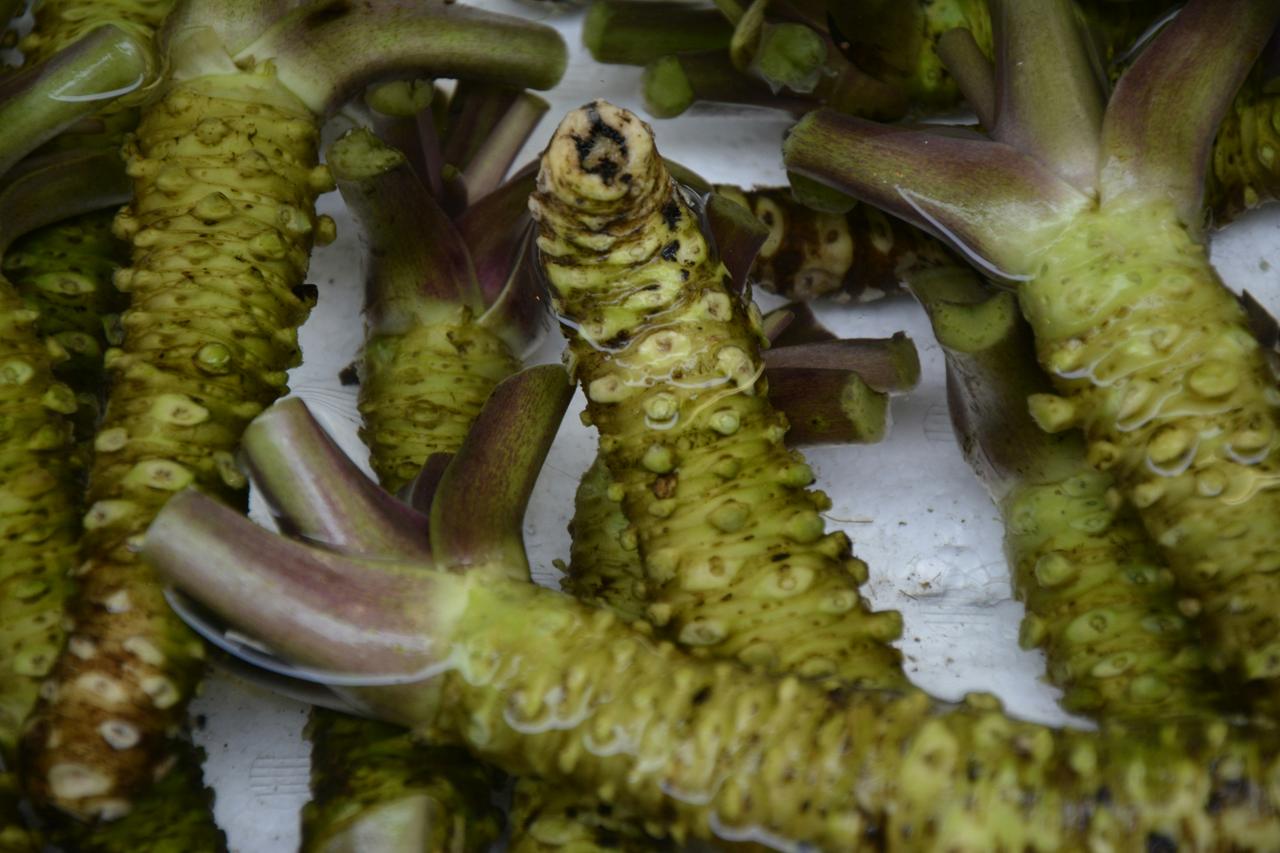
Wasabi, scientifically known as Wasabia japonica (synonym: Eutrema japonicum), is a herbaceous perennial plant adapted to moist, shaded environments near water sources. The most economically and culinarily valuable part of the plant is its underground, thickened stem structure, known as the rhizome. In traditional use, this rhizome is grated fresh to produce the characteristic wasabi paste.
Wasabi typically grows in cool climates, in shaded areas, and around clean water sources rich in dissolved oxygen. It features long-stalked, broad, heart-shaped leaves with a glossy green color that gives the plant a distinctive appearance. As a slow-growing species, wasabi usually requires approximately two years to reach rhizome size suitable for commercial harvest.
When evaluated in terms of its general characteristics, wasabi differs from many other spice plants due to its limited growing range, lengthy production cycle, and sensitive ecological requirements. These traits render wasabi a challenging crop for agricultural production, yet one with high commercial value.

Wasabi Plant Root (Unsplash)
Wasabi belongs to the kingdom Plantae, within the group of flowering plants (Angiospermae), and is classified under the class Eudicots. Taxonomically, it is placed within the order Brassicales and is a member of the Brassicaceae family. While this family encompasses a broad group of plants sharing distinct morphological and physiological traits, wasabi is regarded as a unique taxon within this group due to its restricted geographic distribution.
The currently accepted and widely used scientific name for the species is Wasabia japonica (Miq.) Matsumura. However, for much of botanical literature, it was classified under the name Eutrema japonicum (Siebold ex Maxim.). This reflects the varied nomenclature used in early botanical studies during the 19th and early 20th centuries. Today, both names appear in the literature, but Wasabia japonica is more commonly preferred in agricultural and gastronomic contexts.
At the genus level, wasabi represents a small group of species endemic to East Asia. This genus is classified within a distinct subgroup of Brassicaceae characterized by notable taxonomic features. Systematic studies have revealed that the genus Wasabia is phylogenetically closely related to other species adapted to aquatic or moist habitats.
In terms of taxonomic classification, wasabi is included among both botanically studied species and cultivated plants. Due to its limited natural distribution and unique ecological adaptations, it constitutes a distinctive example in systematic botanical literature.
Wasabi is a plant species whose natural distribution is confined to the mountainous and humid regions of East Asia. In the wild, it is primarily found on the main islands of Japan, particularly along forested slopes and mid-elevation areas. The species typically thrives around small streams, spring sources, and continuously flowing cool water channels. These habitats form the primary ecological niches where natural wasabi populations are concentrated.
In its natural environment, wasabi prefers partial shade over direct sunlight. The forest canopy reduces light intensity during the plant’s growth phase, thereby minimizing environmental stress. Additionally, the tree cover helps regulate water temperature, especially during warmer seasons. This explains why wasabi’s natural distribution is predominantly associated with stream systems within or adjacent to forests.

Grated Wasabi (Unsplash)
Ecologically, wasabi is a species adapted to low temperature fluctuations and high humidity. Continuously flowing clean water ensures sufficient oxygen availability around the roots and rhizomes. In contrast, stagnant water conditions or elevated temperatures negatively affect the plant’s natural development. Consequently, wasabi can only persist naturally in areas where specific microclimatic conditions are met.
The extreme limitation of its natural distribution renders wasabi highly sensitive to environmental changes. Alterations in stream flow patterns, deforestation, and degradation of water quality are recognized as key factors exerting direct pressure on natural populations.
Wasabi has a long historical tradition in Japan, with written records documenting its use from early periods. Initially harvested from wild populations, it was later cultivated under controlled conditions. Historical documents show that wasabi was adopted in Japan both as a component of daily dietary practices and as an accompaniment to specific dishes.
Traditionally, wasabi is closely associated with raw fish dishes. In this context, it is not merely perceived as a flavor enhancer but as an integral component embedded in the presentation and consumption rituals of the meal. Within cultural practices, the use of wasabi in small quantities is regarded as a reflection of balanced taste aesthetics.
Culturally, wasabi is also closely linked to Japanese culinary aesthetics. Its color, quantity, and presentation hold a special place within the visual and sensory harmony of the dish. In this sense, wasabi carries not only a functional role but also a symbolic value within Japanese food culture.

Prepared Wasabi (Unsplash)
Traditionally, wasabi is prepared by grating the fresh rhizome, and it is preferred to process it immediately before consumption to preserve its aroma at the highest level. The plant’s characteristic pungent flavor and unique aroma arise from glucosinolates (GSLs) stored in the rhizome, which, upon grating and exposure to air, undergo an enzymatic reaction with oxygen to form volatile isothiocyanates (ITCs). Because these compounds are highly volatile, the sensory qualities of prepared wasabi deteriorate rapidly, making immediate consumption a critical step.
In traditional Japanese cuisine, wasabi is considered one of the “indispensable trio of seasonings,” alongside horseradish and mustard, used to enhance the flavor of dishes such as sashimi (raw fish) and soba (buckwheat noodles). In Japanese culinary culture, presentation is an artistic process that appeals to both the palate and the eye. Reflecting this aesthetic, wasabi is typically served as a small green mound alongside the dish, functioning as a visually harmonizing garnish.
In industrial kitchens, powdered wasabi products are used for practicality and can be stored in dry form for extended periods. However, once mixed with water to form a paste, these products must be consumed quickly, just like fresh wasabi, to retain their characteristic potency. Thus, the preparation of wasabi is not merely a culinary technique but also a functional and cultural approach aimed at preserving the plant’s high commercial and sensory value.
Bae, Sunghwan, Hyoseong Ahn, Minha Kim, Sangun Park, and Yongduk Kim. “Tailored Spectral Lighting Enhances Growth and Photosynthetic Efficiency of Wasabia japonica.” Horticulturae 11, no. 2 (2025). Accessed January 10, 2026. https://www.proquest.com/scholarly-journals/tailored-spectral-lighting-enhances-growth/docview/3171059565/se-2.
Hodge, W. H. “Wasabi – Native Condiment Plant of Japan.” *Economic Botany* 28, no. 2 (1974): 118–129. https://doi.org/10.1007/BF02861977.
Macdonald, Beth. *Green Cactus on White Table*. Photograph. Unsplash. Accessed January 10, 2026. https://unsplash.com/photos/7tXy8cN20mo.
Macdonald, Beth. *Person in Gray Dress Shirt Holding Green and Black Wooden Board.* Photograph. Unsplash. Accessed January 10, 2026. https://unsplash.com/photos/EOGWA8LTNOA.
McCarty, David Todd. *Green Powder on White Ceramic Plate*. Photograph. Unsplash. Accessed January 10, 2026. https://unsplash.com/photos/JZ0i08sobQE.
Sultana, Tamanna, Geoffrey P. Savage, David McNeil, G.P. Porter, and B. Clark. “Comparison of Flavour Compounds in Wasabi and Horseradish.” *Journal of Food, Agriculture & Environment* 1, no. 2 (2003): 39–45. https://www.researchgate.net/publication/265758516_Comparison_of_flavour_compounds_in_wasabi_and_horseradish

Scientific Name(s) | Wasabia japonica (Miquel) Matsumura | ||||||||
|---|---|---|---|---|---|---|---|---|---|
Type(s) | Perennial herbaceous plant | ||||||||
Family | Brassicaceae | ||||||||
Area(s) of Use | spice and aromatic Traditional Japanese cuisine | ||||||||
Natural Range | Cool, shaded, mountainous regions near streams in Japan, primarily, as well as Korea and China | ||||||||
No Discussion Added Yet
Start discussion for "Wasabi (Wasabia japonica)" article
Definition and General Characteristics
Taxonomy and Systematic Position
Natural Distribution and Ecological Requirements
Historical Use and Cultural Significance
Preparation and Consumption Methods