


This article was automatically translated from the original Turkish version.
Water Cult in Turkish Mythology is a collective of beliefs and practices centered on attributing sanctity to water entities such as rivers, lakes, springs, and pınar; viewing water as a life-giving, purifying, and in some contexts, protective and healing force. Associated with this worldview are various ritual practices involving water, including offerings and kurban sacrifices at water sources, pilgrimages and supplication rituals performed at waters deemed “sacred,” taboos prohibiting certain behaviors such as polluting water or showing disrespect, and practices linking water to şifa, or healing.
In Turkish culture, the belief that water is not merely an ordinary substance but rather harbors an “iye” (protective spirit/entity) or is connected to a sacred being has reinforced behavioral patterns rooted in reverence for water. Consequently, attitudes such as avoiding pollution of water sources, refraining from harmful actions toward water bodies, and regarding specific water sites as “spaces deserving respect” have become widespread. After the adoption of Islam, these beliefs and practices did not disappear entirely; instead, they persisted within popular belief systems, transformed by new religious and cultural interpretations. This transformation became evident in the reinterpretation of water’s sanctity within frameworks of “place,” “pilgrimage,” “prayer,” and “healing.”
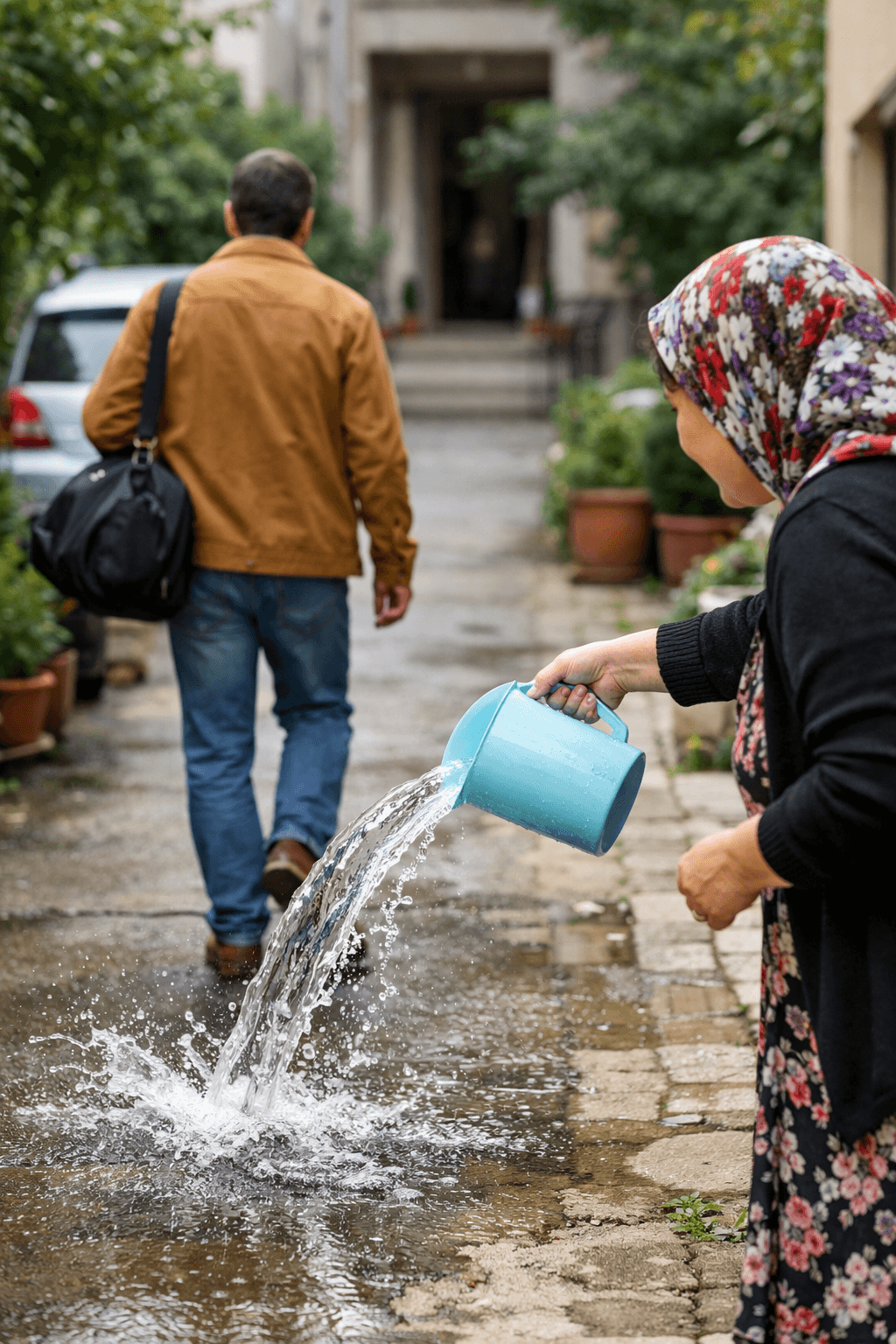
Ritual of Pouring Water After a Departure (Generated by Artificial Intelligence)
Water is a fundamental element symbolically associated with the origin of existence, the potential power containing creative possibility, and fertility/productivity. Within this framework, contact with water, especially washing, is interpreted not merely as physical cleansing but as a symbolic “threshold” act representing transition from an old state to a new one, purification, and renewal.
In Turkish communities, water cult is examined within the context of Sky God belief, beliefs in natural forces, and local water understandings. Although sanctity is attributed to water, it is particularly emphasized that this sanctity rarely corresponds to an independent, personified “water god.” Rather, water is more accurately understood not as a deified entity but as a force and place associated with protective or local spirits (iye), deserving reverence within the natural order.
In ancient Turkish belief systems, it was held that every visible entity in nature possesses a master or protective spirit (iye). Water, in this context, is associated with dominant or protective entities known as “su iyesi.” To appease these iyes, believed to preserve the order and abundance of their water sources, both bloody (such as animal sacrifice) and bloodless offerings (food, drink, tying cloth, etc.) were performed.
According to the belief in the water iye, disrespectful actions toward water—such as polluting it, throwing debris into it, or spitting into it—are widely thought to invite punishment. Therefore, avoiding pollution and maintaining cleanliness of streams, springs, and sources, as well as behaving modestly near water, are practices sustained not merely out of hygiene concerns but within a framework of fear and reverence.
In this context, various restrictions are observed near water sources. These include refraining from shouting, swearing, or littering around springs; prohibiting hunting or cutting trees near springs. It is also noted that as a sign of respect to the water iye, cloth is tied to trees close to springs. All these practices demonstrate that water is perceived not merely as a natural element but as a spiritual component of an ordered universe and a being deserving of reverence.
Among the primary aims of practices developed around water cult are obtaining healing, increasing abundance, and fulfilling wishes. Observations in the Elazığ region indicate that “sacred” water sources are visited with specific intentions, with the pursuit of healing occupying a central role. Individuals who do not achieve desired results from medical treatment regard these water sites as gateways of hope and perform various ritual behaviors there.
The sanctity of sacred water sources is not always attributed solely to the water itself; sometimes it is independently associated with other elements, and at other times with structures such as tombs, trees, or stones and rocks. In such cases, sanctity is strengthened not by the place itself but by its association with a saint and the reinforcement of its holiness through miraculous narratives. Thus, water becomes both a “sacred” component of nature and a “pilgrimage” element supported by religious and hagiographic stories.
In Anatolian examples, rituals connected to water are observed across a broad spectrum. It is reported that bathing in April rain, drinking this water, or using it in daily activities such as dough preparation, cooking, or cleaning is believed to bring good fortune and abundance. Similarly, certain wells, springs, and fountains are regarded as “sacred” and visited for purposes such as attracting luck, bearing children, undergoing the kırklanma ritual, or seeking healing. Additionally, symbolic practices such as narrating dreams to flowing water (on the belief that water will carry away troubles), and the veneration of certain rivers and springs accompanied by animal sacrifices at their banks, serve as concrete manifestations of the living legacy of water cult.
It is known that the ritual of sacrificing animals to water has been practiced in Turkish culture since the Huns and has continued to the present day. Today, when a spring dries up, people travel to a nearby tomb and offer a sacrifice (such as a sheep, cow, ox, or camel) in the hope that the spring will resume flowing. This practice is directly linked to appeasing the water iye.
With the adoption of Islam, water cult did not vanish entirely; on the contrary, it acquired a new dimension through reinterpretation, particularly via Sufi interpretations and Islamic symbols. A significant portion of rituals associated with water cult is accompanied by Islamic motifs, indicating that sacred phenomena are directly influenced by the religious and cultural structure of the societies in which they occur.
The architectural manifestations of water cult can be clearly traced through Anatolian Seljuk architecture. In medieval Anatolian Turkish architecture, structural (fountains, şadırvans, pools, selsebils, water channels, etc.) and iconographic (motifs and figures) elements related to water are found in a wide variety of buildings, including religious, civic, commercial, and educational structures. In Islamic architecture, the use of water is not merely an aesthetic preference but a functional element addressing both physical and spiritual needs for cooling and purification.
Within this framework, water carries symbolic meaning beyond its role in enhancing spatial comfort. Indeed, in some monumental portal decorations, figures such as dragons and snakes are used as visual representations of themes associated with water: abundance, health, and protection. The presence of dragon motifs, particularly in the Erzurum Çifte Minareli Medrese and certain caravanserais, is significant as it demonstrates the integration of this symbolic repertoire related to water into architectural ornamentation programs.
Kıyak, Abdulkadir. “Geleneksel Türk İnanişlarındaki Su Kültü ve Elazığ’daki İzleri.” *Gümüşhane Üniversitesi İlahiyat Fakültesi Dergisi* 2, no. 4 (2013): 22–39. Accessed January 6, 2026.https://dergipark.org.tr/tr/pub/gifad/article/167752
Türkan, Kadriye. “Türk Dünyası Masallarında Su Kültü.” *Millî Folklor* 24, no. 93 (2012): 135–148. Accessed January 6, 2026.https://www.elibrary.az/docs/JURNAL/jrn2015_464.pdf
Türkiyılmaz, Atila. “İslamiyet Öncesi Türklerde Su Kültü ve Günümüze Yansımaları.” *Bilim ve Kültür – Uluslararası Kültür Araştırmaları Dergisi* 1, no. 4 (December 2013): 83–100. Accessed January 6, 2026.https://isamveri.org/pdfdrg/G00055/2013_4/2013_4_TURKYILMAZA.pdf
Uçar, Hüseyin. “Yayla Ocaklarına İlişkin Tören ve İnanışların Eski Türk Dini’ndeki Ateş Kültü Bağlamında İncelenmesi.” *Kültür Araştırmaları Dergisi*, no. 7 (2020): 24–47. Accessed January 6, 2026.

No Discussion Added Yet
Start discussion for "Water Cult in Turkish Mythology" article
The Symbolic Domain of Water
Belief in the Water Iye and Reverence and Taboos Toward Water
Ritual Practices
Sacrifices and Offerings to Water
Contemporary Reflections