

This article was automatically translated from the original Turkish version.
+2 More
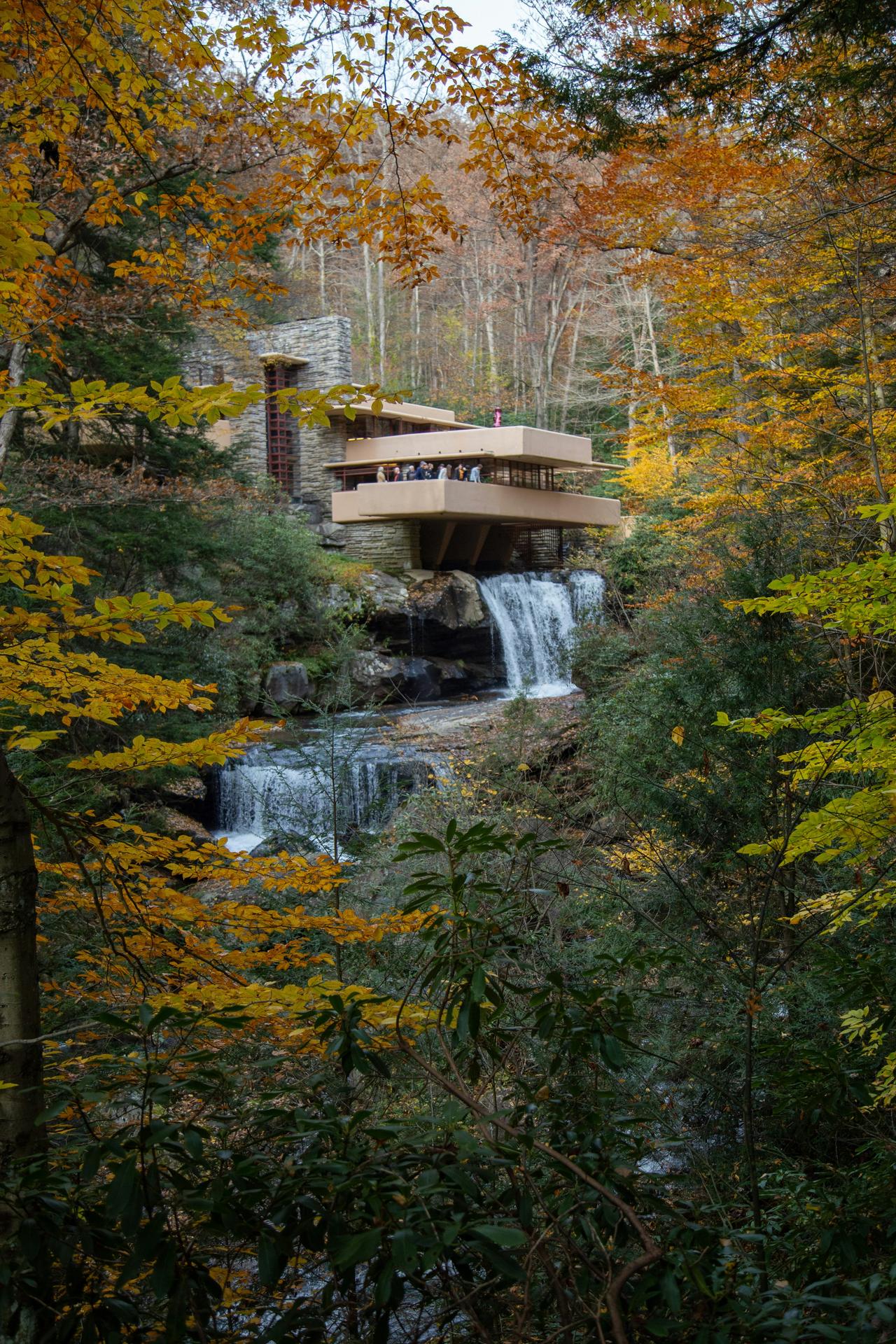
Fallingwater is a residential structure designed by American architect Frank Lloyd Wright for Edgar J. Kaufmann and his family. The building is situated in the Bear Run region of Pennsylvania, directly over a natural waterfall. Designed in 1935, it is regarded as one of the most significant works of 20th century American architecture. The structure was planned to establish a direct relationship with the rocky slopes and water flow, and is conceived as an integral part of its natural surroundings.
Video Showing Fallingwater’s Integration with Nature (Fallingwater)
The building is located southeast of Pittsburgh in the Bear Run region. The site spans 1,543 acres and the house is constructed directly over a natural waterfall. It was used as a weekend residence by the Kaufmann family from 1937 until 1963. In 1963 it was transferred to the Western Pennsylvania Conservancy and opened to the public as a museum in 1964. The interior spaces and surrounding environment are preserved according to the original design principles.
Fallingwater was designed by Frank Lloyd Wright, who was born in 1867 in Richland Center, Wisconsin. Within the framework of organic architecture, continuity is established between the building and its environment. Understanding the nature of materials and adhering to their inherent qualities is central to Wright’s architectural philosophy. The architectural form, interior layout, and natural surroundings are treated as an integrated whole in the design.

Fallingwater – Reinforced Concrete Cantilever Terraces (Unsplash)
Interior spaces are opened to the external environment through glass walls. When small hinged windows are opened, corner lines dissolve and horizontal lines are emphasized. Furniture is designed to suit the function of the space and is made from natural materials such as wood, steel and stone. The kitchen and floor finishes are planned with functionality as the primary consideration.
Roofs and cantilevers are reinforced with steel supports. Roof eaves bear structural loads while establishing a horizontal rhythm. Guest and main sections are connected by bridges, and roofs and terraces are designed to harmonize with the natural slope and rock formations of the surroundings.
Materials used in the design of Fallingwater were selected to create harmony between the structure and its natural environment. The primary structural system consists of reinforced concrete elements. Reinforced concrete slabs are anchored to the natural rock mass and are designed to form cantilevered terraces above the stream. These terraces establish both visual and physical connections between the building and the surrounding rock formations.
The stone material used in the structure is local sandstone. Sandstone is employed on terraces and certain wall surfaces to achieve continuity with the natural rock formations in the vicinity. The stone surfaces are applied to preserve their natural texture, contributing to a sense of continuity between the building and its natural setting.
Materials used in the interior spaces are also planned in harmony with the overall architectural design. In the living room, a natural rock outcrop has been preserved and incorporated as an integral part of the interior. This approach is one of the key elements that enable the building to merge with the natural topography. Furniture and interior elements are designed to align with the building’s material philosophy, ensuring the continuity of architectural unity.

Fallingwater Built on a Rocky Slope Within the Forest (Unsplash)
Rather than facing the stream, the building is placed directly over it. This site decision creates a direct physical relationship between the residence and its natural environment. The water flows beneath the structure and continues immediately below the terraces.
Fallingwater is designed to blur the boundaries between nature and space. Transitions between interior, semi-open, and open spaces are arranged gradually. The waterfall and rock formations become physical components of the building, and interior spaces are organized as extensions of the environmental conditions. Glass walls provide panoramic views, integrating the forest and water into the spatial experience. Corner glazing and stone columns generate perspectives that harmonize with the rhythm of the natural surroundings.
The structure responds directly to the topography and rock formations. The anchoring of reinforced concrete terraces to the rock, the combined use of stone and glass, and the continuity between interior and exterior spaces establish an organic relationship with the environment. Furniture and interior elements are treated as integral components of the architectural design and are conceived in harmony with the overall composition.
Erbaşa, Bayram Can, and Mahmut Atilla Söğüt. “Wabi-Sabi Tasarımların Organik Mimari Üzerinden İncelenmesi.” *YDÜ Mimarlık Fakültesi Dergisi* 6, no. 2 (2024): 1–17. Accessed March 11, 2026. https://dergipark.org.tr/en/download/article-file/3994181
Fallingwater. "An (Official) Introduction to Fallingwater, Frank Lloyd Wright’s Masterwork Built Above a Waterfall." YouTube, 01:07. January 19, 2024. Accessed March 11, 2026. https://www.youtube.com/watch?v=C3RTgK0zipY
Frank Lloyd Wright Foundation. “Fallingwater.” Frank Lloyd Wright Foundation. Accessed March 11, 2026. https://franklloydwright.org/site/fallingwater/
Frank Lloyd Wright Foundation. “Frank Lloyd Wright.” Accessed March 11, 2026. https://franklloydwright.org/frank-lloyd-wright/
Haobam, Martin. “A Bridge Over a Waterfall JPG.” Unsplash. Accessed March 11, 2026. https://unsplash.com/photos/a-bridge-over-a-waterfall-GSKX8DqSf6U
Iconic Houses. "Fallingwater." Iconic Houses. Accessed March 11, 2026. https://www.iconichouses.org/specials/fallingwater
Thornton, Kirk. “Beige and Brown Brick House Between Trees JPG.” Unsplash. Accessed March 11, 2026. https://unsplash.com/photos/beige-and-brown-brick-house-between-trees-rgl1uZyaEww
Wiebe, Charles. “Frank Lloyd Wright, Fallingwater.” Smarthistory. Accessed March 11, 2026. https://smarthistory.org/frank-lloyd-wright-fallingwater/
Location and General Information
Frank Lloyd Wright and the Organic Architecture Approach
Architectural Features
Interior Layout
Structural Elements
Material Usage
Relationship with Nature
Site Selection
Spatial Relationships
Organic Architecture Characteristics