


This article was automatically translated from the original Turkish version.
Waterfall Software Development Model is a lifecycle approach that divides the software development process into distinct phases, with each phase proceeding sequentially and without backward feedback. It is typically preferred for large-scale, complex projects where requirements can be clearly defined. The model emphasizes specific milestones, documentation, and quality control in project management.
The Waterfall model represents a milestone in the formation of process-based management in software engineering. First proposed by Winston W. Royce in 1970, this approach was not presented by Royce as a single, flawless model; rather, he highlighted its shortcomings and opened it to discussion. Royce aimed to overcome communication gaps, flawed requirement analyses, and inadequate documentation prevalent in the complex defense and space projects of his time by breaking project management into sequential stages, where the output of each stage served as the input for the next.
This sequential nature gave the model its name: just as water flows down steps of a waterfall without reversing direction, software development phases proceed one after another without feedback channels. However, in subsequent years, this rigid structure became a standard in many industries, particularly in disciplines requiring strict regulation such as aerospace, defense, and medicine. Even today, many modern lifecycle approaches—such as Spiral, V-Model, and Incremental Model—build upon the fundamental philosophy of the Waterfall model.
The Waterfall model manages the software development process by dividing it into distinct, discrete phases. Each phase is linked to the next through a clear input-output relationship. According to the classical approach, five primary phases are emphasized:
The foundation of project success lies in the complete and unambiguous definition of requirements. Customer expectations are gathered, analyzed, and documented in a Software Requirements Specification (SRS) document. This document guides all subsequent design and development activities.
The requirements clarified during the analysis phase are transformed into a concrete system architecture. This phase is typically divided into High-Level Design (HLD) and Low-Level Design (LLD). HLD outlines the modular structure and interactions between components, while LLD specifies the internal workings, algorithms, and data structures of each module.
Approved design outputs are converted into source code. Programmers develop individual modules and perform unit tests at the module level. The coding phase serves as a practical validation of the design’s correctness.
Developed modules are integrated and subjected to comprehensive testing. Alpha testing is conducted by the development team, while beta testing involves selected users. Finally, acceptance testing confirms whether the software meets customer expectations. Software that passes all tests is ready for deployment.
After deployment, the longest phase of the software lifecycle begins. This includes correcting errors (corrective maintenance), adding new features (perfective maintenance), and adapting the software to new platforms (adaptive maintenance).
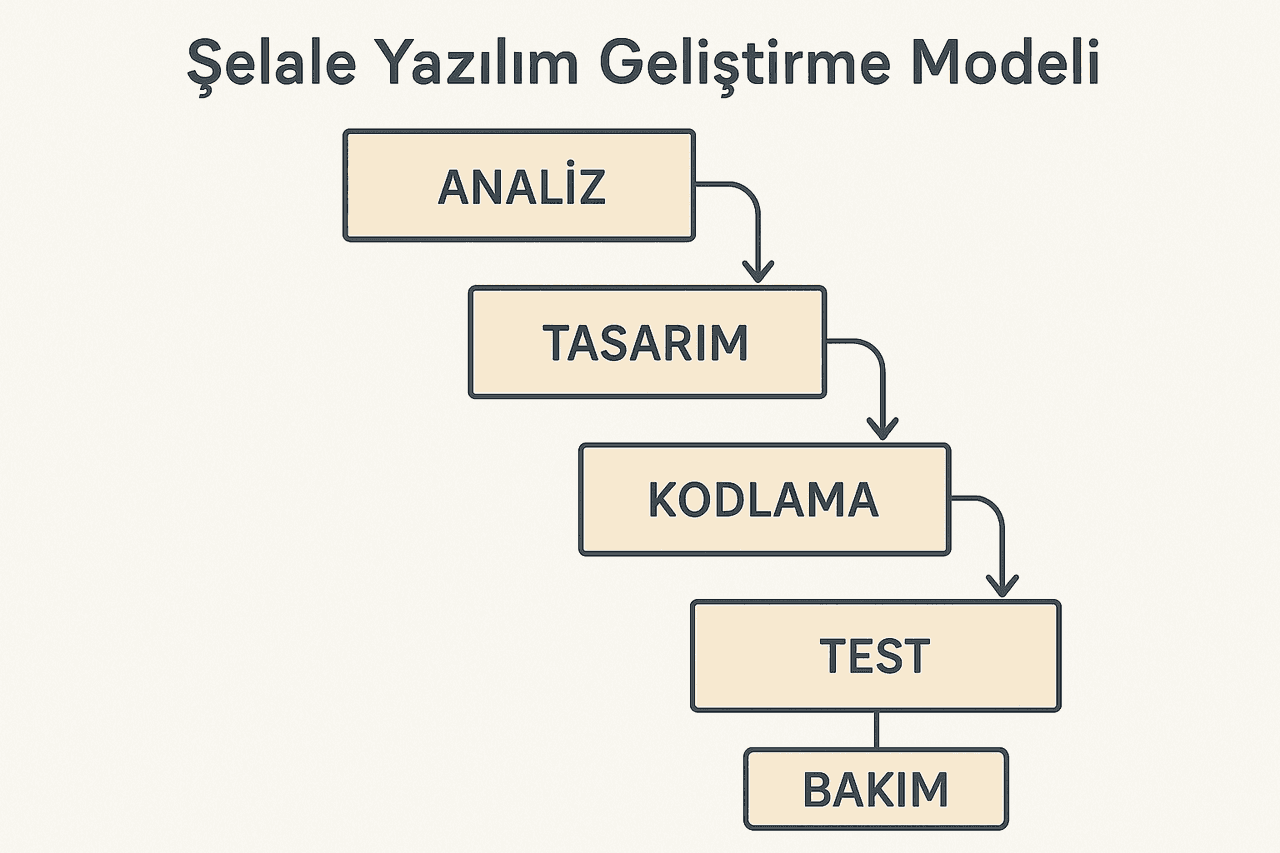
Waterfall Model Implementation Steps (Generated by artificial intelligence.)
Due to its structured linear nature, the Waterfall model does not yield ideal results in every project. However, its use is recommended in academic and industry circles under specific conditions:
The Waterfall model remains strong in several aspects:
Alongside its historical advantages, the Waterfall model has well-documented limitations:
Compared to modern development approaches, the Waterfall model stands out in the following ways:
These differences illustrate where the Waterfall model is appropriate and where it falls short.
The Waterfall model is recommended in the following situations:
Although the Waterfall model lacks flexibility, it retains its importance in specific domains. It remains the preferred choice for projects requiring strict regulation and where safety and security are critical—such as aircraft control systems, defense software, and nuclear energy monitoring. Additionally, the model serves as a foundational reference for modern hybrid approaches; many Agile adaptations draw inspiration from Waterfall’s phase discipline. Thus, beyond its historical role as an initial model in software engineering, the philosophical foundations of the Waterfall model continue to live on in today’s process-oriented software production culture.
Adenowo, Adetokunbo AA, and Basirat A. Adenowo. "Software engineering methodologies: a review of the waterfall model and object-oriented approach." International Journal of Scientific & Engineering Research 4, no. 7 (2013): 427-434. Accessed Adresi.
Alshamrani, Adel, and Abdullah Bahattab. "A comparison between three SDLC models waterfall model, spiral model, and Incremental/Iterative model." International Journal of Computer Science Issues (IJCSI) 12, no. 1 (2015): 106. Accessed Adresi.
Andrei, Bogdan-Alexandru, Andrei-Cosmin Casu-Pop, Sorin-Catalin Gheorghe, and Costin-Anton Boiangiu. "A study on using waterfall and agile methods in software project management." Journal of Information Systems & Operations Management (2019): 125-135. Accessed Adresi.
Geeksforgeeks. "Waterfall Model - Software Engineering". 2025. Accessed July 8, 2025. Accessed Adresi.
Iqbal, Muzaffar, and Muhammad Rizwan. "Application of 80/20 rule in software engineering Waterfall Model." In *2009 International Conference on Information and Communication Technologies*, pp. 223-228. IEEE, 2009. Accessed Adresi.
Klein, Matt. "Waterfall Model Methodology: Everything You Need to Know". 2024. Accessed July 8, 2025. Accessed Adresi.

No Discussion Added Yet
Start discussion for "Waterfall Software Development Model" article
Key Features
Historical Development of the Waterfall Model
Phases of the Waterfall Model
Requirements Analysis and Specification
Design
Coding (Development)
Testing and Deployment
Maintenance
Application Areas of the Waterfall Model
Advantages of the Waterfall Model
Disadvantages of the Waterfall Model
Comparison with Other Software Development Models
Situations Suitable for the Waterfall Model
The Waterfall Model in Contemporary Context