


This article was automatically translated from the original Turkish version.
+2 More
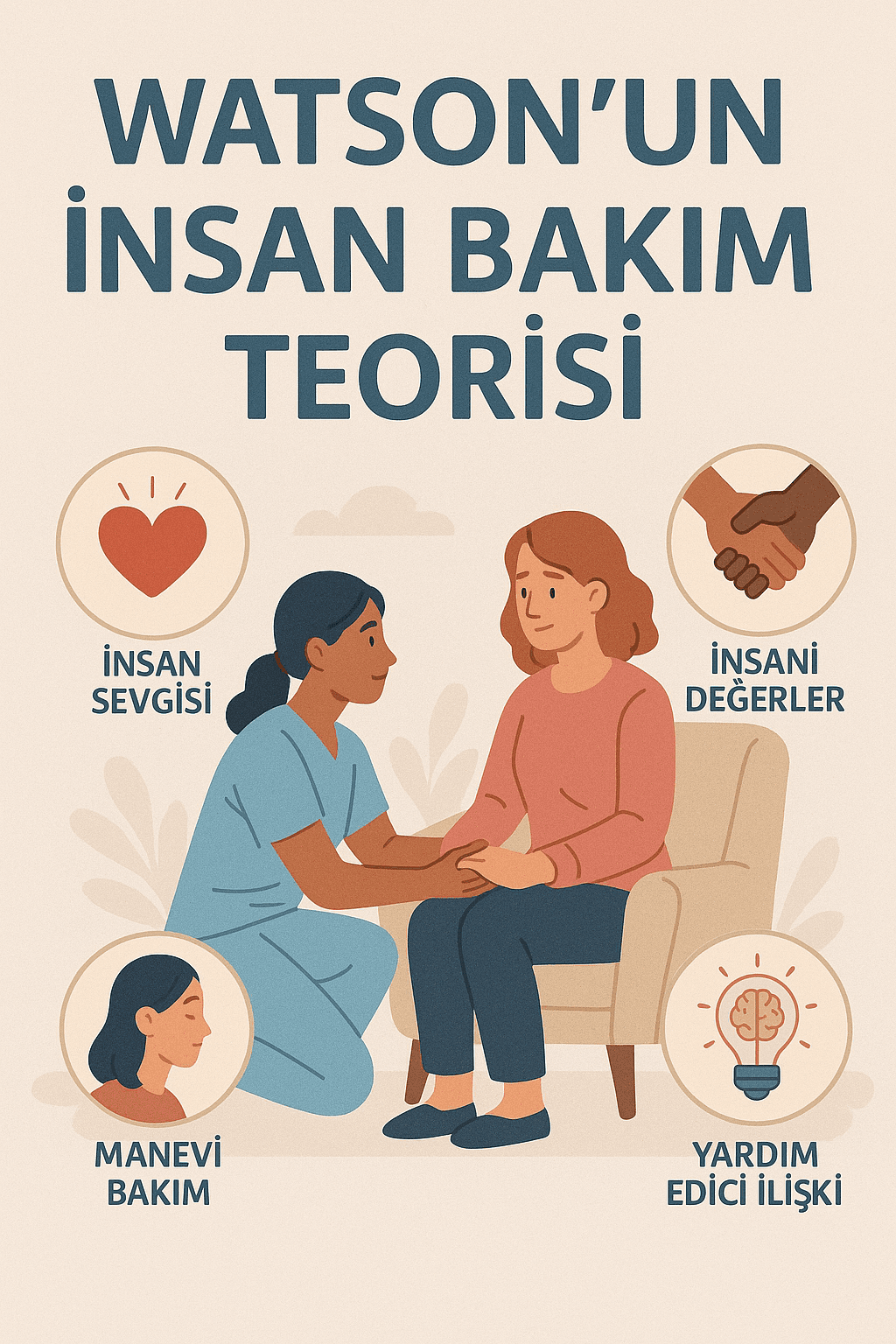
Watson’s Theory of Human Caring is a nursing theory developed by Jean Watson in 1979 that embraces a person-centered holistic approach to care within the nursing discipline. First published in her book titled “The Science of Human Caring,” the theory aims to guide nursing practices within a systematic and humanistic framework. It defines the nurse-patient relationship through love compassion ethics and aesthetic values with a focus on the unity of mind body and spirit. Watson characterizes nursing as “a transpersonal caring process” and emphasizes that care seeks to establish balance and harmony in the individual’s health-illness experience.
Watson’s Theory of Human Caring is structured around four fundamental concepts that constitute the nursing paradigm:
1. Person: A unique being composed of mind body and spirit capable of making autonomous choices. The person is neither purely objective nor solely spiritual but is understood through a holistic lens.
2. Health: Not the absence of disease but a state of harmony and balance among mind body and spirit. Disruption of this balance leads to illness.
3. Environment: A healing environment is defined as a peaceful and aesthetic setting that supports physical emotional and spiritual comfort.
4. Nursing: A discipline that aims to restore balance in the individual’s health-illness experience through scientific ethical aesthetic and personal practices.
In addition to these concepts the theory is built upon key components such as “caritas processes” “interpersonal caring relationship” “caring moment” and “caring-healing consciousness.” Supporting concepts such as “authentic relationship” and “healing environment” have further expanded the theory’s application scope.

Health Services (Pexels)
Watson’s theory encompasses ten caritas processes that guide nursing care. These processes aim to support the humanistic and holistic nature of care and adopt a non-linear flexible approach. The processes are as follows:
1. Cultivation of loving-kindness and altruistic values: Approaching the person with love and compassion.
2. Faith-hope: Instilling faith and hope in the person.
3. Sensitivity to self and others: Developing awareness of oneself and the person and nurturing individual beliefs and practices.
4. Helping-trusting relationship: Establishing a trusting caring relationship.
5. Expression of positive and negative feelings: Enabling the person to express emotions authentically through active listening.
6. Creative problem solving: Employing creative and scientific methods of problem solving.
7. Teaching-learning: Creating a learning environment tailored to individual needs.
8. Healing environment: Creating a physically emotionally and spiritually comforting environment.
9. Assistance with basic needs: Supporting fundamental physical emotional and spiritual needs.
10. Spiritual openness: Being attuned to life death and existential dimensions.
These processes constitute the essence of Watson’s nursing care and aim to support the healing process while preserving the person’s wholeness.
Watson’s Theory of Human Caring has a broad range of applications in nursing practice. The theory has been extensively applied in areas such as chronic illness infertility postpartum care oncology pediatrics intensive care and geriatric care. A systematic review indicated that between 2009 and 2019 the theory was used in 48 studies; of these 23 employed the theory as a conceptual framework 18 used it for care practices or data collection instruments and 7 applied it as a guide for case studies.
In particular the application of the theory in women’s health domains such as infertility and the postpartum period has been generally effective in addressing individuals’ emotional and psychological needs. For instance in nursing care provided to women experiencing failure in infertility treatment it was observed that the theory helped women express their emotions cultivate hope and adapt to new life conditions. Similarly in care provided to a primiparous mother during the postpartum period the theory strengthened mother-infant bonding enhanced maternal self-confidence and supported coping mechanisms for stress.
Watson’s theory embraces a person-centered approach rather than a medically focused one. While preserving the mind-body-spirit unity of the person it treats love and compassion as fundamental elements of care. The theory transforms nursing practice from a task-oriented profession into a uniquely individualized ethical and aesthetic discipline.
The theory has also contributed to nursing education clinical practice and research. Some studies have demonstrated that the theory increases patient satisfaction enhances nurses’ communication skills and serves as a guide in clinical management. For example nursing education programs based on the theory have been found to improve nurse performance reduce medication errors and foster positive attitudes toward patient care.
The literature notes limited clinical application of the theory. Contributing factors include the time and training required for implementation the dominance of medically oriented approaches in some clinical settings and challenges in adapting the theory to diverse cultural contexts. In countries such as Türkiye adoption and application of the theory remain quite limited.
Buldum, Aysu, and Duygu Vefikuluçay Yılmaz. 2020. “Watson İnsan Bakım Kuramı’na Göre Postpartum Anneye Bütüncül Hemşirelik Yaklaşımı: Olgu Sunumu.” *Sağlık Bilimleri Üniversitesi Hemşirelik Dergisi / University of Health Sciences Journal of Nursing* 2 (2). Accessed May 30, 2025. https://dergipark.org.tr/en/download/article-file/960520.
Durgun Ozan, Yeter, and Hülya Okumuş. 2013. “Tedavi Sonucu Başarısız Olan İnfertil Kadınların Watson’ın İnsan Bakım Kuramına Göre Hemşirelik Bakımı.” *Anadolu Hemşirelik ve Sağlık Bilimleri Dergisi* 16: 190–196. Accessed May 30, 2025. https://dergipark.org.tr/en/download/article-file/29632.
Kampus Production. "Kadın, Ev, Yuva, Oda." Pexels, 2025. Accessed May 30, 2025. https://www.pexels.com/tr-tr/fotograf/kadin-ev-yuva-oda-8949835/.
Korhan, Esra Akın. 2019. “Watson’un İnsan Bakım Modeli: Bir Sistematik Derleme.” *SAÜ Hemşirelik Bilim ve Sanat Dergisi* 2, no. 2: 46–68. Accessed May 30, 2025. https://dergipark.org.tr/en/download/article-file/859385
Korhan, Esra Akın. 2019. “Watson’un İnsan Bakım Modeli: Bir Sistematik Derleme.” SAÜ Hemşirelik Bilim ve Sanat Dergisi 2, no. 2: 46–68. Accessed May 30, 2025. https://dergipark.org.tr/en/download/article-file/859385.

No Discussion Added Yet
Start discussion for "Watson's Human Caring Theory" article
Core Concepts of the Theory
Caritas Processes
Application Areas of the Theory
Characteristics and Contributions of the Theory
Limitations and Challenges in Application