


This article was automatically translated from the original Turkish version.
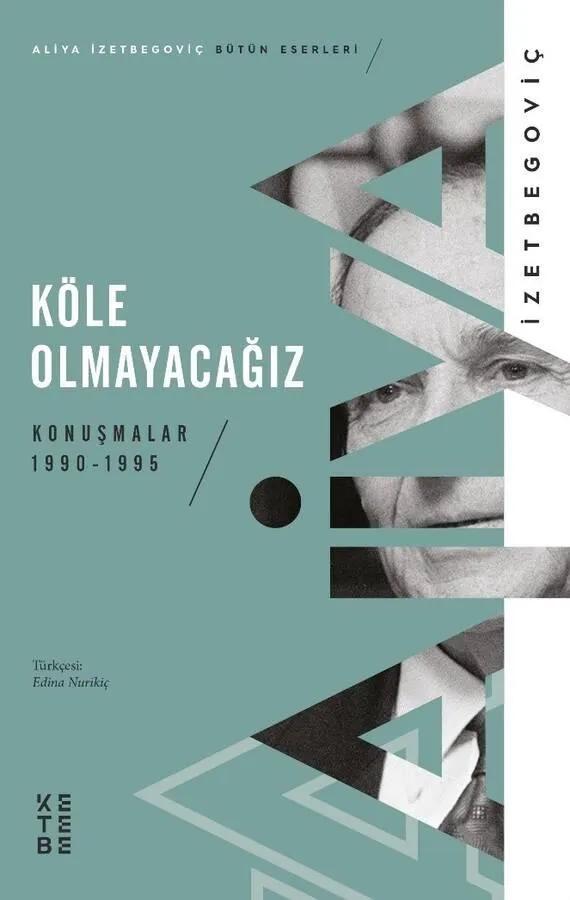
We Will Not Be Slaves (Book)
Author(s) | Aliya Izetbegović | ||||||||
|---|---|---|---|---|---|---|---|---|---|
Publisher(s) | Ketebe Yayınları | ||||||||
Translator(s) | Edina Nurikić | ||||||||
Number of Pages | 300 pages | ||||||||
Type(s) | Politics Narrative | ||||||||
Original Language | Bosnian | ||||||||
We Will Not Be Slaves is a work that reflects the ideas and leadership philosophy of Alija Izetbegović, the first president of Bosnia and Herzegovina, comprising his speeches delivered between 1990 and 1995 on various occasions and platforms. The book conveys the devastating impact of the Bosnian War (1992–1995) through Izetbegović’s own words while addressing themes such as freedom, justice, morality, and human dignity. Translated into Turkish, this work has reached a wide readership, particularly within the Islamic world and in Türkiye. Izetbegović’s speeches reveal his persistent efforts to uphold ties with peace, culture, and humanity even under the harsh conditions of war.
We Will Not Be Slaves is a compilation of speeches delivered by Alija Izetbegović during the transition of Bosnia-Herzegovina to independence amid the dissolution of Yugoslavia and throughout the Bosnian War. This period began in 1990 with the founding of the Party of Democratic Action (SDA) and encompasses the most intense years of Bosnia-Herzegovina’s struggle for independence and the ensuing conflict.
The book includes speeches delivered by Izetbegović across diverse platforms, from election rallies to international commissions. These addresses aimed to inspire hope among the Bosnian people, mobilize the international community, and strengthen cultural and spiritual resistance against the destruction wrought by war.
The work holds significant historical importance within the context of the Bosnian War (1992–1995). The war, which began in 1992 following the breakup of Yugoslavia, marked a period of immense genocide and devastation for the Bosniak people. During this time, Izetbegović served both as a leader guiding his people and as a defender of Bosnia’s rights on the international stage. The book stands as a primary source documenting Izetbegović’s leadership philosophy and his struggle for Bosnia’s independence during these difficult years.
We Will Not Be Slaves explores themes such as freedom, justice, human dignity, and the role of Islam in the modern world through Izetbegović’s speeches. The book demonstrates how, even amid the chaos of war, Izetbegović maintained his emphasis on peace, ethics, and culture. The main themes are as follows:
In his speeches, Izetbegović emphasized that freedom is both an individual and a collective right. The phrase “I swear by Allah, who holds power over all things, that we will never be slaves!” serves as the central motto of the book and has become a symbol of the Bosniak people’s struggle for independence. Izetbegović defended resistance against totalitarian regimes and the inhumane conditions imposed by war.
Even during the most intense phases of the war, Izetbegović preserved his faith in peace. His speeches reflect his vision of tolerance by defining Bosnia as a place where people of different religions and cultures could live together. “When this storm eventually passes, we will have to return to ourselves,” he urged his people to strengthen themselves not only through war but also through art, literature, and culture.
Izetbegović argued that Islam serves as a guiding system for both individual and social life. In his speeches, he demonstrated how Islamic principles of tolerance, justice, and morality could be reconciled with the challenges of the modern world, enabling Muslim societies to offer solutions to contemporary problems. In addresses directed at Europe, he emphasized that his tolerance was rooted in Islam, not in European traditions: “My tolerance is not European but Islamic in origin.”
Izetbegović asserted in his speeches that justice is the foundation of any society. He clearly criticized the failure to uphold rulings by the Constitutional Court of Yugoslavia as evidence of his belief in the supremacy of law. According to him, a society’s commitment to the rule of law is measured by its attitude toward minorities and dissenters.
The work had a profound impact both during and after the Bosnian War, within Bosnia-Herzegovina and across the Islamic world. Izetbegović’s speeches became symbols of hope and resistance against the destructive effects of war. In Türkiye especially, the book played a crucial role in establishing Izetbegović’s reputation as the “Wise King” and in disseminating his ideas to broad audiences. Published by Ketebe Yayınları, the work was translated directly from the Bosnian original for Turkish readers.
The book is regarded as a primary source for those seeking to understand Izetbegović’s leadership during the war and his struggle for Bosnia’s independence. While laying bare the suffering and human tragedy of the conflict, it presents a narrative that underscores Izetbegović’s unwavering pursuit of peace and justice.
İzzetbegoviç, Aliya. Köle Olmayacağız - Konuşmalar 1990-1995. İstanbul: Ketebe Yayınları, 2021.

We Will Not Be Slaves (Book)
Author(s) | Aliya Izetbegović | ||||||||
|---|---|---|---|---|---|---|---|---|---|
Publisher(s) | Ketebe Yayınları | ||||||||
Translator(s) | Edina Nurikić | ||||||||
Number of Pages | 300 pages | ||||||||
Type(s) | Politics Narrative | ||||||||
Original Language | Bosnian | ||||||||
No Discussion Added Yet
Start discussion for "We Will Not Be Slaves (Book)" article
Writing Process and Historical Context
Themes and Content
Freedom and Human Dignity
Peace and Tolerance
Islam and Modernity
Justice and Leadership
Impact and Reception