

This article was automatically translated from the original Turkish version.
Wealth Tax is a one-time tax introduced on 11 November 1942 in Türkiye during the economic crisis triggered by the Second World War, designed to collect revenue from wealth and extraordinary profits. The tax came into effect during the government led by Şükrü Saraçoğlu. Its primary objectives were to close the budget deficit created by the war economy, control inflation, and curb black market activities and profiteering.【1】
Although Türkiye did not officially participate in the First World War, it was severely affected by its economic and social consequences. The mobilization of approximately one million men reduced production, while increased consumption, declining imports, and market imbalances led to inflation, black markets, and shortages.

Son Posta (12 Teşrinisani 1942)
Under the administration of İsmet İnönü, the state initially implemented interventionist policies such as the National Protection Law to control the economy. However, when these measures proved insufficient, the Wealth Tax emerged as a more radical solution.
Despite Türkiye’s non-belligerent status in the Second World War, the heavy defense expenditures, economic contraction, and decline in production created severe fiscal pressures that pushed the Şükrü Saraçoğlu government to seek new sources of revenue. In this context, the Grand National Assembly of Türkiye adopted on 11 November 1942 a law consisting of seventeen articles entitled the “Wealth Tax Law.”【2】
The Wealth Tax Law was designed to collect revenue from individuals possessing wealth and income, and it had the following key features:
Local commissions played a decisive role in implementing the Wealth Tax, classifying taxpayers according to various criteria to determine their liabilities. However, the lack of objective and standardized criteria in assessing tax amounts led to major problems. In many cases, tax assessments were based on estimates rather than official records, fueling allegations of inequality among taxpayer groups. Particular attention has been drawn to assessments indicating that non-Muslim taxpayers were taxed at disproportionately higher rates, often based on religious and ethnic classifications.
Furthermore, the requirement to pay the tax within a very short timeframe placed severe economic pressure on taxpayers. The absence of appeal mechanisms and the narrow payment window intensified criticism regarding the fairness of the implementation.
Taxpayers who failed to pay within the stipulated period faced asset seizures. Those unable to settle their debts were sent to work camps established in various regions, notably Erzurum’s Aşkale.
Although the Wealth Tax was theoretically designed as a fiscal measure to restore economic balance, its practical implementation generated controversial outcomes due to methodological flaws and systemic inequalities, affecting both the economy and society.
The Wealth Tax faced criticism both domestically and internationally. The heavy tax burden on non-Muslim taxpayers and allegations of discriminatory practices attracted negative attention in the international press, particularly in the American media, which published unfavorable assessments of Türkiye.【3】 These developments negatively affected Türkiye’s foreign relations and international image, increasing diplomatic pressure on the government.
Under mounting domestic and international pressure, the enforcement of the Wealth Tax was effectively relaxed from 1943 onward, with authorities scaling back harsh collection measures. By the end of that year, taxpayers in work camps were released and new collection efforts were halted, signaling the de facto end of the tax.
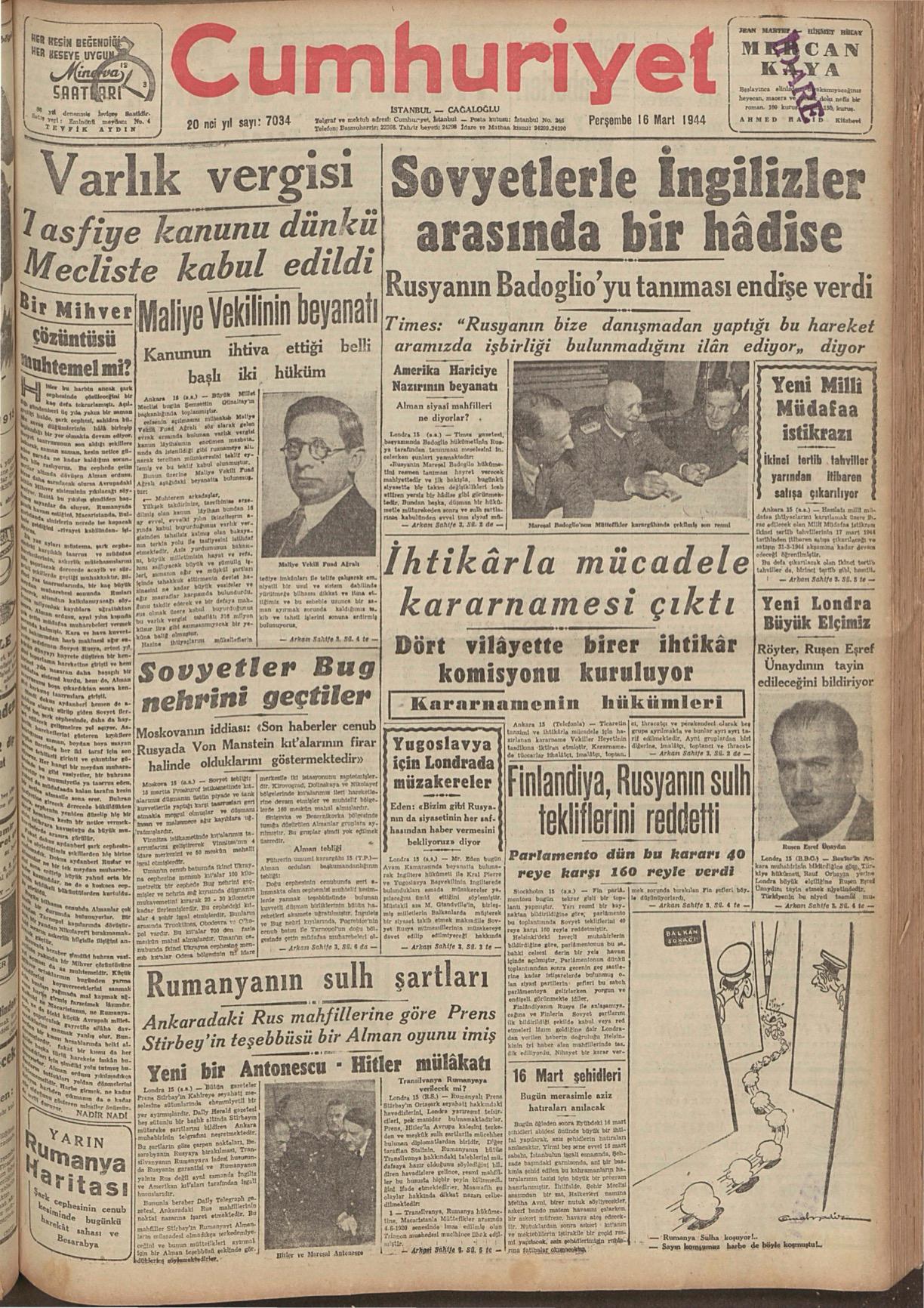
This process was formally legalized on 15 March 1944 by a law that officially abolished the Wealth Tax. All outstanding tax debts were erased, and the state relinquished its claims. Thus, this short-lived but long-lasting policy was officially terminated.
The economic effects of the Wealth Tax yielded different outcomes in the short and long term. The tax revenues collected provided significant contributions to the state budget and were used to finance public expenditures. It also functioned as a tool to limit the money supply in circulation, contributing to a partial slowdown in inflation. However, these effects were not lasting; after the tax was discontinued, economic balances failed to be sustainably improved.

Yeni Sabah (17 Birinci Kânun 1942)
Socially, the manner of implementation generated widespread tensions. Allegations of inequality among taxpayers created social unrest and eroded trust between different segments of society. The forced sale of assets by some taxpayers led to significant changes in property ownership, weakening the economic position of certain societal groups.
Politically, the Wealth Tax intensified criticism of the ruling government. The problems exposed during implementation damaged public confidence in the administration and became a major topic of political debate in subsequent years. Indeed, during the transition to multi-party politics, it emerged as a frequently cited issue by the opposition and a central element in political competition.
The Wealth Tax occupies a prominent place in the literature as one of the most controversial economic policies in the history of the Turkish Republic. Central to these debates is the question of whether the tax arose solely from economic necessity or was shaped by the political preferences of the era. While the severe economic conditions of the Second World War—including inflation and black markets—justify viewing the tax as a fiscal measure, the practices employed during implementation have rendered this interpretation highly contested.
In particular, the arbitrary nature of tax assessments and the absence of transparent, standardized criteria led to claims of unequal treatment. Criticisms have highlighted that tax burdens were not equitably distributed among religious and ethnic groups, with a strong consensus emerging that non-Muslim citizens were disproportionately taxed. This demonstrates that the Wealth Tax transcended its economic purpose and produced significant social and political consequences.
Some researchers interpret the implementation of the tax within the framework of a “Turkification policy,” arguing that the restructuring of the economy and the transfer of capital were deliberate choices. In contrast, other scholars maintain that these measures were the result of administrative weaknesses and emergency responses to the extraordinary conditions of wartime.
[1]
Mehmet Cural ve Mehmet Yücedoğru, “Türkiye’de Varlık Vergisi: Nedenleri, Uygulanması ve Etkileri Üzerine Bir Değerlendirme,” içinde Mali Sosyoloji, ed. Serpil Ağcakaya (İstanbul: Ekin Yayınevi, 2021), 59.
[2]
Türkiye Cumhuriyeti, ''Varlık Vergisi Kanunu,'' Kanun No. 4305, Resmî Gazete, 12 Kasım 1942, 13214–13217. Erişim tarihi: 06 Nisan 2026, https://www5.tbmm.gov.tr/tutanaklar/KANUNLAR_KARARLAR/kanuntbmmc024/kanuntbmmc024/kanuntbmmc02404305.pdf
[3]
Ayhan Aktar, Varlık Vergisi ve “Türkleştirme” Politikaları (İstanbul: Aras Yayıncılık, 2021), 365.

Historical Background
Wealth Tax Law
Content and Characteristics of the Law
Implementation Process
Abolition
Economic, Social, and Political Effects of the Wealth Tax
Debates and Critical Perspectives on the Wealth Tax