This article was automatically translated from the original Turkish version.
Team(s) | Strigiformes (Owls) | ||||||||
|---|---|---|---|---|---|---|---|---|---|
Family | Strigidae (Eared owls) | ||||||||
Genus | Megascops | ||||||||
Specie(s) | M. kennicottii | ||||||||
Size(s) | 18–25 cm (7–10 in) | ||||||||
Wingspan | Approximately 55 cm | ||||||||
Weight(s) | 100–250 g | ||||||||
Habitat | Deciduous desert scrub stream banks suburbs canyons forest edges and coniferous forests mixed | ||||||||
Geography | From southeastern Alaska to northern Mexico | ||||||||
IUCN Status | Least Concern | ||||||||
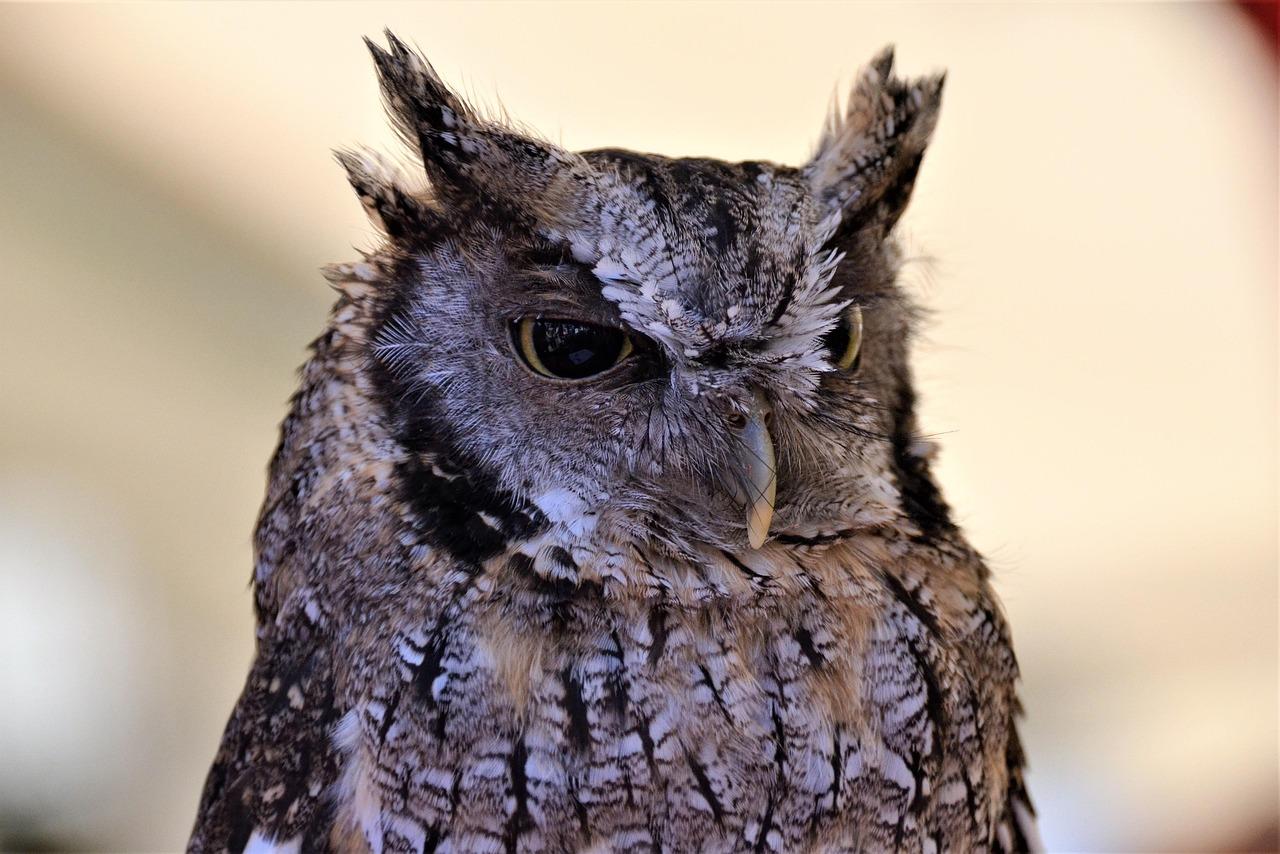
Western Screech-Owl (Megascops kennicottii) is a small, stocky owl species with prominent ear tufts. It measures approximately 18–25 cm (7–10 inches) in length and is about the size of an American Robin (Turdus migratorius). Its head is round with a short neck, and it can flatten its ear tufts. The eyes are bright yellow, and the beak is typically dark gray to black. Its plumage provides excellent camouflage, ranging in color from gray, brownish, or reddish (rust-colored) tones. The facial disk is pale and bordered by dark arcs; the upperparts are spotted white, while the underparts are marked with dark, web-like streaks. Individuals in the Pacific Northwest are typically reddish in tone, while those in the Southwest are more grayish.

Western Screech-Owl (Pixabay)
The Western Screech-Owl inhabits a wide geographic range from the coastal forests of southeastern Alaska to the desert cacti of Arizona. It occurs in a variety of habitats including forested canyons, deciduous or mixed forests, suburbs, orchards, and riparian corridors. Although strongly associated with coniferous forests, it can also live in small wooded areas near human settlements. It can be found at elevations up to 6,000 feet (approximately 1,800 meters). It was once common across much of Washington State outside the Columbia Basin.
Nocturnal and silent, it is usually detected by its calls. It hunts during twilight and nighttime, either perching and watching or gliding silently to capture prey. It locates prey using its acute vision and hearing. Socially monogamous, pairs typically nest together, sing duets, and preen each other’s feathers. The female usually incubates the eggs while the male brings food. After hatching, both parents care for the young.
It is carnivorous. Its diet varies according to region and season. It feeds on small mammals (mice, shrews, kangaroo rats, bats), birds, lizards, frogs, fish, and numerous large invertebrates (insects, scorpions, spiders, earthworms, beetles). Occasionally, it wades in streams to catch crayfish and may also hunt flying insects in mid-air.
It typically nests in tree cavities, using old woodpecker holes or natural hollows. It sometimes prefers nest boxes, large cacti, utility poles, or hawk nests. Nests are usually located 1.5–10 meters above ground. It does not bring nesting material; instead, it lays eggs directly on the cavity floor. The average clutch size is 2–5 eggs, with an incubation period of about 26 days. Young leave the nest after four weeks and remain with their parents for up to five more weeks. When humans or other predators approach the nest, adults may display distraction behaviors.
It is classified by the International Union for Conservation of Nature (IUCN) as Least Concern and is considered common overall. However, populations are declining in some areas. Population trends are difficult to monitor due to its nocturnal nature. A slight decline has been observed between 1966 and 2019. According to Partners in Flight, the global breeding population is approximately 180,000. Individuals in the Pacific Northwest are particularly vulnerable to predation by Barred Owls (Strix varia). Additionally, habitat loss, drought, changes in precipitation patterns, and forest degradation (from fires, insect outbreaks, etc.) negatively impact local populations. Nevertheless, the Western Screech-Owl demonstrates adaptability to human presence, can thrive in suburban areas, and responds positively to conservation efforts such as the installation of artificial nest boxes.
Audubon. *Western Screech-Owl*. National Audubon Society. Accessed July 7, 2025. https://www.audubon.org/field-guide/bird/western-screech-owl
BirdLife International. “Western Screech-Owl (Megascops kennicottii).” BirdLife Data Zone. Accessed July 7, 2025. https://datazone.birdlife.org/species/factsheet/western-screech-owl-megascops-kennicottii#IUCN-Red-List-assessment
Cornell Lab of Ornithology. *Western Screech-Owl Identification*. All About Birds. Accessed July 7, 2025. https://www.allaboutbirds.org/guide/Western_Screech-Owl/id
Cornell Lab of Ornithology. *Western Screech-Owl Range Map*. All About Birds. Accessed July 7, 2025. https://www.allaboutbirds.org/guide/Western_Screech-Owl/maps-range
Pixabay. "Tropical Screech Owl, Baykuş." Photograph. Accessed July 7, 2025. https://pixabay.com/tr/photos/tropical-screech-owl-bayku%C5%9F-2687227/
Pixabay. “Batı Screech Baykuş, Baykuş, Kuş.” Photograph. Accessed July 7, 2025. https://pixabay.com/tr/photos/bat%C4%B1-screech-bayku%C5%9F-bayku%C5%9F-ku%C5%9F-4017157/
Washington Department of Fish and Wildlife. *Western Screech-Owl – Otus kennicottii macfarlanei*. Accessed July 7, 2025. https://wdfw.wa.gov/species-habitats/species/otus-kennicotii-macfarlanei#resources

Team(s) | Strigiformes (Owls) | ||||||||
|---|---|---|---|---|---|---|---|---|---|
Family | Strigidae (Eared owls) | ||||||||
Genus | Megascops | ||||||||
Specie(s) | M. kennicottii | ||||||||
Size(s) | 18–25 cm (7–10 in) | ||||||||
Wingspan | Approximately 55 cm | ||||||||
Weight(s) | 100–250 g | ||||||||
Habitat | Deciduous desert scrub stream banks suburbs canyons forest edges and coniferous forests mixed | ||||||||
Geography | From southeastern Alaska to northern Mexico | ||||||||
IUCN Status | Least Concern | ||||||||
No Discussion Added Yet
Start discussion for "Western Screech Owl (Megascops kennicottii)" article
Distribution and Habitat
Behavior and Ecology
Diet
Reproduction
Conservation Status and Threats