


This article was automatically translated from the original Turkish version.
+1 More
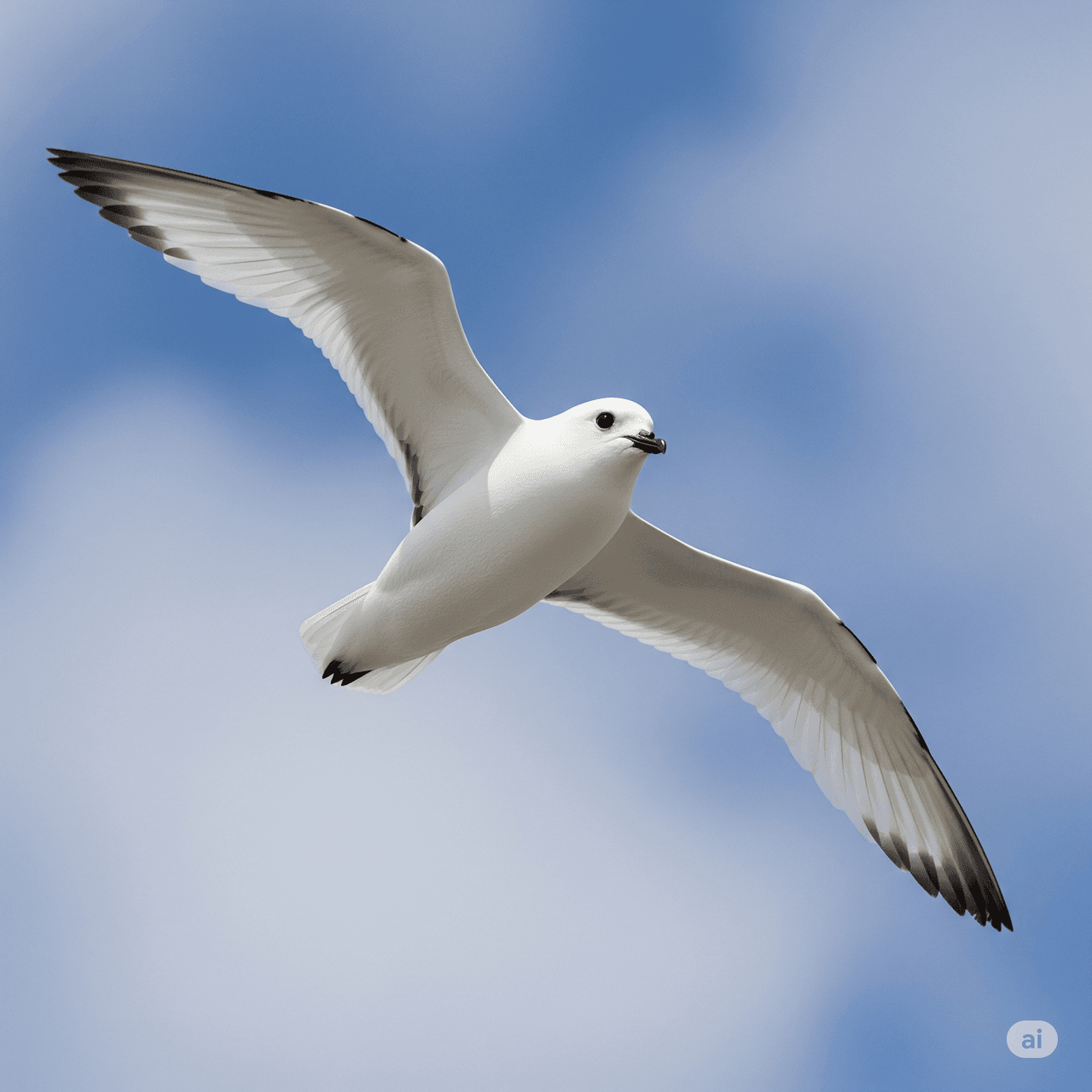
White Storm Petrel (Pagodroma nivea) (generated by artificial intelligence.)
Team(s) | Procellariiformes | ||||||||
|---|---|---|---|---|---|---|---|---|---|
Family | Procellariidae | ||||||||
Specie(s) | Pagodroma Nivea | ||||||||
Subspecies | Pagodroma Nivea Confusa Pagodroma Nivea Nivea | ||||||||
Physical Characteristics | wingspan: 75–95 cm black beak and dark eyes White plumage | ||||||||
Conservation Status (IUCN) | Least Concern category | ||||||||
The Antarctic petrel (Pagodroma nivea), a seabird classified within the family Procellariidae of the order Procellariiformes, exhibits a high capacity for adaptation. This species, with its entirely white plumage, achieves visual integration with the glacial landscapes of the region and holds a unique position in polar research due to both its morphological traits and ecological functions.

Antarctic petrel (Pagodroma nivea) (generated by artificial intelligence.)
The Antarctic petrel is the only species within the genus Pagodroma of the order Procellariiformes. The species is divided into two subspecies: P. n. nivea and P. n. confusa. Morphologically it is characterized by a completely white plumage, a short black bill, and dark irises. Its wingspan ranges from 75 to 95 cm, reflecting a flight morphology optimized for aerodynamic efficiency. The feather structure provides high insulation against extreme thermal conditions.
The species breeds exclusively on the Antarctic continent and surrounding subantarctic islands. Breeding colonies are localized in rocky crevices surrounded by glaciers. Outside the breeding season, it adopts a pelagic lifestyle and exhibits a wide distribution across the Southern Ocean. Habitat selection is directly linked to the seasonal dynamics of sea ice.
The Antarctic petrel feeds on zooplanktonic organisms (particularly krill), small teleost fish, and other planktonic creatures. It does not engage in diving behavior and instead employs a surface-feeding strategy. During foraging, it flies close to the sea surface and captures prey directly with its bill.
This species exhibits a monogamous mating system and lays a single egg in glacial crevices. The incubation period lasts approximately 40 to 45 days, with both parents actively participating in chick care. Breeding success is closely associated with environmental stress factors and food availability.
The feather structure provides high insulation capacity for thermoregulation. Additionally, specialized salt-excreting nasal tubules enable the bird to drink hypersaline seawater. This physiological trait is a characteristic adaptation of the order Procellariiformes.
The Antarctic petrel is regarded as a biotic indicator species for the functioning of the Antarctic ecosystem. Seasonal variations in sea ice distribution and fluctuations in krill populations can be monitored through its migratory and breeding behaviors. In this context, behavioral data from this species serve as an important parameter in climate change studies.
The species is frequently referenced in scientific literature in the context of polar ecology, behavioral biology, and environmental change monitoring. Long-term observational data, in particular, form a fundamental basis for understanding the dynamics of the Antarctic biosphere.
1996, pp. 388-423, ScienceDirect. Accessed August 22, 2025. https://www.sciencedirect.com/science/article/abs/pii/B9780127354156500090.
Carboneras, Carles, Francesc Jutglar, and Guy M. Kirwan. "Snow Petrel." *Cornell Lab of Ornithology Birds of the World*. Accessed August 22, 2025. https://birdsoftheworld.org/bow/species/snopet1/cur/introduction.
Roper, Timothy J. "Olfaction in Birds." Advances in the Study of Behavior, Volume 28, 1999, pp. 247-332, ScienceDirect. Accessed August 22, 2025. https://www.sciencedirect.com/science/article/abs/pii/S0065345408602193.
Warham, John. "CHAPTER 9 - Locomotion." The Behaviour, Population Biology and Physiology of the Petrels
Özkan, Korhan. “Ak Fırtınakuşu.” TÜBİTAK Kutup Araştırmaları Ansiklopedisi. Accessed August 22, 2025. https://ansiklopedi.tubitak.gov.tr/kutup/ansiklopedi/ak-firtinakusu.

White Storm Petrel (Pagodroma nivea) (generated by artificial intelligence.)
Team(s) | Procellariiformes | ||||||||
|---|---|---|---|---|---|---|---|---|---|
Family | Procellariidae | ||||||||
Specie(s) | Pagodroma Nivea | ||||||||
Subspecies | Pagodroma Nivea Confusa Pagodroma Nivea Nivea | ||||||||
Physical Characteristics | wingspan: 75–95 cm black beak and dark eyes White plumage | ||||||||
Conservation Status (IUCN) | Least Concern category | ||||||||
No Discussion Added Yet
Start discussion for "White Storm Petrel (Pagodroma nivea)" article
Taxonomic Position and Morphological Characteristics
Habitat Selection and Geographic Distribution
Trophic Behavior and Feeding Strategies
Reproductive Biology and Parental Investment
Physiological Adaptations
Role as an Ecological Indicator Species
Position in Scientific Research