

This article was automatically translated from the original Turkish version.
White Suckerfish (Remora albescens) is a species of fish that lives by attaching itself to host organisms using a suction disc located on the upper part of its head. Approximately 90 percent of individuals typically cling to manta rays (Manta spp.) but may also use other large marine animals as hosts. Thanks to the suction mechanism, they are commonly found within the host’s mouth cavity and gill chamber. This species is generally observed at depths of 0 to 50 meters in tropical and warm waters.
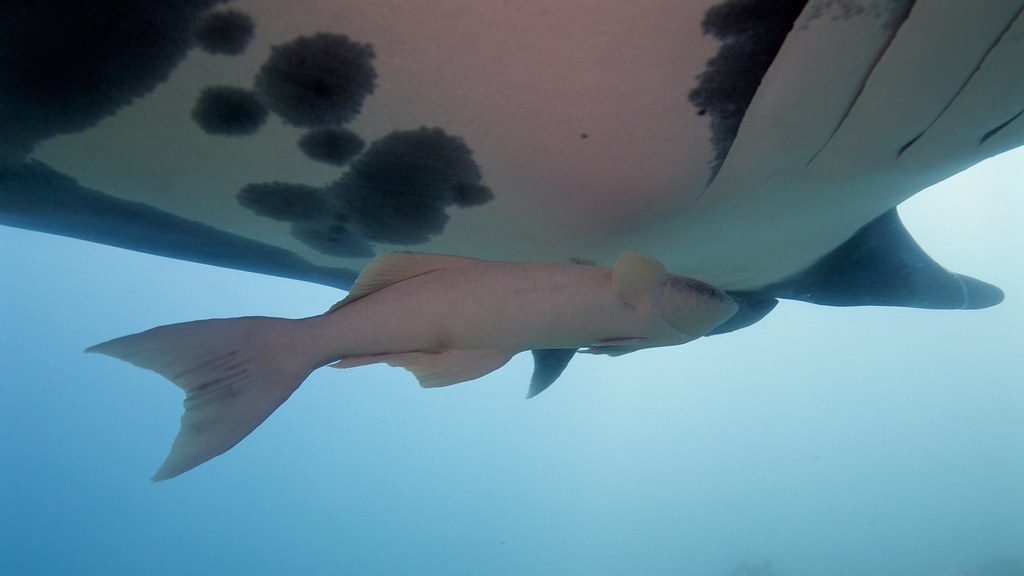
Remora albescens is a small fish with a long and slender body. The attachment disc on its head is derived from a modified dorsal fin and enables the fish to adhere firmly to its host. Within this disc, lamellae (plates) allow the fish to remain attached even under strong water currents. In this species, the attachment disc is relatively short and broad.
The overall color of the fish ranges from pale white to gray; the ventral region is lighter in tone, an example of countershading—a common camouflage strategy in marine animals. It can be distinguished from other remora species by its lighter coloration and smaller attachment disc.
In size, it typically reaches a length of 20 to 30 centimeters. The largest known specimens measure approximately 40 centimeters. Its lightweight body allows it to reside within internal areas of its host, such as the mouth or gill chamber.

Appearance of the White Suckerfish (flickr)
Remora albescens has a wide global distribution across tropical and temperate seas. It occurs along the coastal regions of the eastern Pacific from San Francisco to Chile; in the western Pacific around Indonesia, China, Japan, and the Philippines; in the Indian Ocean near the Maldives, Mauritius, and Réunion Island; and in the Atlantic Ocean along the western coasts from Florida to Brazil, as well as on eastern Atlantic islands such as Madeira, Saint Helena, and Ascension. This species has been observed in numerous countries including the United States (Florida, California, Hawaii), Mexico, Brazil, South Africa, India, China, Korea, New Zealand, and Australia.
In terms of habitat preference, it lives exclusively in marine systems and can be found in both coastal (neritic) and open ocean (oceanic) zones. It is typically observed at depths of 0 to 50 meters, inhabiting the epipelagic zone near the sea surface. It moves primarily by attaching itself to large marine animals such as manta rays. About 90 percent of individuals are associated with these rays, and some individuals may reside within the host’s gill chamber or mouth cavity. As a migratory species, it can cover vast distances thanks to its hosts.
Its most distinctive behavior is attaching itself to host organisms and moving with them. This behavior provides both access to food and protection. It commonly lives attached to manta rays, with approximately 90 percent of individuals found in association with them. Other individuals may associate with sharks, whales, and certain large fish species. Thanks to its suction disc, it remains firmly attached even in strong water currents.
Its dependence on hosts leads to its classification as a migratory species. It cannot travel long distances on its own but can cross entire oceans by riding its hosts. This enables its wide geographic spread. It uses its host as a shield against predators. It is usually found alone on its host, although multiple individuals may occasionally share the same host.
Remora albescens is not a predator. Its feeding strategy is largely dependent on its host. It feeds on food particles expelled from the host’s mouth, parasites on the host’s skin, and shed dead tissue. Additionally, detritus (organic debris) and microorganisms accumulating in areas such as the host’s gill chamber contribute to its diet. Thus, this species can also fulfill a symbiotic cleaning role beneficial to its host.
Remora albescens is an oviparous marine fish. Reproduction typically occurs in pelagic (open ocean) environments, with eggs released into the water column to develop freely. Females release eggs into the water without internal fertilization; males release sperm directly into the water to achieve fertilization. This process is known as external fertilization.
The eggs are generally pelagic and planktonic in structure, drifting near the sea surface as they develop. Larvae also spend a period in planktonic life before completing their development and transitioning to a benthic or host-dependent lifestyle. Direct data on age at sexual maturity and reproductive周期 are lacking, but based on other Remora species, it is presumed that reproduction occurs year-round, with peak activity during warmer seasons.
Due to the difficulty of observing mating and reproductive behavior, it is believed that spawning occurs independently of hosts in open ocean waters. Juveniles hatch and remain free-swimming until they reach a certain size, after which they attach to suitable host organisms and adopt a symbiotic lifestyle.
Parasite removal that helps maintain host health is a key function of this species. In this regard, it exemplifies mutualistic symbiosis. Additionally, by utilizing uneaten food residues, it contributes to nutrient cycling in marine environments. Occupying a horizontal position in the trophic network, it supports the sustainability of interspecies relationships. The structure of its suction disc serves as a model for biomechanical research. Finally, some studies suggest that this species may act as an indicator of host health and could be used as a biological indicator in marine monitoring programs.

A Remora albescens in its natural habitat (Flickr)
Remora albescens has very little direct commercial value, but it has several indirect uses. The most notable application is in traditional Chinese medicine, where the fish is dried or ground and incorporated into various remedies for both humans and animals. It is reported that specific body parts are used for purposes such as stimulating metabolism and detoxification.
Additionally, due to its symbiotic lifestyle, this species has the potential to remove parasites from its hosts. As such, it plays a beneficial ecological role as a natural “cleaner” organism, indirectly supporting the health of large marine animals.
The structure of its suction disc is used as a model in biomechanical and evolutionary biology research. Furthermore, host-species interactions, migratory behavior, and symbiosis are frequently cited as educational examples.
However, its consumption as food is negligible, due both to lack of culinary preference and its habit of living inside hosts, raising hygiene concerns. It is not a target species in commercial fisheries and has limited economic importance.
Remora albescens is classified by the International Union for Conservation of Nature (IUCN) as “Least Concern.” This classification reflects its wide distribution, presumed stable population, and absence of direct major threats. However, this does not mean the species is entirely free from risk. Indirect threats may influence future population trends.
The primary survival strategy of Remora albescens is symbiotic life attached to large marine animals, particularly manta rays. Therefore, the main threats to this species are not directed at it directly but stem from threats facing its host species. Manta rays and other large pelagic animals are negatively affected by overfishing, habitat loss, marine tourism, vessel collisions, and climate change-induced alterations in ocean conditions. Declines in host populations could indirectly threaten the distribution and habitat of Remora albescens.

No Discussion Added Yet
Start discussion for "White Sucker Fish (Remora Albescens)" article
Morphological Characteristics
Distribution and Habitat
Behavior
Feeding
Reproduction
Ecological Importance
Uses
Threats and Conservation Status