


This article was automatically translated from the original Turkish version.
Every day, as we type messages on our smartphones, compose emails at our computers, or prepare reports, our fingers automatically follow the same familiar path: Q, W, E, R, T, Y... But have you ever paused to look at your keyboard and wondered why the orderly alphabet you learned as a child is arranged so differently here? Why is the letter A not at the beginning but alone on the left edge? Is this complex and seemingly random arrangement of letters an engineering mistake or a historical necessity?
To answer this question, we must travel back about 150 years, to an era when letters and official documents were still written entirely by hand using ink-filled quills. At that time, the writing process was extremely slow, exhausting, and messy. Writers had to dip their pens into ink after just a few words. This inconvenience drove the ingenious inventors of the era to seek a mechanical solution, and thus the mechanical typewriter entered our lives.
The first typewriters operated much like the internal mechanism of a giant piano. In a piano, pressing a key causes a felt-covered hammer to strike a string and produce a sound. In early typewriters, the system was nearly identical: each key was attached to a mechanical lever ending in a metal letter. To make an impression on paper, you had to press the keys quite forcefully.【1】 When you pressed the A key, a metal lever carrying the letter A would spring forward and strike the ribbon, leaving an imprint on the paper, after which the paper roller would shift slightly to the left to make room for the next character.
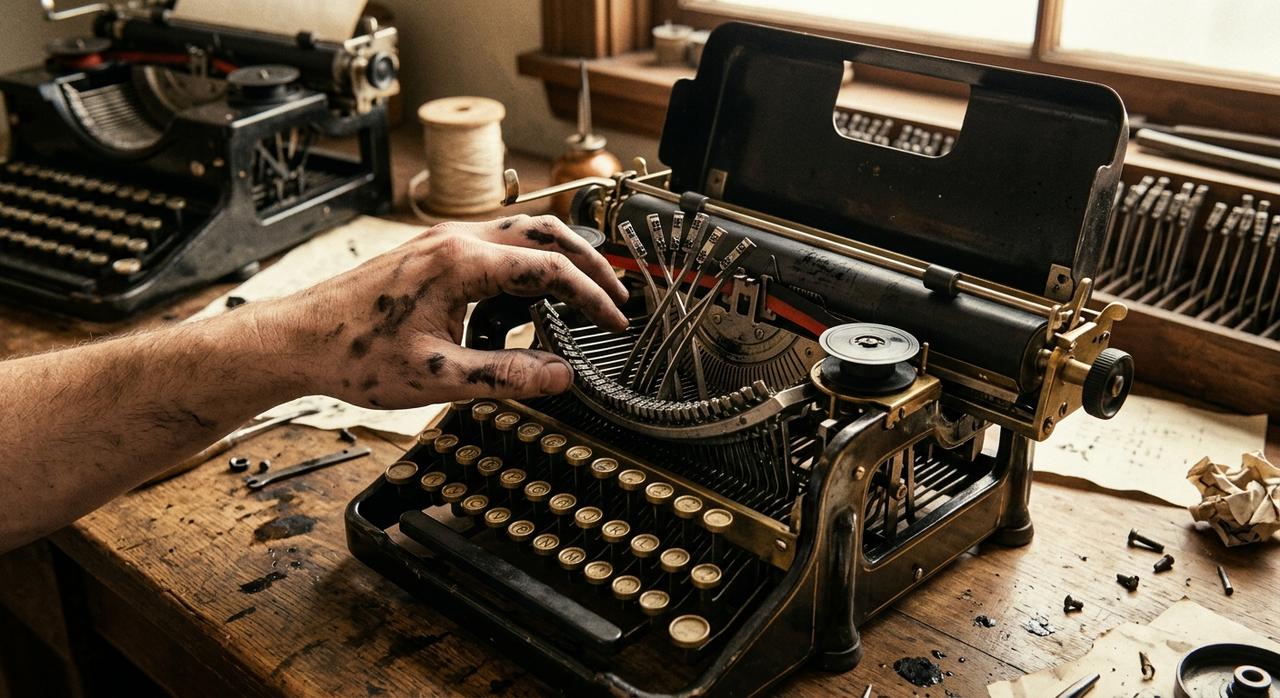
İlk Üretilen Daktilolar ve Mürekkep Sorunu (Yapay Zeka ile Oluşturulmuştur.)
It was precisely at this point that a major technical crisis emerged. In the earliest designs, the letters were arranged in strict alphabetical order (A, B, C, D...). However, as people began to write more quickly, an unexpected problem appeared: in English, frequently used letter pairs were positioned so close together mechanically that their levers would collide.
When a typist tried to type rapidly, the metal lever for the second letter would spring out before the first had returned to its resting position, causing the levers to jam in midair. Each jam required the writer to stop, manually separate the stuck levers, and clean ink-stained hands.【2】
As machine speeds increased, mechanical parts continued to jam, and the alphabetical layout became the typewriter’s greatest enemy. Rearranging the letters was essential to solve this problem. The most practical and enduring solution came from American inventor Christopher Sholes. Sholes developed a layout that placed frequently used letter pairs as far apart as possible on the keyboard, minimizing the chance of lever collisions. After a long process of trial and error, this arrangement eventually gave rise to the QWERTY layout we use today. The goal was not to slow down typing, but to ensure the mechanical components operated without jamming and in a continuous flow.
Sholes sold his revolutionary design to the Remington Company in the United States.【4】 In the 1870s, Remington launched the first commercially mass-produced typewriters, which featured the QWERTY keyboard as standard.【5】Soon after, institutions, government offices, and businesses adopted these machines.
For approximately 100 years following the widespread adoption of Remington typewriters, hundreds of thousands of people worldwide learned the “ten-finger typing” technique. This vast professional workforce, capable of typing rapidly without looking at the keyboard, became the backbone of the business world. Over time, the problem of jamming levers disappeared entirely with the advent of computers and electronic devices; yet the QWERTY layout had already become a global standard. Alternative layouts failed because convincing millions of people to relearn their muscle memory was deemed impractical.
Throughout history, many ergonomic keyboard layouts claimed to be faster or easier to learn than QWERTY—for example, Dvorak or Colemak. Yet none offered a sufficient advantage to break QWERTY’s entrenched dominance. Although the jamming levers of the mechanical era are long gone, we continue to live with this legacy of the mechanical age.
The QWERTY layout was originally designed according to the frequency of letter usage in the English language. As a result, other languages gradually developed variations suited to their own phonetic and alphabetic structures. For instance, in French-speaking countries, AZERTY became common; for German, QWERTZ; and for Italian, QZERTY.【6】 In Asia, the situation is even more interesting: countries such as Thailand, Japan, Korea, and China use specialized converter software and unique key arrangements to manage thousands of characters.
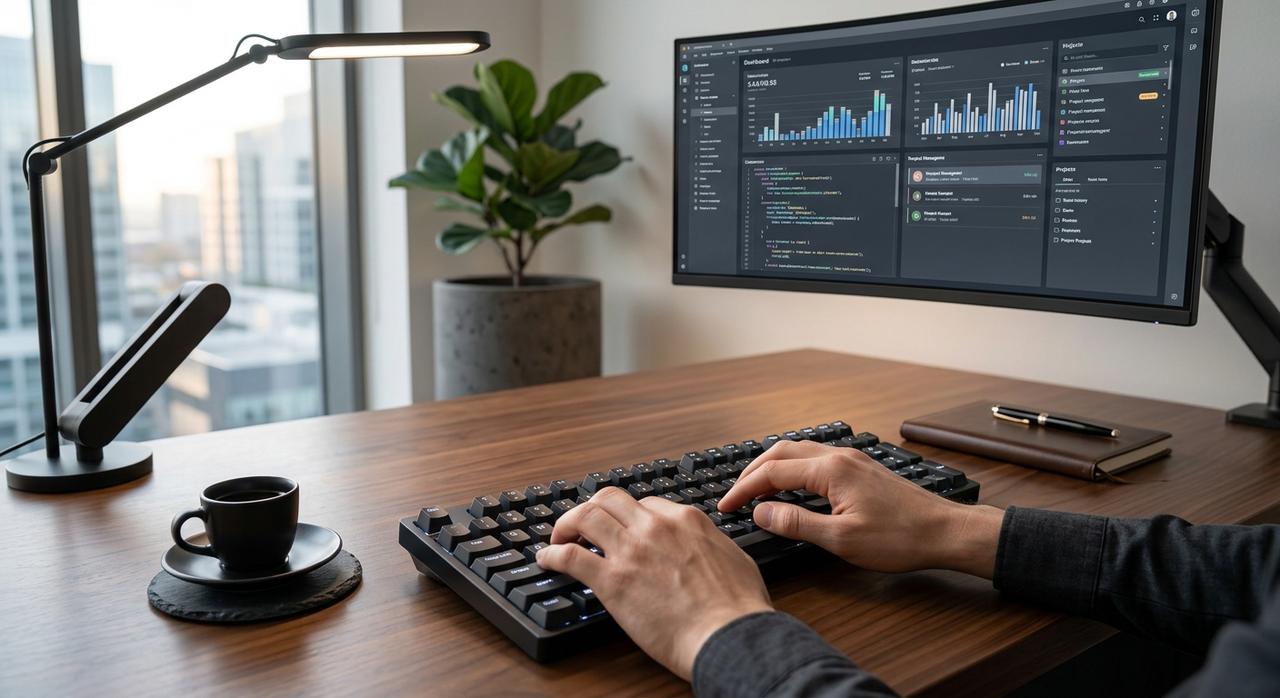
QWERTY Düzenine Sahip Modern Klavye (Yapay Zeka ile Oluşturulmuştur.)
Today, thanks to modern computers and intelligent software, learning ten-finger typing is far easier than it once was. Gamified typing programs help users acquire this skill rapidly. Yet the key principle remains the same simple rule: feel the small tactile bumps on the F and J keys.
Place your left index finger on F and your right index finger on J, then position your other fingers along the ASDF and JKL rows. This places you in the correct home position. Moving your fingers without looking at the screen or keys turns typing into an effortless reflex over time.
Today, thanks to gamified software solutions, interactive exercises, and digital learning tools, new generations adapt to this keyboard layout far more quickly. Reflexes developed around the tactile bumps on the home row directly influence typing speed in the digital age. The structure shaped by the limitations of the typewriter era now endures as one of the most stable interface standards in the digital universe.
Cumming, Geoff. "Why do we have a QWERTY keyboard?" La Trobe University. Accessed August 26, 2026.https://www.latrobe.edu.au/news/articles/2018/opinion/why-do-we-have-a-qwerty-keyboard
Times of India. "Why computer keys are not in alphabetical order." indiatimes.com. Accessed August 26, 2026.https://timesofindia.indiatimes.com/education/learning-with-toi/why-computer-keys-are-not-in-alphabetical-order/articleshow/99611028.cms
[1]
Geoff Cumming, "Why do we have a QWERTY keyboard?" La Trobe University, erişim 26 Ağustos 2026, https://www.latrobe.edu.au/news/articles/2018/opinion/why-do-we-have-a-qwerty-keyboard.
[2]
Cumming, "Why do we have a QWERTY keyboard?"
[4]
Cumming, "Why do we have a QWERTY keyboard?"
[5]
Cumming, "Why do we have a QWERTY keyboard?"
[6]
Cumming, "Why do we have a QWERTY keyboard?"