

This article was automatically translated from the original Turkish version.
+2 More
Original Name(s) | Women in the Garden | ||||||||
|---|---|---|---|---|---|---|---|---|---|
Location | France Paris Musée d’Orsay | ||||||||
Model | Camille Doncieux | ||||||||
Technique | Oil on canvas | ||||||||
Creation Date | 1866 | ||||||||
Artist | Claude Monet | ||||||||
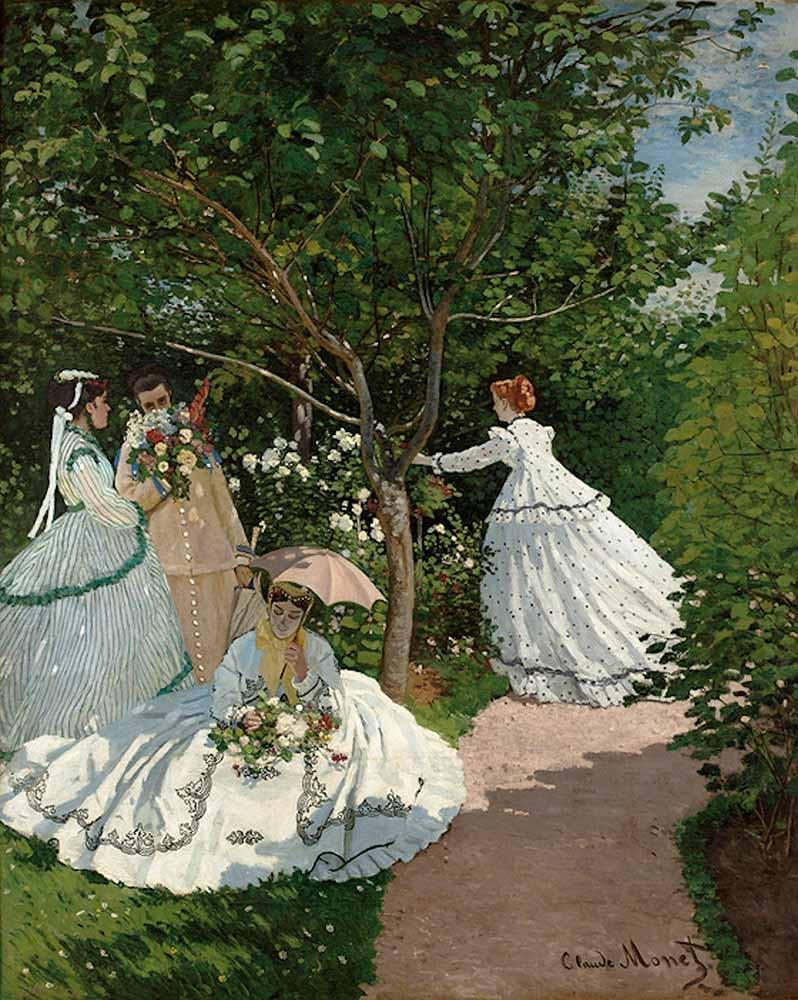
Women in the Garden (Femmes au jardin) is a large-scale oil painting on canvas executed around 1866 by Claude Monet. The work depicts a scene from everyday life with figures rendered in nearly life-size proportions and is regarded as one of the foundational pieces of Monet’s early output, marking a crucial stage in the development of Impressionism's.【1】
In 1866, Monet began working on this large composition in the garden of a house he rented in the suburbs of Paris. The artist faced two major challenges. The first was the technical difficulties inherent in painting outdoors. To maintain a consistent viewing angle while painting the upper portions of the canvas, Monet had to lower the canvas into a trench dug into the ground using a pulley system. The second challenge was attempting to apply a format traditionally reserved for historical or academic subjects to an ordinary scene drawn from contemporary life.
Monet’s primary aim was to explore how figures could be positioned within a landscape and to capture the impression of light and atmosphere moving around them. He addressed this challenge by carefully observing and rendering shadows, colored light, patches of sunlight filtering through leaves, and faint reflections in partial shade.
The painting is executed in oil on canvas. Measuring approximately 255 × 205 cm, the work achieves an even more monumental scale when framed. The palette is clear and vibrant; colors are applied directly rather than through the soft tonal transitions typical of classical painting. Reflections of light are pronounced, and shadows are rendered with color. Broad, visible brushstrokes create an impression of unfinishedness, a characteristic that drew criticism from contemporaries.
It is known that the bodies of the four female figures in the painting were modeled by Camille, a close associate of Monet. The faces are deliberately left indistinct; the figures are not treated as individual portraits but as elements within a dynamic interplay of light and movement. Monet skillfully rendered the white tones of the dresses to place the figures within a balanced structure of greens and browns, centered around the axial tree and path that form the compositional spine.

Women in the Garden (1866) Figure Detail (Musée d'Orsay)
Women in the Garden is recognized as one of the earliest examples to embody the fundamental principles of Impressionism, predating the very term’s emergence. In this work, light, color, and movement have become primary concerns, surpassing narrative. The figures’ subtle blurring and the scene’s treatment as a fleeting moment emphasize the passage of time and transience.
During the second half of the 19th century, artists increasingly turned to perceiving nature through individual “optical sensitivities,” seeking to capture changing light conditions and atmospheric effects.【2】 Monet’s work established a pivotal threshold in the development of modern painting through its reliance on direct observation, plein air practice, and free brushwork.
Women in the Garden stands out as a work that challenged the academic painting tradition, both by its large-scale format and its focus on an everyday scene.【3】 Its emphasis on light and color remains a defining and early expression of the Impressionist language Monet would further develop in the years to come.
Beaux Arts. “Femmes au jardin de Monet: l’impressionnisme en éclosion.” Beaux Arts. Accessed January 3, 2026. https://www.beauxarts.com/grand-format/femmes-au-jardin-de-monet-limpressionnisme-en-eclosion/
Musée d’Orsay. "Femmes au jardin." M'O. Accessed January 3, 2026.
Musée d’Orsay. “Femmes au jardin: restauration d’un chef-d’œuvre de Monet.” M'O. Accessed January 3, 2026. https://www.musee-orsay.fr/fr/articles/femmes-au-jardin-restauration-dun-chef-doeuvre-de-monet-202356
Napoleon.org. “Femmes au jardin.” Accessed January 3, 2026. https://www.napoleon.org/histoire-des-2-empires/tableaux/femmes-au-jardin/
[1]
Napoleon.org, “Femmes au jardin,” napoleon.org, Erişim tarihi: 3 Ocak 2026, https://www.napoleon.org/histoire-des-2-empires/tableaux/femmes-au-jardin/
[2]
Napoleon.org, “Femmes au jardin,” napoleon.org, Erişim tarihi: 3 Ocak 2026, https://www.napoleon.org/histoire-des-2-empires/tableaux/femmes-au-jardin/
[3]
Beaux Arts, “Femmes au jardin de Monet: l’impressionnisme en éclosion,” Beaux Arts, Erişim tarihi: 3 Ocak 2026, https://www.beauxarts.com/grand-format/femmes-au-jardin-de-monet-limpressionnisme-en-eclosion/

Original Name(s) | Women in the Garden | ||||||||
|---|---|---|---|---|---|---|---|---|---|
Location | France Paris Musée d’Orsay | ||||||||
Model | Camille Doncieux | ||||||||
Technique | Oil on canvas | ||||||||
Creation Date | 1866 | ||||||||
Artist | Claude Monet | ||||||||
No Discussion Added Yet
Start discussion for "Women in the Garden (Painting)" article
Production Process
Technical Features
Iconography and Figure Composition
Place in Art History