This article was automatically translated from the original Turkish version.
Geographies are not merely fragments of countries defined by borders. First and foremost, whenever the word homeland is uttered, the value of every patch of land we tread upon and every drop of water that flows is immeasurable. The very grains of soil we have defended with martyrs and taken pride in as victors extend our homeland’s boundaries into the seas through their meeting with waves. This is a unique and sacred unity for us. First and foremost, it is called the Blue Homeland. The value thus carved is as enduring as the lifespan of the names given to it. It is equally important to preserve and sustain the name of a geography by transmitting its spirit from generation to generation, just as it is to make it a homeland. This is possible only through the power of language and words.
Words, like human beings, are born, grow, live, and if neglected, can be forgotten. The term Blue Homeland not only signifies the protection of our rights and interests in the seas, but also entails recognizing the maritime heritage within our lexicon and the meanings it carries.
Every word we use today—harbor, pier, shipyard, sail, lighthouse, captain, sea—bears the traces of our centuries-long relationship with the seas where waves crash against the shore. As a result of this long-standing connection, we must learn to see, read, and understand the seas not merely as geography, but as one of the most significant symbols of our history, language, and cultural heritage.
Alongside the words that breathe life into the seas, one of the immortal witnesses of the Blue Homeland concept is Pîrî Reis and his world-influencing map, which has illuminated the seas from centuries past to the present. In this context, to ground the linguistic heritage of Turkish maritime culture in concrete historical evidence, it is necessary to examine the most prominent figures and works of this collective memory.
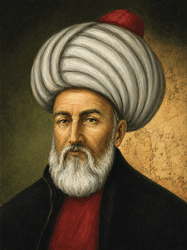
Piri Reis (1465-1554), (Yapay Zeka ile Oluşturulmuştur.)
Only a fragment of Pîrî Reis’s 1513 world map has survived to the present day. This fragment depicts the eastern coast of America as well as the Atlantic coasts of Europe and Africa. His later work, Kitâb-ı Bahriyye, evolved into a comprehensive maritime treatise and portolan atlas covering the coasts of the Aegean and Mediterranean Seas. The first version was completed in 1521, and the second revised version was compiled in 1526. It is known that the second version contained 223 maps.
Moreover, Pîrî Reis did not merely draw the shapes of coastlines. His works also include vital information for sailors—such as shallows, beaches, cliffs, harbors, water sources, and settlements.
Thus, this map does not merely answer the questions “what” and “where.” It also provides answers to how we can better understand our seas and how we can etch them into our collective memory.
The seas that Pîrî Reis inscribed into our geographical memory did not remain confined to our minds over time; they also set sail into our hearts. This maritime memory, made tangible on the geographical plane through maps, was transmitted from generation to generation on the cultural plane through the power of words and expressions.
Just as words have breathed life into the seas, over time the seas have given life to words. Ships sailing through the Blue Homeland have floated in the verses of poets and found their place within the turbulent waters of Turkish literature. This love of the sea expressed through our language is not limited merely to the shores touched by waves. The methods used by a master boatbuilder, the professional expertise of a fisherman, or the transmission of coastal traditions from generation to generation are only a few of the cultural imprints left by the Blue Homeland in our collective memory.
UNESCO’s approach to intangible cultural heritage places great emphasis on preserving knowledge, skills, and practices passed down from generation to generation. The recognition of traditional boatbuilding techniques as cultural heritage in various countries demonstrates that maritime culture is not merely composed of material objects.
For Turks, who understand the value of sweat and labor, this heritage allows us to see, when we look at a boat, not only its wood and sails, but also the labor that produced it and the knowledge passed down through generations. To make the best use of today’s advanced technologies—such as satellite data and digital maps—we must recognize the efforts of Pîrî Reis and countless other sailors, and comprehend the legacy they left behind. For although times have changed and centuries have passed, the fundamental human desire to know and understand the seas has not. This unchanging awareness has elevated the seas beyond mere physical domains of sovereignty, transforming them into a deep-rooted cultural accumulation woven stitch by stitch over centuries. The endeavor to know and understand the seas has, over time, transcended the realm of strategic necessity and become a permanent identity within the Turkish nation’s language, art, and tradition.
Reading the concept of the Blue Homeland, which transcends geographical boundaries, through a holistic approach that integrates history, literature, and cultural heritage offers a broader perspective on the subject. For the seas do not merely transport people; they also carry the words, emotions, experiences, and cultures that emerge from human speech and are committed to writing.
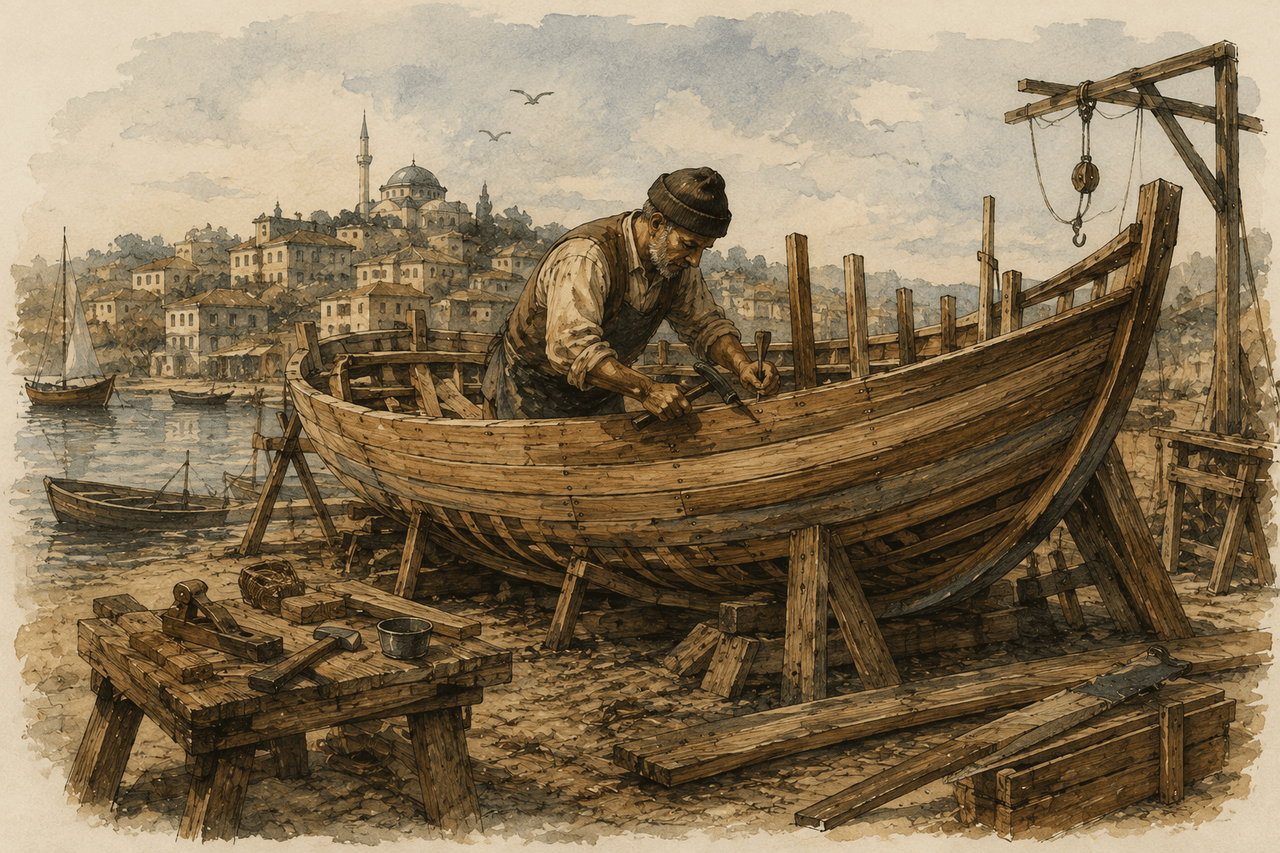
Ustalardan Kalan Denizcilik Mirası (Yapay Zeka ile Oluşturulmuştur)
This is why the boundless expanse of the Blue Homeland is a treasure stretching from the past to the future. Just as a map shows us what lies where in the seas, words reveal to us where the Blue Homeland resides in our minds and hearts. For instance, every maritime term inscribed into languages serves as a foundational bridge carrying the legacy of the past into the future. Preserving this memory is the key to ensuring the eternal existence of the Blue Homeland. Protecting the seas through words and keeping this cultural memory alive is the noblest way to make the Blue Homeland not only a value of today but also a foundational value for the future.
Akçura, Yusuf. “Pîrî Reis Haritası Hakkında İzahname.” *Türk Tarih Kurumu*. Accessed August 4, 2026.
Bostan, İdris. “Pîrî Reis.” *TDV İslâm Ansiklopedisi*. Accessed August 5, 2026.
Sarıcaoğlu, Fikret. “Kitâb-ı Bahriyye.” *TDV İslâm Ansiklopedisi*. Accessed August 4, 2026.
How Many Years Does a Word Live?
Pîrî Reis and the Memory of the Seas
Seas Given Life by Words
The Cultural Memory of the Blue Homeland