

badge icon

This article was automatically translated from the original Turkish version.

Article
Quote

World Class Manufacturing (WCM) is a production philosophy and strategy aimed at maximizing production processes, product quality, workforce efficiency, and customer satisfaction. WCM focuses on the continuous improvement of production processes, the elimination of waste, increased efficiency, and the timely delivery of high-quality products to customers. This model encompasses a holistic approach that extends beyond production to include organizational processes as well.

Historical Background

The concept of World Class Manufacturing emerged globally in the late 1980s, influenced by Japan’s Toyota Production System (TPS) and Lean manufacturing methods. This philosophy offers a more flexible, efficient, and customer-oriented approach to production compared to the large-scale mass production systems traditionally dominant in Western industries. Toyota’s “Just-in-Time” (JIT) production model aimed to eliminate unnecessary inventory and ensure high quality at every production step. WCM builds on these successes within a broader framework, making it applicable not only to the automotive industry but also to many other sectors.

Core Principles of WCM

WCM is built upon four main pillars:

  1. Workplace Organization: Organizing work areas, eliminating waste on the shop floor, and enhancing efficiency.
  2. Quality: Ensuring high quality throughout production processes, embedding quality at every stage, and striving to reduce defects to zero.
  3. Maintenance: Ensuring the efficient and continuous operation of production equipment, preventing machine breakdowns, and maximizing equipment effectiveness.
  4. Logistics: Delivering products at the right time, in the right quantity, and with the right quality, while optimizing these processes.

In addition to these core pillars, the success of WCM depends on a strong management structure, the effective implementation of international methods and tools, and active employee involvement. These interrelated elements are integrated across all production and operational processes to create an efficient production system.

WCM Implementation Methods

WCM employs various tools and methods to ensure continuous improvement in production processes. These tools aim to enhance efficiency across all stages, from production and logistics to maintenance and quality.

  1. Total Industrial Engineering (TIE): WCM seeks to improve employee performance. TIE is used to eliminate inefficient procedures, unnecessary movements, and non-value-adding processes. In this approach, every employee is trained to actively participate in problem solving and continuous improvement.
  2. Total Quality Control (TQC): TQC aims to eliminate quality issues at every stage from design to production. Its goal is the zero-defect principle. This method uses a systematic set of approaches to ensure quality at every production step.
  3. Total Productive Maintenance (TPM): TPM is an approach designed to minimize machine breakdowns, ensure efficient machine operation, and prevent production errors. TPM focuses on continuous equipment maintenance and increasing machine effectiveness.
  4. Just-in-Time (JIT): JIT aims to produce only what is needed, in the required quantity, and at the required time. This method minimizes waste on the production floor by eliminating unnecessary inventory and reducing operational costs.

WCM Implementation Steps and Methods

WCM is implemented through a series of fundamental methods and tools designed to optimize production processes and eliminate waste at every stage. These methods include:
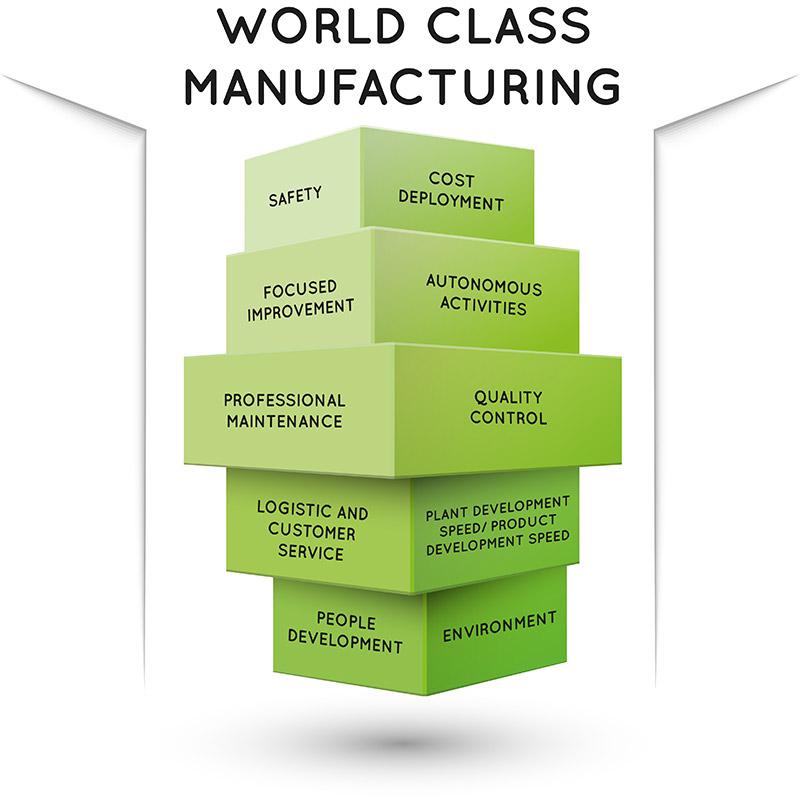
  1. Safety: World Class Manufacturing considers safety a top priority. Safety forms the foundation of a high-performance production system. Any production accident or workplace safety violation reduces efficiency and endangers the organization.
  2. Environment: Establishing environmentally friendly production processes is essential to comply with legal regulations and promote sustainable manufacturing.
  3. Customer Service and Logistics: Customer satisfaction is one of WCM’s most important objectives. Products must be delivered on time and at the required quality, with customer service provided at the highest level.
  4. Focused Improvement: This method involves continuous improvements targeted at reducing waste in specific areas. Each problem is addressed and resolved by the entire organization.
  5. Autonomous Maintenance: Employees take responsibility for maintaining their own machines to improve efficiency and reduce downtime. This approach minimizes interruptions in production processes.
  6. Professional Maintenance: After sufficient progress is achieved through autonomous maintenance, professional maintenance teams step in. These teams possess the specialized expertise required for complex maintenance tasks and equipment repairs.
  7. Early Equipment Management: Planning is conducted in advance to ensure the proper management and commissioning of new equipment. This prevents unexpected stoppages on production lines.
  8. Quality Control: A systematic quality control process is applied at every stage of production to ensure consistent quality.
  9. People Development: Employee skills are enhanced through training in teamwork and problem-solving abilities. This increases the overall efficiency and productivity of the company.
  10. Cost Deployment: Waste, scrap, and inefficiencies are continuously monitored and optimized to minimize production costs.

WCM Pillar List (generated by artificial intelligence)

World Class Manufacturing (WCM) is an improvement philosophy that encompasses the entire organization, not just production processes. WCM implementations not only enhance corporate efficiency but also elevate customer satisfaction to higher levels. This philosophy promotes continuous development and active employee participation, ensuring that workforce at every level takes responsibility for solving problems. WCM can be successfully applied across diverse industries and serves as a strategic tool for ensuring sustainable business success in today’s highly competitive global environment.

Bibliographies


Erozan, İhsan, Zeynep Sayan, and Meltem Beşkardeşler. “Dünya Klasında Üretim Odaklanmış İyileştirme Sütunu İçin Metodoloji Önerisi ve Bir Uygulama.” *Endüstri Mühendisliği* (2022): 243–264. Accessed May 21, 2025. https://doi.org/10.46465/endustrimuhendisligi.948232.

Jetley, S., Catalan, M., and Alix, G. World Class Manufacturing: A Guide to Implementation. New York: McGraw-Hill, 2001.

Ketter, B. World Class Manufacturing: Strategic Techniques for Improving Manufacturing Performance. New York: McGraw-Hill Education, 2006.

Sarı, Emre Bilgin. Dünya Klasında Üretim (WCM) / World Class Manufacturing. 1. baskı. Ankara: Detay Yayıncılık, 2018.

Author Information

Avatar
AuthorSaid Bahadır DemircanDecember 8, 2025 at 1:15 PM

Tags

Discussions

No Discussion Added Yet

Start discussion for "World Class Manufacturing" article

View Discussions

Contents

  • Historical Background

  • Core Principles of WCM

  • WCM Implementation Methods

  • WCM Implementation Steps and Methods

Ask to Küre