


This article was automatically translated from the original Turkish version.
+1 More
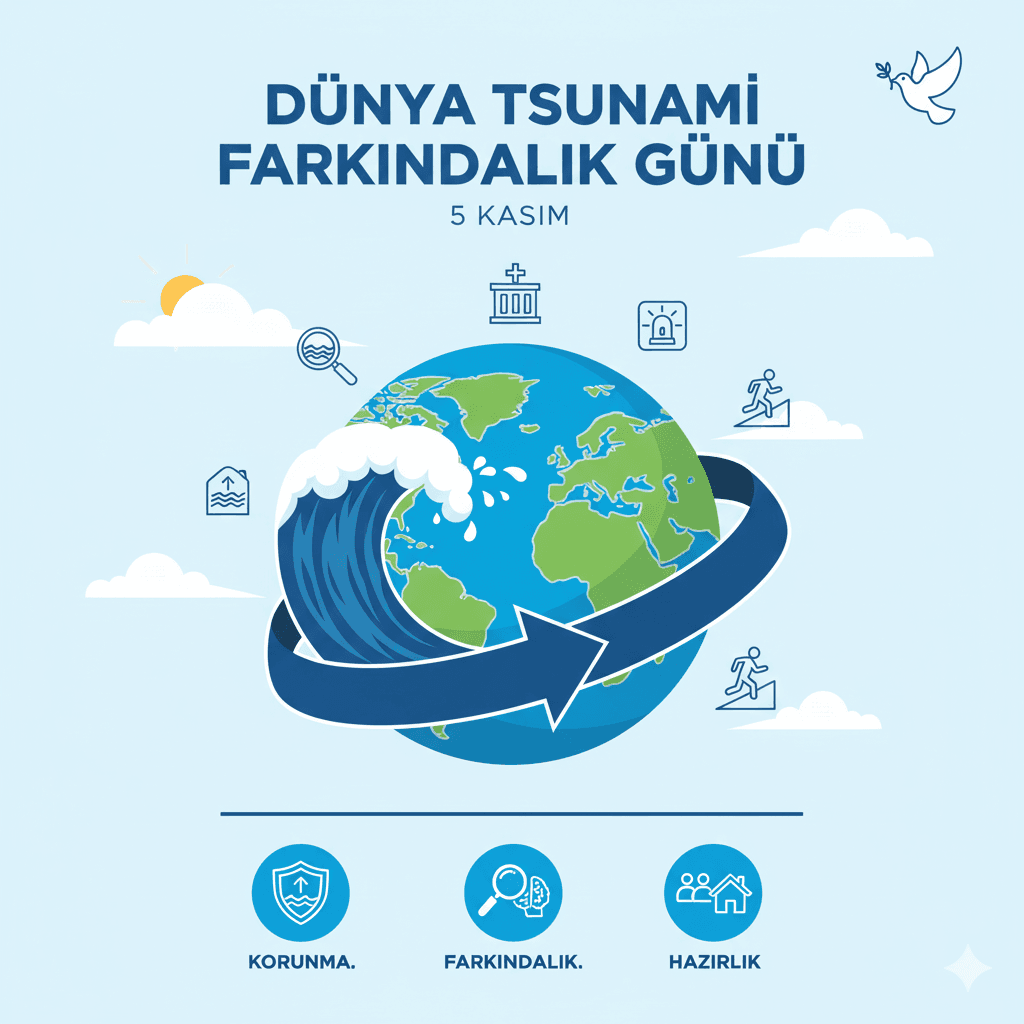
Generated by Artificial Intelligence.
World Tsunami Awareness Day
History | 5 November | ||||||||
|---|---|---|---|---|---|---|---|---|---|
Year First Announced | 2015 | ||||||||
Initiating Organization | United Nations | ||||||||
Purpose(s) | and transmit lessons learned from past tsunamis to new generations promote early warning systems and evacuation routes prepare communities for disasters Create global awareness about tsunamis | ||||||||
World Tsunami Awareness Day is an international observance aimed at raising awareness about the destructive impacts of tsunamis and preparing communities for disasters. It has been designated by the United Nations General Assembly as 5 November. The day seeks to promote the sharing of innovative approaches to disaster risk reduction, raise public awareness about tsunami hazards, and foster a global culture of preparedness.
World Tsunami Awareness Day was officially adopted by the United Nations General Assembly in 2015. The concept originates from Japan, which has developed expertise in early warning systems, post-disaster reconstruction, and public education through its historical experience with tsunamis. Historically, the tsunami that struck the village of Hiro-mura on 5 November 1854 and the preventive measures taken by Hamaguchi Goryo to protect his village are regarded as the inspiration for the day. More recently, the tsunami in the Indian Ocean on 26 December 2004 resulted in approximately 230,000 deaths and affected 14 countries, becoming the deadliest tsunami of the 21st century. Globally, the Hyogo Framework for Action was adopted in 2005 and the Sendai Framework for Disaster Risk Reduction in 2015 as frameworks for reducing disaster risks. These agreements aim to reduce disaster risks and enhance tsunami preparedness.
World Tsunami Awareness Day is observed to create awareness of tsunami risks, ensure communities are prepared for disasters, and strengthen their resilience. The day promotes the effectiveness of preparedness mechanisms such as early warning systems and evacuation routes and enables new generations to learn about tsunami hazards through engagement with youth and educational institutions. Although tsunamis are rare, they can be extremely destructive, and coastal communities—particularly those in low-lying and densely populated areas—are the most vulnerable. Therefore, international cooperation is vital to develop deeper political and public awareness regarding tsunamis and other coastal natural hazards and to reduce these risks. This awareness is essential to minimize loss of life and property from disasters and to mitigate the impacts of future events by remembering lessons learned from past tsunamis.

Tsunami Disaster (Anadolu Agency)
Tsunamis are massive waves generated by sudden movements of water in oceans or seas, typically triggered by earthquakes, landslides, volcanic eruptions, and rarely by extraterrestrial impacts. Earthquakes along plate boundaries can cause tsunamis, especially those that are shallow and involve vertical movement. Coastal or submarine landslides can displace large volumes of water and generate waves. Intense volcanic eruptions can also produce destructive tsunamis through sudden water displacement. Asteroid or meteor impacts may rarely trigger tsunamis. When tsunamis reach the coast, the first wave is not always the largest; subsequent waves can be more destructive. Natural warning signs such as the sea receding before the wave arrives and ground shaking can be observed.
Various initiatives are implemented worldwide to reduce tsunami risk and increase awareness. The United Nations Office for Disaster Risk Reduction (UNDRR) promotes tsunami awareness through the #GetToHighGround campaign, encouraging communities to participate in evacuation drills, walks, and runs. In the United States, the National Weather Service and the National Tsunami Warning Center inform coastal communities through alerts and monitoring systems. The TsunamiReady® program ensures community preparedness through risk assessment, planning, and education. The National Centers for Environmental Information (NCEI) collects and makes accessible sea level and historical tsunami data, enhancing the effectiveness of tsunami early warning systems. Globally, the transboundary nature of tsunamis and the density of coastal populations necessitate international cooperation and the widespread dissemination of awareness.
In Türkiye, the Istanbul Metropolitan Municipality organizes conferences with expert participation on the occasion of World Tsunami Awareness Day. Experts from institutions such as the Kandilli Observatory and Earthquake Research Institute of Boğaziçi University, the Department of Civil Engineering at Middle East Technical University, and Kagawa University in Japan provide information on tsunami risk, early warning systems, and preventive measures. Online education and simulation games are used to raise tsunami awareness among youth and educational institutions.
World Tsunami Awareness Day ensures that lessons learned from past tsunamis are passed on to future generations. Information gained from major disasters such as the 2004 Indian Ocean Tsunami is used to increase preparedness awareness among young people and children. Developed early warning systems, evacuation plans, and educational activities aim to minimize the destructive impacts of future tsunamis. The day is regarded as a comprehensive initiative to generate awareness at both global and local levels and to build community resilience against tsunami risks.
Anadolu Ajansı. “Son Yüzyıl Tsunamileri Yaklaşık 260 Bin Can Aldı.” Accessed October 20, 2025. https://www.aa.com.tr/tr/dunya/son-yuzyil-tsunamileri-yaklasik-260-bin-can-aldi/1634928
Kandilli Observatory Earthquake Research Institute. "5 November World Tsunami Awareness Day." Boğaziçi University Kandilli Observatory Website. Accessed October 20, 2025. http://www.koeri.boun.edu.tr/new/tr/haber/5-kas%C4%B1m-d%C3%BCnya-tsunami-fark%C4%B1ndal%C4%B1k-g%C3%BCn%C3%BC
National Centers for Environmental Information (NCEI). “November 5: World Tsunami Awareness Day.” NCEI Web Sitesi. Accessed October 20, 2025. https://www.ncei.noaa.gov/news/november-5-world-tsunami-awareness-day
UNESCO. “Tsunami Awareness Day.” UNESCO Website. Accessed October 20, 2025. https://www.unesco.org/en/days/tsunami-awareness
United Nations. “World Tsunami Awareness Day.” United Nations Web Sitesi. Accessed October 20, 2025. https://www.un.org/en/observances/tsunami-awareness-day

Generated by Artificial Intelligence.
World Tsunami Awareness Day
History | 5 November | ||||||||
|---|---|---|---|---|---|---|---|---|---|
Year First Announced | 2015 | ||||||||
Initiating Organization | United Nations | ||||||||
Purpose(s) | and transmit lessons learned from past tsunamis to new generations promote early warning systems and evacuation routes prepare communities for disasters Create global awareness about tsunamis | ||||||||
No Discussion Added Yet
Start discussion for "World Tsunami Awareness Day" article
History
Purpose and Significance
Tsunamis and Their Causes
Global Applications and Measures
Applications and Activities in Türkiye
Significance and Future Generations