This article was automatically translated from the original Turkish version.
Type of Geographical İndication | Mahreç Sign | ||||||||
|---|---|---|---|---|---|---|---|---|---|
Application Date | 21.06.1996 | ||||||||
Registration Number | 18 | ||||||||
Registration Date | 14.11.1997 | ||||||||
Product / Product Group(s) | Rugs and kilims | ||||||||
Province(s) | Kayseri | ||||||||
Applicant/Registrant(s) | Yahyalı Municipality | ||||||||
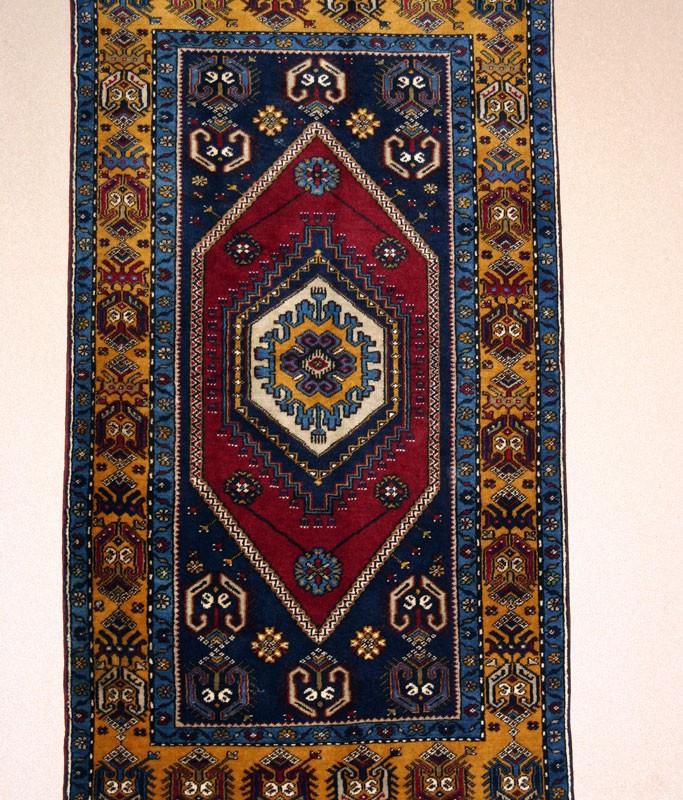
Yahyalı hand-knotted rug is a traditional weaving art with a history of approximately 250 years in the Yahyalı district of Kayseri. These rugs are classified as Mahreç marks and were officially announced in the Official Gazette dated 01.09.1996 and numbered 22744. Yahyalı hand-knotted rugs attract attention through their regional production techniques natural materials and cultural motifs.

Yahyalı El Halısı (Yahyalı Municipality)
Yahyalı hand-knotted rug is a hand-woven product made entirely of wool and produced within the geographical boundaries of the Yahyalı district. The local population prepares the warp weft and pile yarns using wool from sheep raised in the Taurus Mountains during summer pastoralism. These wools are of high quality in terms of luster and durability ensuring the rug’s long lifespan. The region’s diversity of plants and fruits provides a significant advantage in natural dye production. Since the indigo plant used exclusively for blue dye does not grow locally it is sourced from outside and processed in local dye houses.
The distinguishing features of the rugs are evident in their color and motif choices. Dominant colors include red navy brown yellow gray and their tones; small amounts of white black and camel hair colors are also used. These colors reflect the cool and dark tones suited to Yahyalı’s continental climate. Designs typically feature stylized botanical and geometric motifs with corner-center compositions and borders adorned with natural or architectural landscapes. These patterns also contain mythological figures that reflect influences from Central Asian Seljuk and Ottoman cultures.

Yahyalı El Halısı (Yahyalı Municipality)
Yahyalı hand-knotted rugs are woven using the Turkish knot (double knot) technique and possess the following technical characteristics:

Yahyalı El Halısı (Yahyalı Municipality)
The production process of Yahyalı hand-knotted rugs follows traditional regional methods. Wool sheared from sheep is washed along riverbanks using wooden mallets and then dried. Subsequently it is beaten with wooden sticks to clean it and then flattened using carding machines. The wool is then twisted using a spindle or chirk and prepared for dyeing in the form of roving. Dyeing is primarily carried out using natural dyes derived from local plants and fruit peels. For red dye the root of Rubia tinctorium is used; for yellow the leaves of grapevine or St. John’s wort; for green the leaves of walnut or grapevine; for brown the husk of walnut; and for lead-gray the wild mint (Mentha spicata). Black dye is obtained from black wool sheep while white dye comes from naturally white wool. A small amount of chemical mordant is used to fix the dyes onto the yarns.
Yahyalı hand-knotted rugs carry a rich cultural heritage through their diverse motifs and patterns. The motifs reflect the lifestyle beliefs and aspirations of the local community. The main motifs include:
Among the patterns are sandıklı (symbolizing desire for marriage) mihraplı (prayer rug type designs) çit ayaklı (symbolizing joy of life) dabazlı (border limitation) karpuzlu (geometric shapes resembling watermelon) camili ayak (family life) göbekli and üç göbekli (fertility and abundance) and baltalı (stylized axe figure). These patterns draw inspiration from nature and daily life.

Yahyalı El Halısı (Yahyalı Municipality)
The production of Yahyalı hand-knotted rugs must occur within the boundaries of the Yahyalı district. Wool sourcing dyeing and weaving require local craftsmanship and are shaped by cultural heritage. Quality control is conducted twice annually during October–April by a four-member inspection committee composed of representatives from the Yahyalı Municipality Yahyalı District Governorship Yahyalı Chamber of Tradesmen and Artisans and Yahyalı National Education Directorate. Additional inspections are carried out as needed or upon complaint. During inspections the number of knots knotting technique dye properties motif and color appropriateness and production materials are examined. Inspection reports are submitted to the Turkish Patent and Trademark Office.
Once one of the most important sources of employment in the Yahyalı district the Yahyalı hand-knotted rug has gained international recognition in recent years primarily through tourists visiting Cappadocia. These rugs which are produced by local artisans using natural materials attract attention for their aesthetic and cultural values. The preservation of traditional weaving techniques and motifs ensures the continuity of Yahyalı’s cultural heritage.
Yahyalı El Halısı. Geographical Indications Portal, Turkish Patent and Trademark Office. Accessed August 18, 2025. ci.turkpatent.gov.tr/cografi-isaretler/detay/37881
Yahyalı El Halısı. Türk Patent ve Marka Kurumu. Technical details and weaving characteristics. Accessed August 18, 2025. ci.turkpatent.gov.tr/Files/GeographicalSigns/d5eb505f-4530-4534-9d4c-5ea557b3447f.pdf
Yahyalı Halısı. "Yahyalı Halısı." Yahyalı Belediyesi. Accessed August 18, 2025. www.yahyali.bel.tr/yahyali-halisi

Type of Geographical İndication | Mahreç Sign | ||||||||
|---|---|---|---|---|---|---|---|---|---|
Application Date | 21.06.1996 | ||||||||
Registration Number | 18 | ||||||||
Registration Date | 14.11.1997 | ||||||||
Product / Product Group(s) | Rugs and kilims | ||||||||
Province(s) | Kayseri | ||||||||
Applicant/Registrant(s) | Yahyalı Municipality | ||||||||
Description and Characteristics
Technical Specifications
Production Process
Motifs and Patterns
Monitoring and Geographical Indication
Cultural and Economic Significance