



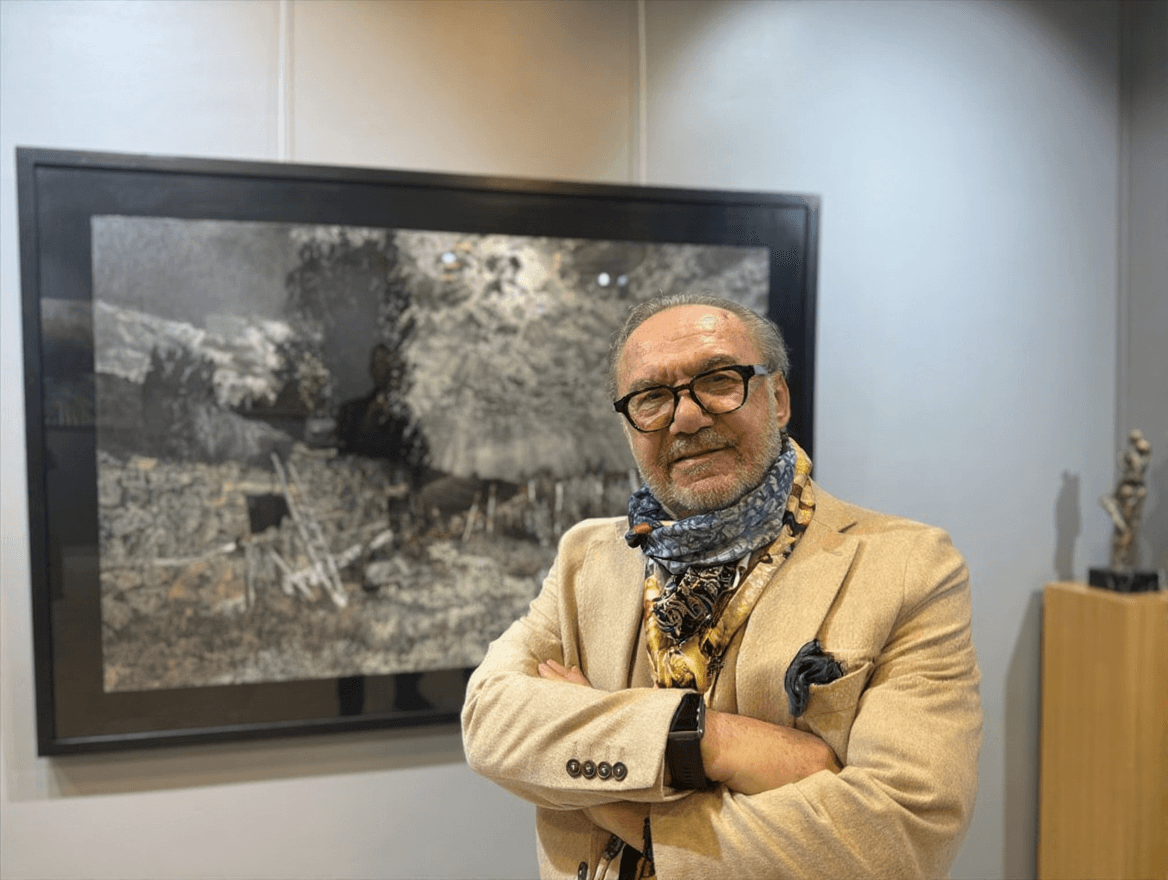
(Anadolu Agency)
Yalçın Gökçebağ
Eş | Fevziye Gökçebağ | ||||||||
|---|---|---|---|---|---|---|---|---|---|
Birth | 1944, Zeyve (Akkent), Çal (Denizli) | ||||||||
Field | Painting | ||||||||
Education | Primary Teacher Training School (Village Institute tradition) Gazi Education Institute Painting Department (graduation: 1966) Çapa Primary Teacher Training School Painting Seminar | ||||||||
Professional Roles | Primary school teaching, cameraman at TRT, teaching assistant at Middle East Technical University Faculty of Fine Arts after retirement from TRT | ||||||||
Çocuk | Gökçen Gökçebağ | ||||||||
Yalçın Gökçebağ was born in 1944 in the village of Zeyve (Akkent), located in the Çal district of Denizli. He completed his primary education in Çal and showed an early interest in painting. The surrounding countryside, agricultural production, and daily rural life became foundational elements that frequently appear as subject matter in his later works.
In the mid-1950s, he received his education within the tradition of teacher training schools and village institutes; he then continued his studies at the Drawing Seminar of the Çapa Primary Teachers College in Istanbul. During this period, he underwent intensive training in both painting and music, experimented with various forms during summer vacations—including landscapes and abstract/cubist studies—and was influenced by the methods and artistic identities of certain teachers.
In 1963, he enrolled in the Painting Department of Gazi Education Institute and graduated in 1966. After completing his studies, he worked as a painting teacher in various locations; during his teaching years, he produced paintings centered on portraits and local narratives. His drawings and illustrations also appeared in periodical publications.
Gökçebağ’s professional trajectory developed between teaching and the audiovisual media field. After graduation, he was appointed as a painting teacher; later, he worked in various roles in İzmir. In the early 1970s, he began working at TRT as a cameraman. He was part of TRT’s first teams of on-location cameramen, which gave him the opportunity to observe filming across different regions of the country.
It is noted that during his years at TRT, he temporarily set aside painting; however, by the mid-1970s, he returned to painting, influenced by his relationships with artist friends and the cumulative experiences of his travels throughout Anatolia. This return to painting coincided with a clearer emphasis in his work on rural life, seasons, agricultural activities, and scenes of everyday labor.
He retired from TRT in 1992 and subsequently worked as a lecturer at Middle East Technical University. He lived in both Ankara and Istanbul and simultaneously maintained two studios—one associated with the Ankara/Armoni Art Gallery circle, according to some sources, and another in Kadıköy, Istanbul, according to others.

Yalçın Gökçebağ (AA)
Gökçebağ’s paintings are closely linked to themes such as rural life, the relationship between nature and humans, agriculture, and the cycle of seasons. Depictions grounded in communal practices like production and imece, the daily rhythms of village life, and the Anatolian landscape have been identified in numerous texts as the central axis of his art. These themes are conveyed through compositions that integrate figures and landscape. Stylistically, his works are often described as “naive,” though this label is understood within the context of broader debates about artistic schools or categorizations. His art achieves a balance between simple expression and meticulous craftsmanship.
The artist produced works using various techniques, including oil and acrylic on canvas, and demonstrated a range of styles in his early period, moving from abstract experiments to figurative and landscape representations. Additionally, his 1990 work titled “A Sunny Winter Day,” published as a postcard by UNICEF, stands as a concrete example of the international circulation of his artworks.

One of Gökçebağ’s Works (AA)
In 1973, Gökçebağ married Fevziye Gökçebağ. Their son, Gökçen Gökçebağ, born in 1980, is an actor. It is also known that the artist played the saz for a period of time.
Anadolu Ajansı. "Ressam Gökçebağ, Cumhurbaşkanlığı Kültür ve Sanat Büyük Ödülü'ne layık görülmenin mutluluğunu yaşıyor." Accessed December 18, 2025. https://www.aa.com.tr/tr/kultur/ressam-gokcebag-cumhurbaskanligi-kultur-ve-sanat-buyuk-odulune-layik-gorulmenin-mutlulugunu-yasiyor/3774290
Anadolu Üniversitesi Çağdaş Sanatlar Müzesi. “GÖKÇEBAĞ, Yalçın.” Accessed December 18, 2025. https://csmuze.anadolu.edu.tr/muze-koleksiyonu/gokcebag-yalcin
Antikalar.com. "Yalçın Gökçebağ." Accessed December 18, 2025. https://www.antikalar.com/yalcin-gokcebag
Arnica Art Land. "Yalçın Gökçebağ." Accessed December 18, 2025. https://arnicaartland.com/sanatci/yalcin-gokcebag/
Artfulliving. “Resmin Yaşar Kemal’i Yalçın Gökçebağ ile Dünden Bugüne.” Accessed December 18, 2025. https://www.artfulliving.com.tr/sanat/resmin-yasar-kemali-yalcin-gokcebag-ile-dunden-bugune-i-11825
Biyografiler.com. "Yalçın Gökçebağ." Accessed December 18, 2025. https://www.biyografiler.com/kimdir/yalcin-gokcebag
Galeri Soyut. "Yalçın Gökçebağ." Accessed December 18, 2025. https://www.galerisoyut.com.tr/sanatcilar/157/yalcin-gokcebag
Sanat Gezgini. “Yalçın Gökçebağ Sanatçı Bilgileri ve Eserleri.” Accessed December 18, 2025. https://www.sanatgezgini.com/marketplace/seller/profile/yalcin-gokcebag
Sanattan Yansımalar. "Yalçın Gökçebağ Kibele Sanat Galerisi’nde." Accessed December 18, 2025. https://www.sanattanyansimalar.com/yalcin-gokcebag-kibele-sanat-galerisi-nde/6786/
Sanattan Yansımalar. "ÇAĞSAV Onur Ödülü, ressam Yalçın Gökçebağ ve Çorum Sanat Müzesi’ne." Accessed December 18, 2025. https://www.sanattanyansimalar.com/cagsav-onur-odulu-ressam-yalcin-gokcebag-ve-corum-sanat-muzesi-ne/6002/
Türkiye Cumhuriyeti İletişim Başkanlığı. "Cumhurbaşkanı Erdoğan, Cumhurbaşkanlığı Kültür ve Sanat Büyük Ödüllerinin sahiplerini açıkladı (29.10.25)." Accessed December 18, 2025. https://www.iletisim.gov.tr/turkce/haberler/detay/cumhurbaskani-erdogan-cumhurbaskanligi-kultur-ve-sanat-buyuk-odullerinin-sahiplerini-acikladi-29-10-25
UxMüzayede. "Yalçın Gökçebağ." Accessed December 18, 2025. https://www.uxmuzayede.com/en/blog/1804/yalcin-gokcebag
Yalçın Gökçebağ. "Anasayfa." Accessed December 18, 2025. https://www.yalcingokcebag.net/
Yalçın Gökçebağ. "Biyografi." Accessed December 18, 2025. https://www.yalcingokcebag.net/biyografi/

(Anadolu Agency)
Yalçın Gökçebağ
Eş | Fevziye Gökçebağ | ||||||||
|---|---|---|---|---|---|---|---|---|---|
Birth | 1944, Zeyve (Akkent), Çal (Denizli) | ||||||||
Field | Painting | ||||||||
Education | Primary Teacher Training School (Village Institute tradition) Gazi Education Institute Painting Department (graduation: 1966) Çapa Primary Teacher Training School Painting Seminar | ||||||||
Professional Roles | Primary school teaching, cameraman at TRT, teaching assistant at Middle East Technical University Faculty of Fine Arts after retirement from TRT | ||||||||
Çocuk | Gökçen Gökçebağ | ||||||||
Professional Career
Artistic Orientation and Subject World
Personal Life and Biographical Details