


This article was automatically translated from the original Turkish version.
+1 More
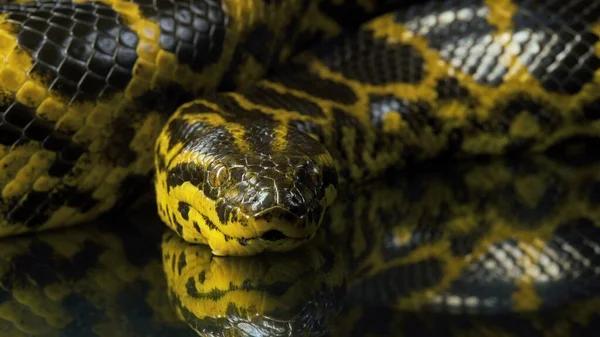
Yellow Anaconda
World | Animalia (Animals) | ||||||||
|---|---|---|---|---|---|---|---|---|---|
Branch | Chordata (Chordates) | ||||||||
Class | Reptilia (Reptiles) | ||||||||
Team(s) | Squamata (Scaled Reptiles) | ||||||||
Subteam | Serpentes (Snakes) | ||||||||
Family | Boidae (Boas) | ||||||||
Genus | Eunectes (Anacondas) | ||||||||
Specie(s) | Notaeus (Yellow Anaconda) | ||||||||
The yellow anaconda (Eunectes notaeus) is one of four species in the Boidae family and is particularly known for its life in aquatic ecosystems of South America. Although smaller in length compared to the green anaconda (E. murinus), the yellow anaconda still possesses a large and muscular build. This species is commonly found in the tropical river basins of Paraguay, Argentina, Bolivia, and Brazil and is distinguished by its semiaquatic lifestyle.
The ecological role of the yellow anaconda is highly significant. As mid-level predators, they regulate prey populations and maintain dynamic balance within the food chain. This species typically feeds on fish, birds, and mammals and is sensitive to environmental changes. Additionally, its ovoviviparous reproductive system and hunting strategies render it both an evolutionary example and a valuable species in terms of biodiversity.
Yellow anacondas also occupy a distinct position in human perception compared to other snakes. Although sometimes portrayed in media as highly aggressive or mythical creatures, actual attacks on humans in the wild are extremely rare. On the contrary, factors such as habitat loss, illegal hunting, and the spread of misinformation threaten the survival of the yellow anaconda species.

Yellow Anaconda (depositphotos)
The yellow anaconda can reach an average length of 3 to 4.5 metres, with some individuals reported to grow up to 5 metres. Their weight ranges between 25 and 35 kilograms, with females generally larger than males. This sexual dimorphism is linked to the females’ ability to carry more offspring.
Body color varies between yellowish-green and brownish tones. Irregularly distributed black spots, rings, or stripes are observed on this background. Color patterns are unique to each individual and can be used for identification. These patterns also provide camouflage, making the anaconda harder to detect beneath sun-filtered leaves or in murky waters.
The head of the yellow anaconda is smaller than its body; the eyes and nostrils are positioned on the upper part of the head. This placement allows the animal to remain fully submerged while breathing and observing its surroundings using only its nostrils and eyes. This adaptation has resulted in a body structure highly suited for ambush hunting.
The muscular structure is dense, with a thick and cylindrical body. The intervertebral muscles play a major role in constricting prey to suffocation. Additionally, they possess a broad and powerful tail that aids in directing movement underwater. Their teeth are recurved, preventing prey from escaping and facilitating swallowing.
The digestive system is adapted to process large prey. Digestion can last for weeks, during which the snake remains largely motionless. Moreover, the anaconda’s metabolic rate varies depending on the size of the ingested prey. During digestion, heart rate, secretion of digestive enzymes, and stomach acidity increase significantly.
The yellow anaconda inhabits aquatic and humid environments, particularly in the subtropical and tropical regions of South America. Its primary range includes the Paraguay River, Pilcomayo River, and Paraná River systems. Northeastern Argentina, southeastern Bolivia, the Mato Grosso do Sul region of Brazil, and western Paraguay constitute its natural habitats.
It is commonly found in swamps, ponds, slow-moving river channels, and flooded forests. These habitats are ideal due to the thermal advantages of proximity to water and high prey availability. During dry seasons, when water sources recede, anacondas prefer to remain in swamp depressions or shaded, moist areas.
Yellow anacondas are excellent swimmers and spend significantly more time in water than on land. However, during dry periods, they may undertake short-distance migrations to reach new water sources. In these periods, they conserve energy by remaining passive during the day to avoid dehydration risks.
The yellow anaconda is an opportunistic predator. Its diet varies according to the ecosystem, season, age, and sex of the individual. Juvenile anacondas typically feed on small fish, water birds, and amphibians, while adults may prey on larger mammals, birds, and even other predatory reptiles.
After capturing prey, it coils its body tightly around it to suffocate. During this process, each exhalation further tightens the constriction, ultimately leading to suffocation. This method is both rapid and energy-efficient. Once the prey is dead, the anaconda swallows it headfirst; digestion begins after ingestion.
The frequency of hunting depends on the size of the prey. A large meal can satisfy nutritional needs for weeks or even a month. During this period, the anaconda typically remains motionless and reduces its metabolic activity. The digestive system becomes highly active both enzymatically and thermally, facilitating digestion.
Water is a critical factor in the anaconda’s hunting success. It can remain hidden underwater to set ambushes and detect approaching prey through sound, scent, and vibration. Observation and attacks often occur in the early morning hours, as mammals drawn to water sources after nocturnal activity are more abundant and metabolic activity is elevated under morning sunlight.
Reproduction in yellow anacondas typically occurs during the transition from spring to summer, coinciding with the onset of the rainy season. This seasonal breeding biology is directly linked to humidity, temperature, and abundance of water sources. Females release pheromones during the mating period to attract males.
Mating usually lasts several days. Structures known as “breeding balls” form, in which six to twelve males may surround a single female. In this system, where the female is the deciding factor, males that endure the longest gain mating rights. This process serves as an important mechanism of natural selection.
Yellow anacondas are ovoviviparous. Fertilized eggs develop inside the female’s body and are born live. The gestation period averages six to seven months. During this time, the female feeds very little or sometimes not at all.
A single birth yields between 10 and 40 offspring. Newborns are approximately 60 to 70 centimetres long at birth and are fully independent. They receive no maternal care. From the moment of birth, they can swim, breathe, and feed on small prey.
Yellow anacondas are not a direct threat to humans. However, due to their size and proximity to slow-moving waters, they are occasionally encountered near farmland or in areas frequented by villagers. Such encounters can lead to fear, misinformation, and myth-based perceptions of threat among local populations. As a result, anacondas are often unprotected and face a risk of being killed.
Legally, the yellow anaconda is protected in many countries. It is listed under Appendix II of CITES, the Convention on International Trade in Endangered Species, which imposes restrictions on its trade. Nevertheless, illegal wildlife trafficking, poaching, and demand for exotic pets continue to threaten this species.
Another serious threat is habitat loss. Dams constructed on major river systems of South America, drainage of wetlands, deforestation, and conversion of land for agriculture are reducing and fragmenting the natural habitats of yellow anacondas, forcing them to relocate. This situation weakens their ecological roles and leads to population fragmentation.
Climate change is another significant threat. Rising temperatures, irregular rainfall patterns, and prolonged dry periods endanger the sustainability of water sources vital to semiaquatic life forms. Increased temperatures also negatively affect juvenile development and reproductive cycles.
Nevertheless, conservation organizations, scientists, and some government-supported programs are implementing various projects to protect the yellow anaconda. These include designating habitat conservation areas, conducting species monitoring, launching environmental education initiatives, and engaging directly with local communities.
Education programs aim to increase local awareness about this species and develop strategies for coexistence. In regions with ecotourism potential, projects that allow live observation of anacondas are transforming the species into an economic asset, thereby contributing to its conservation.
The yellow anaconda is one of four recognized species within the genus Eunectes of the family Boidae. The other three species in this genus are the green anaconda (E. murinus), the dark-spotted anaconda (E. deschauenseei), and the Bolivian anaconda (E. beniensis). Eunectes notaeus differs from these species in physical size, color patterns, and geographic distribution.
The Boidae family is one of the ancient snake lineages of the New World. Alongside anacondas, this family includes boa constrictors (Boa constrictor). One of the most fundamental differences between the yellow anaconda and boa constrictors lies in habitat preference. While boa constrictors are primarily terrestrial and favor forested areas, the yellow anaconda is more active in aquatic environments.
Evolutionarily, anacondas are believed to have developed aquatic adaptations over millions of years to suit the wetland habitats of tropical South America. Key examples include the dorsal positioning of the eyes and nostrils, a flattened tail structure, and specialized skin patterns. These adaptations provide advantages both for hunting and for avoiding predators.
Molecular phylogenetic analyses indicate that Eunectes species diverged from a common ancestor 15 to 20 million years ago. This divergence paralleled climatic changes and geographic barriers in South America, such as the Amazon and Orinoco basins. The yellow anaconda is evolutionarily one of the closest relatives to the green anaconda, but its smaller size can be explained by geographic isolation, climatic differences, and niche differentiation based on food web structure.
Modern systematic studies suggest that yellow anacondas may exhibit genetic differentiation across different geographic regions, potentially warranting subspecies classification. However, current findings are based on limited samples, and further molecular analyses and morphological observations are needed to fully understand intraspecific variation.
Animalia.bio. "Yellow Anaconda." Accessed May 11, 2025. https://animalia.bio/yellow-anaconda.
Colthorpe, Kelly. “Eunectes notaeus.” *Animal Diversity Web.* Accessed May 11, 2025. https://animaldiversity.org/accounts/Eunectes_notaeus/.
Depositphotos. Pablo255. “Sarı Anaconda Ağaç Gövdesinde Kalır - Hayvan Portre Kadar Yakın.” Accessed May 11, 2025. https://depositphotos.com/tr/photos/sar%C4%B1-anaconda.html?qview=176990720.
HowStuffWorks. "Yellow Anaconda." Accessed May 11, 2025. https://animals.howstuffworks.com/snakes/yellow-anaconda.htm.
The Animal Facts. "Yellow Anaconda." Accessed May 11, 2025. https://www.theanimalfacts.com/reptiles/yellow-anaconda/.
World Land Trust. "Yellow Anaconda." Accessed May 11, 2025. https://www.worldlandtrust.org/species/reptiles/yellow-anaconda/.

Yellow Anaconda
World | Animalia (Animals) | ||||||||
|---|---|---|---|---|---|---|---|---|---|
Branch | Chordata (Chordates) | ||||||||
Class | Reptilia (Reptiles) | ||||||||
Team(s) | Squamata (Scaled Reptiles) | ||||||||
Subteam | Serpentes (Snakes) | ||||||||
Family | Boidae (Boas) | ||||||||
Genus | Eunectes (Anacondas) | ||||||||
Specie(s) | Notaeus (Yellow Anaconda) | ||||||||
Morphology and Anatomical Features
Ecology and Behavioral Characteristics
Habitat and Geographic Distribution
Feeding Habits
Reproduction and Life Cycle
Conservation Status and Human Interaction
Taxonomy, Evolution, and Systematic Interpretations