


This article was automatically translated from the original Turkish version.
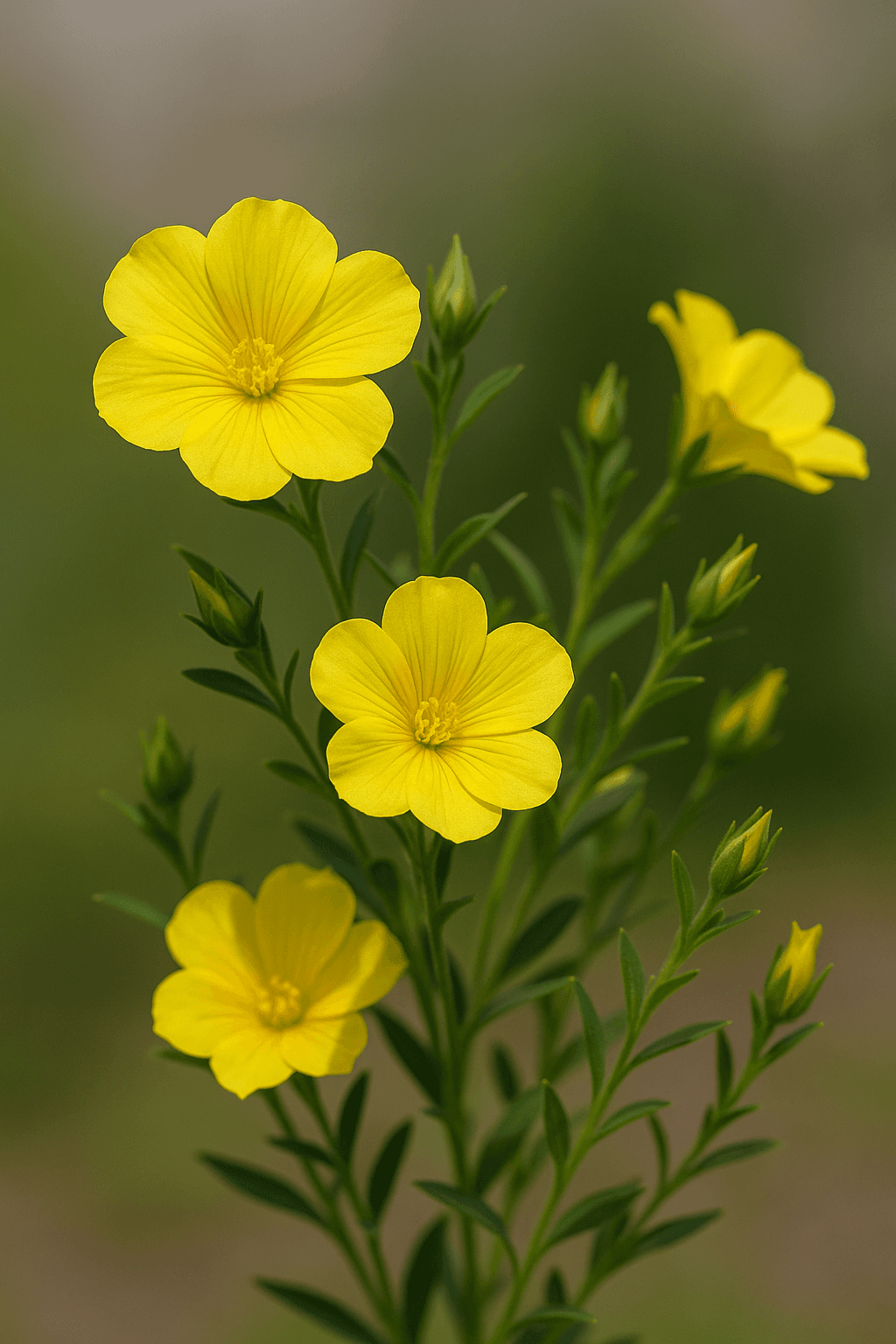
Yellow Flax Flower (Linum flavum L.)
Family | Linaceae (flax family) | ||||||||
|---|---|---|---|---|---|---|---|---|---|
Distribution Area | Central and Southern Europe; especially France, Germany, Austria, Czechia and Hungary | ||||||||
Habitat and Climate | Calcareous, stony, well-drained soils; open, sunny, semi-arid grasslands and slopes. Grows in temperate and semi-arid climates | ||||||||
Flowering Period | Between May and July | ||||||||
Height(s) | 20–40 cm | ||||||||
Growth Form | Woody, perennial, upright shrub-like form | ||||||||
Saffron flax (Linum flavum L.) is a perennial, woody plant species belonging to the Linaceae family, distinguished by its small yellow flowers and native primarily to central and southern Europe. Also known as “golden flax” or “saffron flax,” this species naturally grows in dry, calcareous soils, sunny meadows, and stony slopes. While its natural distribution is largely confined to central Europe, it is frequently cultivated and used in research due to various taxonomic varieties such as L. flavum var. compactum.
This species thrives under temperate climatic conditions and exhibits tolerance to drought and calcareous soils. It can be propagated through seeds or tissue culture. It is particularly widespread in European countries such as France, Germany, and the Czech Republic. Although documented natural occurrences in Türkiye’s flora are limited, field studies have recorded its presence in the arid steppe regions of Central Anatolia and the Western Black Sea. Key factors supporting its growth include permeable, mineral-rich, slightly alkaline soil structure and high light exposure.

Saffron flax (Linum flavum) plant (Photo: Gaye Durmuş)
L. flavum is a perennial, woody plant with an upright, shrub-like growth form. It typically reaches a height of 20–40 cm. Its thick, short, fibrous stem produces numerous branches. The leaves are oppositely arranged, narrowly elliptic or ovate in shape, and short-stalked; their surfaces are densely covered with hairs, an adaptation to drought conditions. Its structural resilience and odorless foliage when fresh are notable features.
The flowers are bright yellow, five-lobed, and symmetrical. Inflorescences are arranged in racemes and contain numerous flowers. Although direct observations of pollinator interactions are lacking, the floral morphology is considered favorable for pollination.
While seed production has been studied only marginally, research evaluating lignan production has shown that vegetative propagation is more effective. The root and stem tissues exhibit a structure prone to continuous cell division, indicating a high regenerative potential.
L. flavum develops in dry, permeable, and mineral-rich soils under open, sunny conditions. It also demonstrates long-term survival and lignan production potential under greenhouse conditions. The successful in vitro development of its root system indicates a genetic predisposition toward differentiation.
Studies have observed enhanced accumulation of lignans—particularly aryltetralin lignans—in environments with low nitrogen content. Metabolite profiles in roots, leaves, and fruit tissues vary according to habitat conditions, with reports indicating increased lignan levels under greenhouse settings.
Compounds such as β-peltatin-A methyl ether, podophyllotoxin, and coniferin, isolated from hairy root (HR) cultures, demonstrate the species’ chemical diversity and biosynthetic capacity. These metabolites can accumulate at levels of 1–3% of dry weight, indicating significant pharmaceutical potential.
Linum flavum is a plant species capable of both sexual (generative) and vegetative reproduction. In natural populations, it reproduces via seeds, while under laboratory conditions it has been successfully propagated through tissue culture, root culture, and hairy root techniques. Particularly in studies on the L. flavum var. compactum variety, its root and stem tissues, which exhibit continuous cell division alongside lignan production, indicate a high regenerative potential.
The flowers are distinctly yellow, five-lobed, and symmetrical, with inflorescences arranged in racemes. Each inflorescence typically contains numerous flowers and provides strong visual attraction for pollinators. However, no detailed observational reports on specific pollinator species have been published. Although no findings regarding pollinator diversity or floral scent have been reported, it is assumed that the flowering morphology and pigment composition facilitate pollination.
Although data on seed formation is limited, studies evaluating lignan synthesis have observed sustained secondary metabolite production, particularly in root tissues, beyond seed-based reproduction. The accumulation of lignans such as β-peltatin-A methyl ether in hairy root cultures demonstrates their long-term viability and ongoing regenerative capacity.
Vegetative propagation is achieved through in vitro regeneration of roots and shoots; root development can be accelerated using appropriate phytohormone balances, such as application of 2,4-D. However, high concentrations of 2,4-D have been shown to increase the production of undifferentiated callus tissue, which in turn reduces lignan production. This observation suggests that a certain level of morphological differentiation—such as the formation of root tissue—is necessary for lignan biosynthesis.
No specific data on seed germination capacity in natural environments has been provided, but tissue culture studies report that plant material derived from this species is genetically and biochemically stable, capable of sustained lignan synthesis, and highly productive. This indicates that L. flavum is a suitable model species for sustainable production under laboratory conditions.

No experimental or observational evidence exists regarding the direct role of Linum flavum in water quality improvement or filtration. No data has been reported on its interactions with hydrological environments or its function in aquatic ecosystems. The habitats naturally associated with this species are typically semi-arid, permeable, calcareous soils forming terrestrial ecosystems with low water retention capacity.
Furthermore, L. flavum is not associated with any biological process involving water filtration or direct influence on water quality, even under laboratory conditions where lignan compounds are produced via root systems—particularly in hairy root cultures. The primary objective in these systems is not the physical or chemical purification of water but the production of biochemical secondary metabolites.
However, it has been noted that the levels of phytohormones applied in nutrient media used for lignan production—especially liquid media containing 2,4-D—can influence chemical sensitivity to water and indirectly affect metabolite accumulation. This phenomenon, however, is evaluated solely within the context of in vitro medium optimization and not as a feature contributing to water quality or filtration functions.
Although L. flavum is not classified as a direct provider of ecosystem services, it contributes indirectly to scientific research and healthcare through its secondary metabolite production. Hairy root and root cultures used for lignan production are valuable for sustainable biomass supply.
In terms of biodiversity, as one of the few species within the Linaceae family capable of natural lignan production, it holds unique value in phytochemical diversity. Varieties such as L. flavum var. compactum and its adaptability to diverse habitats support the genetic diversity of the species.
Berlin, Jochen, Victor Wray, Christian Mollenschott, and Frank Sasse. “Formation of β-Peltatin-A Methyl Ether and Coniferin by Root Cultures of Linum flavum.” Journal of Natural Products 49, no. 3 (1986): 435–439. Accessed July 2, 2025. https://www.academia.edu/28344791/Formation_of_β_Peltatin_A_Methyl_Ether_and_Coniferin_by_Root_Cultures_of_Linum_flavum
Mikame, Keigo, Norikazu Sakakibara, Toshiaki Umezawa, and Mikio Shimada. “Lignans of Linum flavum var. compactum.” Journal of Wood Science 48, no. 5 (2002): 440–445. Accessed July 2, 2025. https://link.springer.com/article/10.1007/BF00770707
Renouard, Sullivan, Cyrielle Corbin, Samantha Drouet, Barbara Medvedec, Joël Doussot, Cyril Colas, Benoit Maunit, Avninder S. Bhambra, Eric Gontier, Nathalie Jullian, et al. “Investigation of Linum flavum (L.) Hairy Root Cultures for the Production of Anticancer Aryltetralin Lignans.” International Journal of Molecular Sciences 19, no. 4 (2018): 990. Accessed July 2, 2025. https://www.mdpi.com/1422-0067/19/4/990

Yellow Flax Flower (Linum flavum L.)
Family | Linaceae (flax family) | ||||||||
|---|---|---|---|---|---|---|---|---|---|
Distribution Area | Central and Southern Europe; especially France, Germany, Austria, Czechia and Hungary | ||||||||
Habitat and Climate | Calcareous, stony, well-drained soils; open, sunny, semi-arid grasslands and slopes. Grows in temperate and semi-arid climates | ||||||||
Flowering Period | Between May and July | ||||||||
Height(s) | 20–40 cm | ||||||||
Growth Form | Woody, perennial, upright shrub-like form | ||||||||
No Discussion Added Yet
Start discussion for "Yellow Flax Flower (Linum flavum L.)" article
Botanical Structure and Morphological Characteristics
Habitat Adaptation and Ecosystem Role
Pollination and Reproductive Mechanisms
Water Quality and Filtration Function
Ecosystem Services and Biodiversity Contribution