


This article was automatically translated from the original Turkish version.
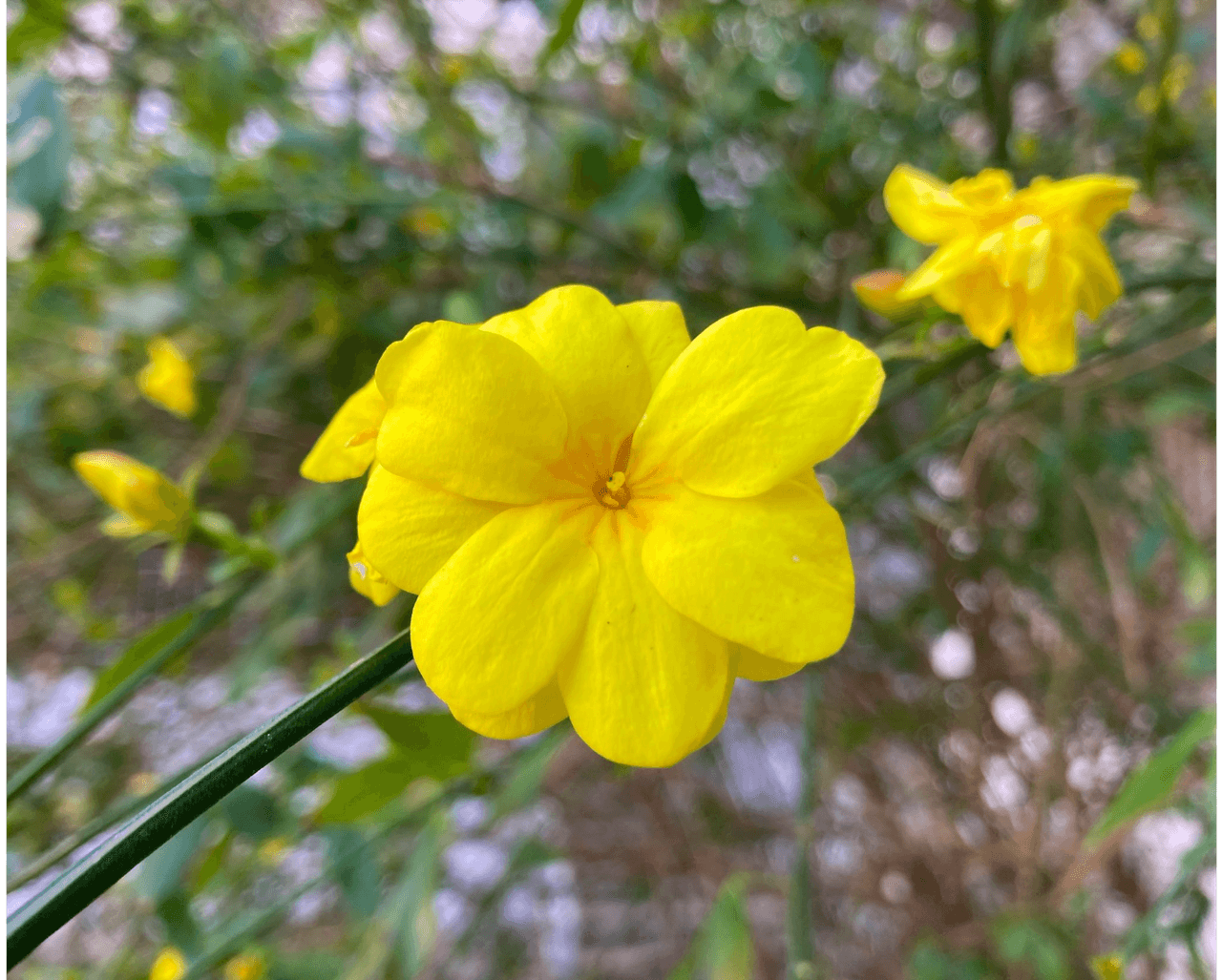
Yellow jasmine (Jasminum mesnyi) is an evergreen ornamental shrub belonging to the Oleaceae family, characterized by its yellow flowers and bushy growth habit. Its natural distribution is confined to southern regions of China. It is cultivated as a decorative plant in areas with temperate climate conditions. It is also known as “primrose jasmine” and “Chinese jasmine”.

Yellow Jasmine (Pexels)
Sarı yasemin (Jasminum mesnyi) is an evergreen shrub with semi-woody and densely branched architecture. Under favorable environmental conditions, it can reach a height of 1.5 to 3.1 meters (5–10 ft) and attain a similar spread, growing in a rounded or loose clump form. Its natural habit is trailing and spreading; however, with support, it can adopt a semi-climbing form. This makes it suitable for use both as a ground cover and as a hedge plant. Young stems are square in cross-section, green and soft; as they mature, they undergo lignification and develop a brownish woody appearance.
Leaves are arranged in opposite pairs and are compound, consisting of three leaflets (trifoliate). The leaflets vary in shape from elliptic-oblong to lanceolate, measuring approximately 2.5 to 7.5 cm in length and 1 to 3 cm in width. The leaf surface is glossy, firm in texture, and dark green in color. The margins are entire, and the leaves remain on the plant throughout the year without shedding, providing year-round green coverage.
Flowers typically open singly on short pedicels (1–4 cm long) at the tips of shoots. The flower diameter averages 3–4 cm. The corolla usually consists of six to ten petals, exhibiting a semi-double form. The petals are oval to nearly round, with a bright lemon-yellow hue. Although flowers are generally considered scentless, some sources report a faint fragrance. The main flowering period extends from late winter to early spring; sporadic and irregular blooming may occur during other times of the year.
The plant is often sterile but occasionally produces fruit. The fruit is blackish-purple, ellipsoid in shape, and about 1 cm long. This berry-like structure, up to 6 mm in diameter, typically contains one or two seeds per segment. However, in cultivation, fruits are rarely formed.
The root system of yellow jasmine is shallow, fibrous, and horizontally spreading. The plant thrives best in well-drained, loose, slightly sandy soils with good aeration. It is highly susceptible to root rot in waterlogged, clay-rich or compacted soils. When grown in containers, pots with drainage holes and a layer of gravel or similar permeable material at the base are recommended. The soil should be kept slightly moist; waterlogging is detrimental.
Jasminum mesnyi is a decorative shrub well adapted to temperate climates and exhibits specific environmental sensitivities regarding light, temperature, soil structure, and pruning needs.
The plant achieves optimal growth and flowering performance in full sun. It also tolerates partial shade, although flowering quantity is noticeably reduced under such conditions. For maximum flowering potential during late winter to early spring, locations receiving at least five to six hours of direct sunlight daily are preferred.
Yellow jasmine has limited cold tolerance and is generally suitable for outdoor cultivation in USDA hardiness zones 8b and above. Temperatures below -5 °C may cause damage to leaves and shoots. Therefore, in colder climates, south-facing, wind-protected microclimates are recommended. In regions with severe winters, container cultivation and indoor overwintering are viable options.
Well-drained soils with loamy, clayey or sandy characteristics provide ideal growing conditions. Poorly drained or water-retentive soils significantly increase the risk of root rot. The plant can tolerate slightly alkaline to neutral pH levels. In container cultivation, pots with drainage holes and a base layer of gravel to prevent water accumulation are recommended. Irrigation should be based on allowing the soil surface to dry slightly between waterings; overwatering can damage the root system.
Yellow jasmine is a fast-growing and dense shrub. Therefore, annual pruning is essential for both the plant’s overall health and aesthetic appearance. Without pruning, it spreads uncontrollably and develops an “untidy, clumped” appearance.
The optimal time for pruning is at the end of spring, immediately after the main flowering period. Severe pruning at this stage encourages new shoot development and establishes a more productive flowering framework for the following season. During pruning, old, woody and non-flowering branches should be removed first, and long, trailing shoots should be shortened. If desired, it can be shaped into a hedge and used for architectural boundary definition.
Jasminum mesnyi can be susceptible to various pests and diseases. Insects such as aphids, mealybugs, and red spider mites commonly affect the plant, while fungal diseases like honey fungus (Armillaria) occur less frequently. Regular monitoring and maintenance are necessary to preserve plant health.
Jasminum mesnyi, native to China, has been naturalized across southern Asia, temperate regions of Europe, and certain southern states of North America. In Türkiye, it is widely cultivated as an ornamental plant, particularly in the Mediterranean and Aegean regions, where it is commonly used along walls, as a hedge, or as a trailing container plant.
Atlas of Living Australia. "Jasminum mesnyi Lindl." Accessed April 29, 2025. https://bie.ala.org.au/species/https://id.biodiversity.org.au/node/apni/2914462
Flora of Pakistan. "Jasminum mesnyi." Flora of Pakistan. Accessed April 29, 2025. http://www.efloras.org/florataxon.aspx?flora_id=5&taxon_id=210000871
GBIF. "Jasminum mesnyi Hance." Global Biodiversity Information Facility. Accessed May 4, 2025. https://www.gbif.org/occurrence/5087238307
GBIF. "Jasminum mesnyi Lindl." Global Biodiversity Information Facility. Accessed April 29, 2025. https://www.gbif.org/species/3172272
Oregon State University. “Jasminum mesnyi.” *OSU*. Accessed April 29, 2025. https://landscapeplants.oregonstate.edu/plants/jasminum-mesnyi
miyou_ 77. “Jasminum mesnyi JPG.” Pexels. Accessed May 4, 2025. https://www.pexels.com/tr-tr/fotograf/cali-guzellik-cicek-acmak-cicek-20763393/

No Discussion Added Yet
Start discussion for "Yellow Jasmine Flower (Jasminum mesnyi)" article
Morphological Characteristics
Ecological Requirements and Care
Soil Structure and Water Management
Pruning and Shaping
Pests and Diseases
Distribution and Uses