

This article was automatically translated from the original Turkish version.
+1 More
Website(s) | https://mawani.gov.sa/ | ||||||||
|---|---|---|---|---|---|---|---|---|---|
Location | Saudi Arabia Yenbu | ||||||||
Port Type | Industrial Oil and Petrochemical Port | ||||||||
Operating Institution | Saudi Ports Authority | ||||||||
Coordinates | 24053803 | ||||||||
Yanbu Commercial Port is a transportation hub located on the western coast of Türkiye, strategically positioned on the Red Sea and among the country’s oldest seaports.【1】 Situated between Jeddah Islamic Port and King Fahd Industrial Port, the port serves as a critical gateway and logistical corridor for the local economies of the Medina and Qassim regions. Opened in 1965, the port supports commercial cargo flows and functions as Saudi Arabia’s second major entry point for pilgrims traveling to the holy cities.

Yanbu Port (Google Maps)
Yanbu Commercial Port consists of 12 piers with a combined annual handling capacity exceeding 13.5 million metric tons.【2】 The port facilities include a passenger terminal capable of serving 2,000 passengers simultaneously, a general cargo terminal, and bulk cargo storage silos with a total capacity of 40,000 tons. The port’s depth has been dredged to 14 meters to accommodate Panamax vessels fully loaded.【3】
The port’s operational equipment fleet includes 100-ton multi-purpose port cranes, pneumatic unloaders, forklifts of various capacities, and heavy-load transport vehicles. Additionally, the port features over 40,000 square meters of covered warehouse space and more than 250,000 square meters of open stacking area.【4】
The port serves a wide variety of cargo types:
In line with Saudi Arabia’s National Transport and Logistics Strategy, large-scale projects are underway to expand Yanbu Port’s capacity.【5】
Under an agreement signed between Mawani and SALIC (Saudi Agricultural and Livestock Investment Company), the largest grain terminal in the country is being constructed at the port.【6】 Covering an area of 313,000 square meters, the project will be completed in two phases and will have an annual capacity of 5 million tons for grain import, processing, and re-export. This facility is designed to be the first regional hub for food security in the Gulf countries.【7】
To strengthen the port’s supply chain capabilities, an investment agreement exceeding 29 million riyals has been signed with Q Saudi Trading Company. This center, to be built on a 120,490-square-meter site, will provide cargo storage, consolidation, and redistribution services, supporting the port’s goal of becoming an international logistics hub.【8】
Yanbu serves as a critical “Plan B” route to reduce dependence on the Hormuz Strait in global energy markets.【9】

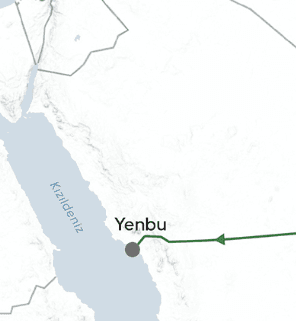
Strategic Importance of Yanbu Port (AA)
East-West Pipeline (Petroline): This 1,200-kilometer pipeline connects oil fields in eastern Saudi Arabia to terminals in Yanbu.【10】 With a daily capacity of 7 million barrels, the pipeline enables direct export of crude oil to the Red Sea without transiting the Hormuz Strait.【11】
Operational Process: During threats or military tensions involving Iran’s potential closure of the Hormuz Strait, Saudi Aramco reroutes its shipments via Yanbu.【12】 During recent crises, daily crude oil exports from Yanbu averaged 3.66 million barrels.【13】
Logistics Corridors Initiative: This newly launched initiative aims to connect GCC port networks by road to Yanbu Commercial Port, enabling goods to bypass the Hormuz Strait and reach European and African markets via the Red Sea.【14】
The port’s growing strategic importance has brought associated geopolitical risks. Yanbu Port and the nearby SAMREF refinery have been targeted by drone and ballistic missile attacks.【15】
Additionally, 70–75 percent of exports from the port must pass southward through the Bab el-Mandeb Strait. Due to their size, very large crude carriers (VLCCs) cannot transit the Suez Canal and are therefore forced to use this narrow passage to reach Asian markets. This makes the port’s operational security directly dependent on regional instability factors such as proxy conflicts in the Red Sea and Houthi activities.【16】
AJWA Port Services. “Yanbu Commercial Port.” AJWA Group. Accessed March 24, 2026. https://ajwa.com/products-and-services/ajwa-port-services/yanbu-commercial-port
Anadolu Ajansı. "Saudi Arabia reports missile, drone attacks on Red Sea port, key refinery." Accessed March 24, 2026. https://www.aa.com.tr/en/middle-east/saudi-arabia-reports-missile-drone-attacks-on-red-sea-port-key-refinery/3871310
Anadolu Ajansı. "Saudi Aramco, Hürmüz'deki aksamalara karşı Yenbu rotasını devreye aldığını bildirdi." Accessed March 24, 2026. https://www.aa.com.tr/tr/ekonomi/saudi-aramco-hurmuzdeki-aksamalara-karsi-yenbu-rotasini-devreye-aldigini-bildirdi/3876405
Anadolu Ajansı. “İran'ın Hürmüz Boğazı'nı kapatmasıyla bölge ülkeleri alternatif ihracat yolu arayışında.” Accessed March 24, 2026. https://www.aa.com.tr/tr/info/infografik/50592.
Arab News. “Saudi Ports to develop massive grain terminal in Yanbu.” Accessed March 24, 2026. https://www.arabnews.jp/en/business/article_22486/
Baker, Nathan. “Saudi Arabia Expands Yanbu Port Logistics Capacity.” *Logistics Middle East*. Accessed March 24, 2026. https://www.logisticsmiddleeast.com/news/saudi-arabia-expands-yanbu-port-logistics-capacity
Google Maps. "Yenbu Limanı." Map. Accessed March 24, 2026. https://cdn.t3pedia.org/media/uploads/2026/03/24/qgogvXJo2JEGf5bH9QccvVsAb0k7F2oO.png
HKTDC Research. “Saudi Arabia: New Logistics Corridor Set to Bypass Strait of Hormuz.” HKTDC Research. Accessed March 24, 2026. https://research.hktdc.com/en/article/MjI3OTI5NDkzNQ
Mohammed, Samiya. “The Yanbu Passage: Saudi Arabia’s 45-Year-Old Back Door to Bypass Hormuz.” *Horn Review*. Accessed March 24, 2026. https://hornreview.org/2026/03/17/the-yanbu-passage-saudi-arabias-45-year-old-back-door-to-bypass-hormuz/
[1]
Nathan Baker, “Saudi Arabia Expands Yanbu Port Logistics Capacity,” Logistics Middle East, Access Date: 24 March 2026, https://www.logisticsmiddleeast.com/news/saudi-arabia-expands-yanbu-port-logistics-capacity
[2]
Nathan Baker, “Saudi Arabia Expands Yanbu Port Logistics Capacity.”
[3]
AJWA Port Services, “Yanbu Commercial Port,” AJWA Group, Access Date: 24 March 2026, https://ajwa.com/products-and-services/ajwa-port-services/yanbu-commercial-port
[4]
AJWA Port Services, “Yanbu Commercial Port.”
[5]
Nathan Baker, “Saudi Arabia Expands Yanbu Port Logistics Capacity.”
[6]
Arab News, “Saudi Ports to develop massive grain terminal in Yanbu,” Arab News, Access Date: 24 March 2026, https://www.arabnews.jp/en/business/article_22486/
[7]
Arab News, “Saudi Ports to develop massive grain terminal in Yanbu.”
[8]
Nathan Baker, “Saudi Arabia Expands Yanbu Port Logistics Capacity.”
[9]
Samiya Mohammed, “The Yanbu Passage: Saudi Arabia’s 45-Year-Old Back Door to Bypass Hormuz,” Horn Review, Access Date: 24 March 2026, https://hornreview.org/2026/03/17/the-yanbu-passage-saudi-arabias-45-year-old-back-door-to-bypass-hormuz/
[10]
Samiya Mohammed, “The Yanbu Passage: Saudi Arabia’s 45-Year-Old Back Door to Bypass Hormuz.”
[11]
Samiya Mohammed, “The Yanbu Passage: Saudi Arabia’s 45-Year-Old Back Door to Bypass Hormuz.”
[12]
Anadolu Ajansı, “Saudi Aramco, Hürmüz'deki aksamalara karşı Yenbu rotasını devreye aldığını bildirdi,” Anadolu Ajansı, Access Date: 24 March 2026, https://www.aa.com.tr/tr/ekonomi/saudi-aramco-hurmuzdeki-aksamalara-karsi-yenbu-rotasini-devreye-aldigini-bildirdi/3876405
[13]
Anadolu Ajansı, “Saudi Aramco, Hürmüz'deki aksamalara karşı Yenbu rotasını devreye aldığını bildirdi.”
[14]
HKTDC Research, “SAUDI ARABIA: New Logistics Corridor Set to Bypass Strait of Hormuz,” HKTDC Research, Access Date: 24 March 2026, https://research.hktdc.com/en/article/MjI3OTI5NDkzNQ
[15]
Anadolu Ajansı, “Saudi Arabia reports missile, drone attacks on Red Sea port, key refinery,” Anadolu Ajansı, Access Date: 24 March 2026, https://www.aa.com.tr/en/middle-east/saudi-arabia-reports-missile-drone-attacks-on-red-sea-port-key-refinery/3871310
[16]
Samiya Mohammed, “The Yanbu Passage: Saudi Arabia’s 45-Year-Old Back Door to Bypass Hormuz.”


Website(s) | https://mawani.gov.sa/ | ||||||||
|---|---|---|---|---|---|---|---|---|---|
Location | Saudi Arabia Yenbu | ||||||||
Port Type | Industrial Oil and Petrochemical Port | ||||||||
Operating Institution | Saudi Ports Authority | ||||||||
Coordinates | 24053803 | ||||||||
No Discussion Added Yet
Start discussion for "Yenbu Commercial Port" article
Physical Infrastructure and Capacity
Operational Services
Strategic Development and New Investments
Regional Grain Terminal
Integrated Logistics Center
Energy Logistics and the Hormuz Strait Alternative
Security and Regional Risks