This article was automatically translated from the original Turkish version.
+2 More
Founder(s) | Sultan I. Alaeddin Keykubad | ||||||||
|---|---|---|---|---|---|---|---|---|---|
Location | Kaleiçi Antalya | ||||||||
Minaret Feature | Eight-fluted body brick and ceramic decorations | ||||||||
Construction Period | 13th century (Anatolian Seljuk State) | ||||||||
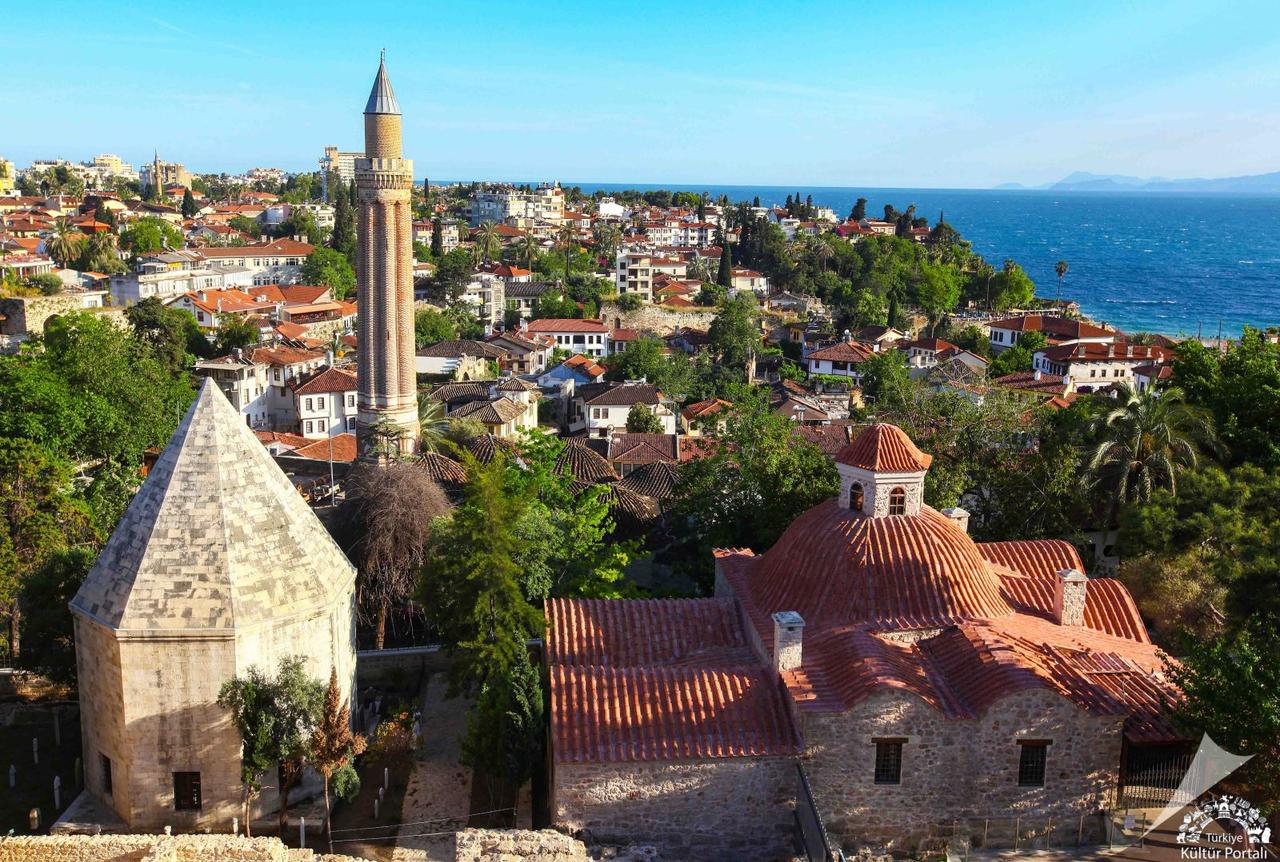
Yivli Minare Camii is a monumental mosque located in the historic Kaleiçi district of Antalya, originally constructed during the Seljuk period and subsequently restored in later centuries. It represents the city’s early Islamic architectural heritage through its multi-domed prayer hall layout, independent fluted minaret, and surrounding külliye elements. Recognized as one of Antalya’s historic symbols, Yivli Minare Camii stands at the heart of the city’s historic center, Kaleiçi.
Also known as Alaeddin Camii or Ulucami, the structure is among the earliest Islamic monuments in the region. It forms part of a large külliye complex that includes the Yivli Minare, madrasas, tombs, a bathhouse, and a mevlevihane. This historic architectural ensemble has been listed on UNESCO’s Tentative World Heritage List since 2016.
The mosque was originally built in the 13th century during the reign of the Anatolian Seljuk ruler I. Alaaddin Keykubat (1220–1237). Over the centuries, the structure underwent various phases of renovation and repair. According to an inscription on the main entrance portal, it was substantially restored in 1372 by Mehmet Bey of the Hamitoğulları dynasty, under the supervision of the architect Balaban Tavaşi. During the Republican era, the mosque was repaired at different times between 1935 and 1964. Following damage caused by a fire in 1972, comprehensive restoration works were carried out in the 1970s. Most recently, surface cleaning and structural consolidation were completed in 2007.

Yivli Minare Camii (Culture Portal)
Yivli Minare Camii is recognized in scholarly literature as the oldest surviving example of the multi-domed mosque type in Anatolian Turkish architecture. The building has a rectangular plan measuring approximately 16.5 meters in width and 26.5 meters in length. Its roof is covered by six hemispherical domes resting on twelve columns, with various transitional elements employed between them. The walls, which are 1.08 meters thick, were constructed using cut stone, brick, and recycled materials from antiquity. There are two main entrance portals, located on the north and east sides.

The Minaret of Yivli Minare Camii Anadolu Agency)
The fluted minaret, which gives the mosque its name, rises independently on its own base to a height of approximately 38 meters. Access to the minaret is via a staircase of 90 steps. Structurally, its shaft rises from an octagonal base and features a distinctive “fluted” form created by the union of eight half-cylindrical projections. Red bricks and turquoise-colored ceramic mosaics are used on the shaft. The minaret also includes Kufic inscriptions, niches, and muqarnas-decorated balconies.
One of the building’s notable technical features is its heating and cooling system, designed according to the conditions of its time. Beneath the mosque floor, a network of passageways and künk (underfloor air channels) allowed the interior to remain warm in winter and cool in summer; this system is now displayed beneath the mosque’s current floor.
During restoration excavations, eight graves, water channels, and Seljuk-era ceramics were uncovered, alongside architectural fragments dating to the Roman and Byzantine periods. These findings suggest that the site had been used for different purposes in earlier historical periods.
Anadolu Ajansı. "Antalya'nın simgelerinden 'Yivli Minare' zamana meydan okuyor." Anadolu Ajansı, June 19, 2016. Accessed January 26, 2026. https://www.aa.com.tr/tr/kultur-sanat/antalyanin-simgelerinden-yivli-minare-zamana-meydan-okuyor/594043.
Directorate General of Cultural Heritage and Museums. "Yivli Minare Camii (Antalya) [2016]." Accessed January 26, 2026. https://kvmgm.ktb.gov.tr/TR-163963/yivli-minare-camii-antalya-2016.html.
Türkiye Kültür Portalı. "Yivli Minare Camii - Antalya." August 20, 2025. Accessed January 26, 2026. https://www.kulturportali.gov.tr/turkiye/antalya/gezilecekyer/yivli-minare-camii-.
Çiğdemli, Aslı Özge Özgen. "Yivli Minare Camii." In *Online Türkiye Turizm Ansiklopedisi*, edited by Nazmi Kozak, 2019. Accessed January 26, 2026. https://turkiyeturizmansiklopedisi.com/yivli-minare-camii.

Founder(s) | Sultan I. Alaeddin Keykubad | ||||||||
|---|---|---|---|---|---|---|---|---|---|
Location | Kaleiçi Antalya | ||||||||
Minaret Feature | Eight-fluted body brick and ceramic decorations | ||||||||
Construction Period | 13th century (Anatolian Seljuk State) | ||||||||
Historical Development and Restorations
Architectural Features and Plan Layout
The Fluted Minaret and Decorative Elements
Technical Infrastructure and Archaeological Findings