


This article was automatically translated from the original Turkish version.
Yocto Project
First Version | v1.0 (Code Name: Bernard) (March 2011) | ||||||||
|---|---|---|---|---|---|---|---|---|---|
Website(s) | yoctoproject.org | ||||||||
The Yocto Project is an open-source initiative launched in 2010 under the leadership of the Linux Foundation to facilitate the creation of customizable Linux distributions for embedded systems.
Supported by numerous companies and developers worldwide, the project enables the rapid, repeatable, and modular creation of Linux distributions for a wide range of hardware architectures including ARM, MIPS, PowerPC, RISC-V, and x86. Many hardware manufacturers such as Texas Instruments, NXP, and STMicroelectronics leverage Yocto’s extensible structure to integrate components like device drivers and bootloaders for their platforms into the project via packages known as Board Support Packages (BSPs).
The Yocto Project is widely used in many sectors where embedded systems are prevalent. It is preferred for developing customized and reliable Linux-based devices in fields such as defense and aerospace, industrial automation, medical devices, automotive, and telecommunications.
Two key components that significantly contribute to the Yocto Project’s ability to generate fast, modular, and repeatable distributions are recipes and layers. Recipes are .bb files that define tasks such as downloading, compiling, and packaging software. They also contain information about the software’s build and runtime dependencies and how the resulting files should be packaged.
The task execution engine, called BitBake, reads the recipes for the software to be included in the distribution and identifies their dependencies. It then executes the tasks defined in the recipes in parallel to build the distribution. The outputs of these tasks are cached, so when additions or removals are made to the distribution, tasks do not need to be re-executed.
Layers are structures that group recipes and various configuration files. Layer names begin with the prefix meta- (with exceptions). Hardware support, system configuration, and application recipes are typically maintained in separate layers. For example, Texas Instruments (TI) provides a BSP layer named meta-ti for its System-on-Chips and development boards, while software layers such as meta-qt3, meta-qt4, meta-qt5, and meta-qt6 enable the development and execution of Qt applications. When creating a distribution, changes are not made directly to these layers; instead, a new layer is created and BitBake’s append files (.bbappend) are used. This approach makes it easier to incorporate updates from TI or Qt when they modify their respective layers and integrate those changes into the existing distribution.
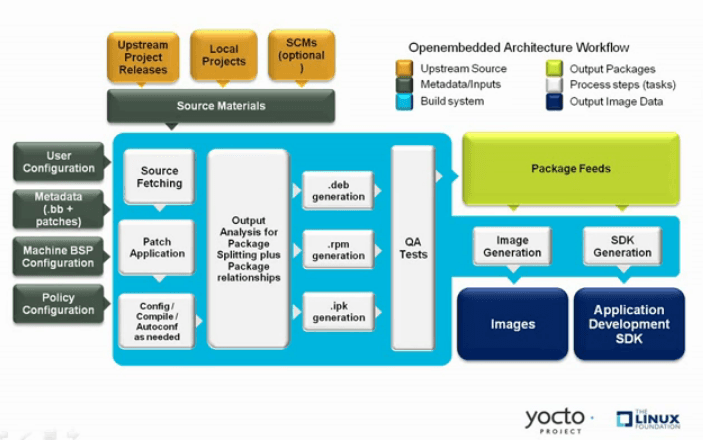
Yocto Project Flow Diagram - Yocto Documentation
Buildroot is a tool designed to create embedded Linux distributions using a Makefile-based approach, emphasizing simplicity and ease of use. To preserve simplicity, its customization capabilities are not as extensive as those of the Yocto Project. For instance, unlike in the Yocto Project, task outputs are not cached. As a result, in some cases, users may be required to wait for all packages to be rebuilt from scratch.
Buildroot Geliştiricileri. The Buildroot User Manual. Accessed April 30, 2025. https://buildroot.org/downloads/manual/manual.html.
Knight, Megan. “Sovereign Tech Fund Boosts Yocto Project.” *The Yocto Project Blog*. October 10, 2023. Accessed May 11, 2025. https://www.yoctoproject.org/blog/2023/10/10/sovereign-tech-fund-boosts-yocto-project/.
Linux Foundation. “How LG Took WebOS from Mobile Phones to TVs in Under a Year.” *Linux Foundation Blog*. April 21, 2014. Accessed May 11, 2025. https://www.linuxfoundation.org/blog/blog/how-lg-took-webos-from-mobile-phones-to-tvs-in-under-a-year.
Linux Foundation. “Introducing the Yocto Project.” *Yocto Project Documentation*. Accessed April 30, 2025. https://docs.yoctoproject.org/overview-manual/yp-intro.html#introducing-the-yocto-project.
Morrison, Scot. “Siemens among industry leaders in commercial grade Linux support for RISC-V.” *Siemens Embedded Software Blog*. December 15, 2022. Accessed May 11, 2025. https://blogs.sw.siemens.com/embedded-software/2022/12/15/siemens-among-industry-leaders-in-commercial-grade-linux-support-for-risc-v/.
OpenEmbedded Projesi. "Layers – Master Branch." *OpenEmbedded Layer Index*. Accessed May 11, 2025. https://layers.openembedded.org/layerindex/branch/master/layers/.
Yocto Project. "Releases." The Yocto Project. Accessed May 11, 2025. https://www.yoctoproject.org/development/releases/.

Yocto Project
First Version | v1.0 (Code Name: Bernard) (March 2011) | ||||||||
|---|---|---|---|---|---|---|---|---|---|
Website(s) | yoctoproject.org | ||||||||
No Discussion Added Yet
Start discussion for "Yocto Project (The Yocto Project)" article
Use Cases
Organizations Using the Project
How It Works
Closest Alternative (Buildroot)