


This article was automatically translated from the original Turkish version.
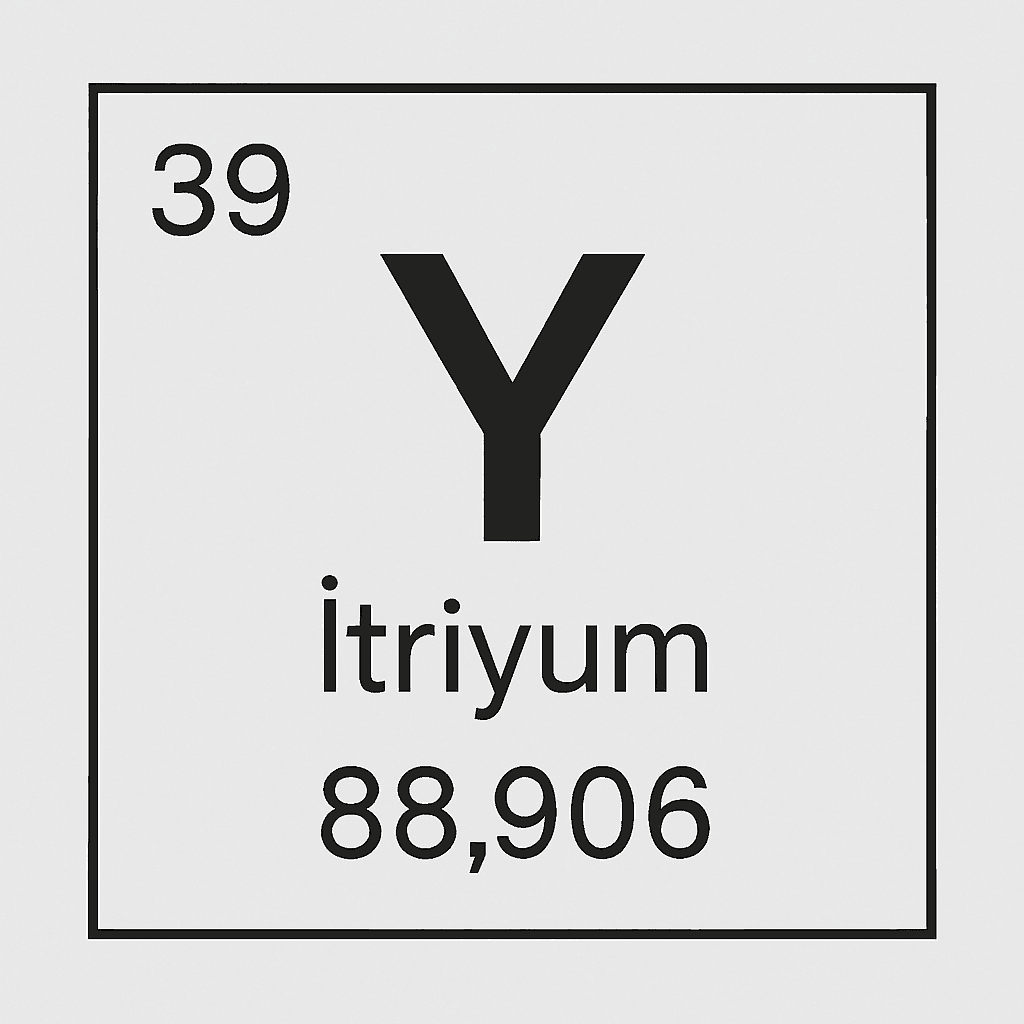
Yttrium (Y) (Generated by artificial intelligence.)
Element Card | Metallic crystal structure: Hexagonal Appearance: Silvery white Natural isotope: Y-89 Electron configuration: [Kr] 4d¹ 5s² Block: d-block Period: 5 Group: 3B Atomic number: 39 | ||||||||
|---|---|---|---|---|---|---|---|---|---|
Oxidation State | +3 | ||||||||
Electronegativity (Pauling) | 1.22 | ||||||||
Melting / Boiling Point | 1526 °C / 3345 °C | ||||||||
Stable Isotope | ^89Y | ||||||||
Common Compounds | YAG (Yttrium Aluminium Garnet) Y₂O₃ (Yttrium oxide) | ||||||||
Applications | Radiotherapy Superconductors LED displays Laser systems Ceramics | ||||||||
Yttrium is a transition metal located in group 3B of the periodic table, exhibiting chemical similarities to the lanthanides and therefore classified among the rare earth elements. It is a silvery-white, bright, and crystalline element that does not occur naturally in its free state; instead, it is commonly found in minerals such as monazite, bastnäsite, and xenotime alongside other rare earth elements. Due to its high-temperature resistance, chemical stability, and optical properties, yttrium has a wide range of applications spanning from ceramics and laser technology to superconductors and medical uses.
Yttrium was discovered in 1794 by the Swedish chemist Johan Gadolin. The discovery resulted from the analysis of a mineral found in the village of Ytterby in Sweden. The element’s name is derived from this village. Gadolin’s discovery marked a pivotal moment in the systematic identification of rare earth elements.

Representative Image of the Yttrium Element (generated by artificial intelligence).
Although yttrium is classified as a transition metal, it is grouped among the rare earth elements due to its chemical similarities with the lanthanides. Its atomic number is 39 and its atomic mass is 88.90584 g/mol. Its electron configuration is [Kr] 4d¹ 5s². The +3 oxidation state is the most stable, and most of its compounds exist in this form. It has a hexagonal crystal structure and exhibits high mechanical strength due to its arrangement of atoms bonded by metallic bonds.
Yttrium is a silvery-white, malleable, and ductile metal. Its melting point is 1526 °C and its boiling point is 3345 °C. Its density is 4.47 g/cm³. When exposed to air, it forms a thin oxide layer on its surface, providing resistance to corrosion. It reacts with acids to release hydrogen gas. At high temperatures, it readily reacts with oxygen to form the compound Y₂O₃.
With a Pauling electronegativity value of approximately 1.22, yttrium is an element with a strong tendency to donate electrons. This low electronegativity enhances its inclination to form ionic compounds. Its reactivity becomes particularly pronounced at high temperatures, as it readily reacts with oxygen, halogens, and water. The Y³⁺ ion is stable in aqueous solutions and plays a significant role in the formation of complex compounds.
The only naturally occurring stable isotope is ^89Y. Numerous radioactive isotopes have been synthesized artificially. Notably, the ^90Y isotope is used in medical applications for targeted radiotherapy. This isotope effectively destroys cancer cells by emitting beta radiation. The production and use of radioisotopes enhance yttrium’s strategic importance in nuclear medicine.
Yttrium does not occur freely in nature; it is found in rare earth minerals alongside other elements. It is extracted through the processing of minerals such as monazite, bastnäsite, and xenotime. Countries with significant deposits of these minerals include China, India, Brazil, and Australia. According to TENMAK data, Türkiye also has reserves containing yttrium. Its most common compound is yttrium oxide (Y₂O₃), which serves as a fundamental material in ceramics, glass, and laser technologies. Additionally, the YAG (Yttrium Aluminium Garnet) compound functions as an optical medium in laser systems.
Yttrium has a hexagonal crystal structure, and its atomic arrangement held together by metallic bonds provides high mechanical strength and workability. This structure ensures stability under high-temperature conditions. The crystal structure enables controlled surface oxidation, forming a protective oxide layer.
Y₂O₃ is preferred in the ceramics and glass industries due to its high-temperature resistance and chemical stability. In laser technology, YAG crystals (Yttrium Aluminium Garnet) serve as optical media. These crystals enable precise energy delivery in medical laser systems. According to TENMAK sources, YAG is also utilized in industrial and military applications.
Yttrium has no known essential biological role in living organisms. However, some of its compounds can exhibit toxic effects. Inhalation or ingestion of yttrium compounds in industrial environments may lead to adverse health impacts. Therefore, appropriate protective measures must be taken during production and use. Although yttrium has low bioaccumulation potential in biological systems, controlling environmental exposure remains important.
Yttrium has a broad range of applications in high-technology fields:
National Center for Biotechnology Information. "Yttrium Compound Page." PubChem Compound Page. Accessed August 22, 2025. https://pubchem.ncbi.nlm.nih.gov/compound/yttrium.
Rombach, Elinor, and Bernd Friedrich. “Chapter 10 - Recycling of Rare Metals.” In *Handbook of Recycling: State-of-the-Art for Practitioners, Analysts, and Scientists*, 125–150. Elsevier, 2014 ScienceDirect. Accessed August 22, 2025. https://www.sciencedirect.com/science/article/abs/pii/B9780123964595000106.
Tübitak Bilim Genç. “İtriyum | Periyodik Tablo.” Bilim Genç. Accessed August 22, 2025. https://bilimgenc.tubitak.gov.tr/periyodik-tablo/itriyum.
Türkiye Energy, Nuclear and Mining Research Organization (TENMAK). "İtriyum (Y)." NATEN. Accessed August 22, 2025. https://naten.tenmak.gov.tr/tr/kullanim-alanlari/11-itriyum-y.html.

Yttrium (Y) (Generated by artificial intelligence.)
Element Card | Metallic crystal structure: Hexagonal Appearance: Silvery white Natural isotope: Y-89 Electron configuration: [Kr] 4d¹ 5s² Block: d-block Period: 5 Group: 3B Atomic number: 39 | ||||||||
|---|---|---|---|---|---|---|---|---|---|
Oxidation State | +3 | ||||||||
Electronegativity (Pauling) | 1.22 | ||||||||
Melting / Boiling Point | 1526 °C / 3345 °C | ||||||||
Stable Isotope | ^89Y | ||||||||
Common Compounds | YAG (Yttrium Aluminium Garnet) Y₂O₃ (Yttrium oxide) | ||||||||
Applications | Radiotherapy Superconductors LED displays Laser systems Ceramics | ||||||||
Discovery
Classification and Fundamental Properties
Physical and Chemical Properties
Electronegativity and Reactivity
Isotopes
Natural Occurrence and Compounds
Crystal Structure and Metallic Properties
Yttrium Oxide (Y₂O₃) and YAG Crystals
Biological Role and Significance to Living Organisms
Applications