
This article was automatically translated from the original Turkish version.
One of the spiritual architects of Anatolia, Yunus Emre continues to speak to humanity as a voice and soulful guide spanning centuries from the past to the present. The concepts of love, tolerance, and humility found in his poetry and verses form the foundational pillars of his worldview. Yunus Emre approaches every person—with whatever religion, sect, language, or race—with equal warmth, delivering universal messages through both his simple language and profound meaning. In this article, we will explore together how Yunus’s teachings illuminate the modern world with the light of his soulful wisdom.
Despite the complex political and social environment of 13th-century Anatolia, Yunus Emre placed love at the very core of his poetry.
“I did not come for controversy; my purpose is love” 【1】
These lines are not merely poetic expressions but a philosophy of life. Yunus Emre advocates a perspective that listens to the voice of the heart rather than the ego. To him, the most precious part of a human being is the love within. This understanding is a rare and urgent reminder in today’s individualistic and polarized societies.
Another recurring theme in Yunus Emre’s verses is humility. His following lines clearly reveal his attitude toward worldly possessions:
“Who is the owner of wealth, who is the owner of property? And who was the first owner of all this?” 【2】
According to Yunus Emre, what gives a person true worth is not what they possess, but the nature of their soul. He emphasizes that it is not the one who sees themselves as superior, but the humble, who is exalted. In today’s era of social media, where the culture of “display” has become widespread, Yunus Emre’s call for humility is a timely counsel we must heed.
The meaning Yunus Emre attaches to the concept of the heart is deeply profound. He says:
“If you have broken a heart, then what you call prayer is not prayer.” 【3】
In this verse, he explains that worship is not merely about ritual form; true worship lies in not breaking hearts or hurting others. Winning a person’s heart is regarded as the greatest act of devotion. In an age when relationships are increasingly digitalized and sincerity is diminishing, Yunus’s advice to “make the heart whole” has become more valuable than ever.
To Yunus Emre, speech is not merely a tool of communication; it is the carrier of goodness, peace, and wisdom. He says:
“Let speech end war, let speech cut off heads.” 【4】
These lines convey the power and responsibility of language. A single word can halt a war, yet it can also cause great destruction. In today’s world, whether in personal relationships or on a societal level, Yunus’s verses remind us that language must be used not to inflict harm but to heal.
According to Yunus Emre, seeing all people and different nations as united is fundamental. He says:
“Whoever does not see the seventy-two nations as one
Though married to the law, is an enemy of truth.” 【5】
These verses declare that those who ignore differences and practice discrimination stand opposed to truth and universal peace. Yunus Emre regards tolerance and unity as essential conditions of being human.
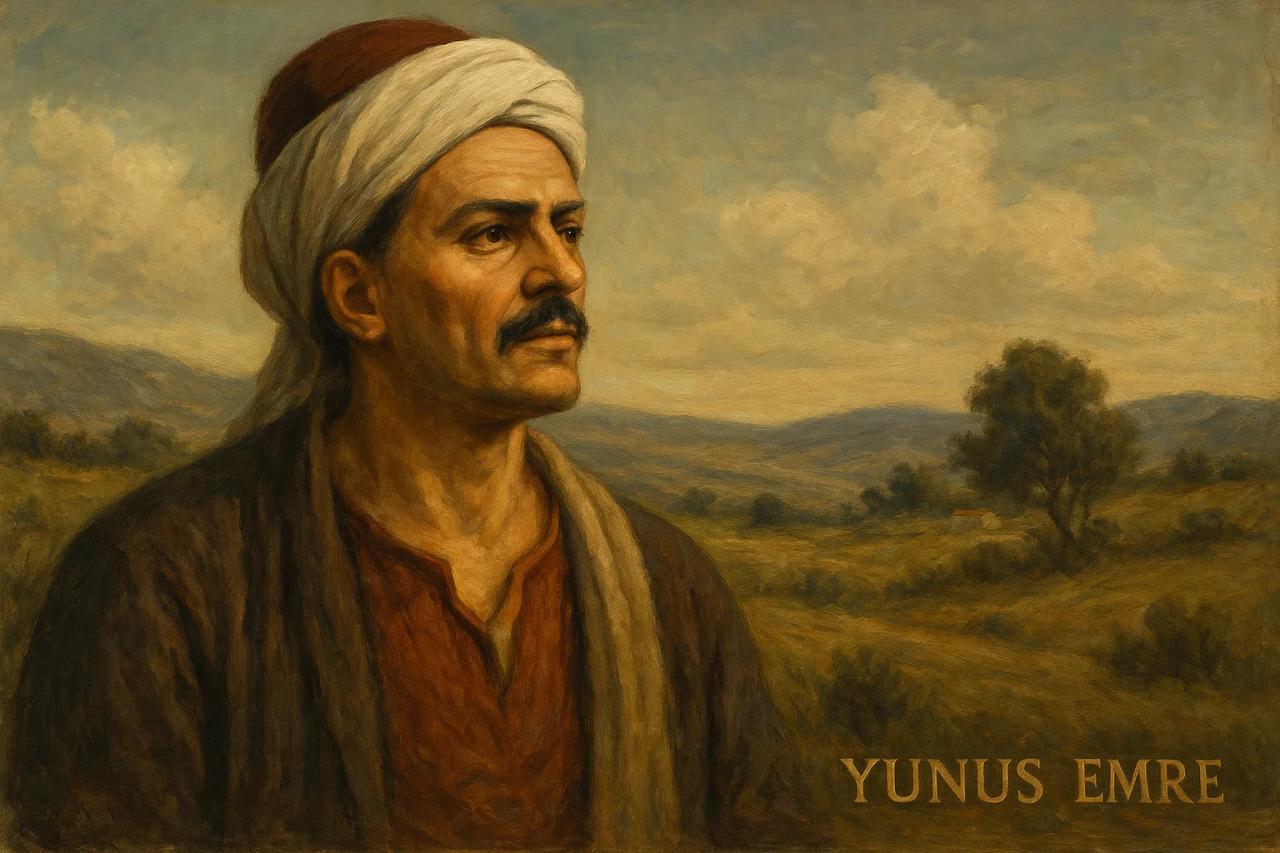
A Visual Representing Yunus Emre (Generated by Artificial Intelligence)
Yunus Emre’s language is simple, yet his messages are profound. Listening to his world of the heart is like pausing in today’s complex relationships to take a breath. Yunus Emre teaches us this: Let love be at our center, avoid breaking hearts, and live with humility. For no value pertaining to humanity ever grows outdated.
Halman, Talât Sait. *A'dan Z'ye Yunus Emre*. İstanbul: İstanbul Büyükşehir Belediyesi Atatürk Kitaplığı Yayınları, 2004. Accessed May 17, 2025. https://ataturkkitapligi.ibb.gov.tr/Content/publications/8/a_dan_z_ye_yunus_emre.pdf.
Tatcı, Mustafa. *Yunus Emre Divanı*. Ankara: Diyanet İşleri Başkanlığı Yayınları, 2021. Accessed May 17, 2025. https://yayin.diyanet.gov.tr/e-kitap/yunus-emre-divani/dr-mustafa-tatci/kultur-sanat-edebiyat/4232.
[1]
Halman, Talât Sait. *A'dan Z'ye Yunus Emre*. Istanbul: Istanbul Metropolitan Municipality Atatürk Library Publications, 2004. Accessed 17 May 2025. https://ataturkkitapligi.ibb.gov.tr/Content/publications/8/a_dan_z_ye_yunus_emre.pdf.
[2]
Halman, Talât Sait. *A'dan Z'ye Yunus Emre*. Istanbul: Istanbul Metropolitan Municipality Atatürk Library Publications, 2004. Accessed 17 May 2025.
[3]
Tatcı, Mustafa. *Yunus Emre Divanı*. Ankara: Diyanet İşleri Başkanlığı Yayınları, 2021. Accessed 17 May 2025.
[4]
Tatcı, Mustafa. *Yunus Emre Divanı*. Ankara: Diyanet İşleri Başkanlığı Yayınları, 2021. Accessed 17 May 2025.
[5]
Halman, Talât Sait. A'dan Z'ye Yunus Emre. Istanbul: Istanbul Metropolitan Municipality Atatürk Library Publications, 2004. Accessed 17 May 2025.
A Worldview Forged by Love
Humility
Making the Heart Whole
The Wisdom and Power of Speech
The Power of Unity
What Does Yunus Emre’s Voice Say to Us Today?
