


+2 More


(Yapay Zeka ile Oluşturulmuştur)
Yusuf Reis, before converting to Islam, was known by his original name John Ward (c. 1553–1622), an English privateer who became an outlaw pirate and ultimately a naval captain under Ottoman protection, active in the Mediterranean at the end of the 16th and beginning of the 17th century. Historical records refer to him by the nicknames "Birdy", "Sharky", and especially "Sparrow".【1】 Although generally regarded in contemporary English literature as "a foe to all Christians" and a "traitor", he was mythologised as a figure of freedom who challenged authority, particularly among the lower classes.
Very little is known about John Ward’s early years, born around 1553 into a poor family in England. It is reported that he spent his youth engaged in fishing and leading an irregular life.【2】
Ward’s first significant step in his maritime career emerged during England’s conflicts with Spain. He gained his initial seafaring experience as a licensed privateer, operating under a letter of marque granted by Queen Elizabeth I to attack Spanish vessels following the defeat of the Spanish Armada.
During this period, he participated in privateering activities sanctioned by Queen Elizabeth I. Under this system, privateers were required to surrender a portion of their plunder to the Crown. While specific details of Ward’s successes during this time are lacking, it is generally accepted that he developed his privateering techniques during these operations.
The licensing of privateering was outlawed in 1603 when King James I ascended the throne and made peace with Spain in 1604. This prohibition marked a turning point in Ward’s life. Dissatisfied with the poor conditions aboard naval vessels, Ward incited thirty sailors to seize a small French merchant bark, owned by a Catholic trader en route from Portsmouth to France. They set sail into open waters, transforming Ward into an outlaw pirate.
Unable to find the expected treasure on their first captured vessel, Ward and his men attacked and captured a French merchant ship in the English Channel, achieving their first major success. Seeking a larger crew, Ward traveled to Cawsand in Cornwall, recruiting smugglers and fishermen into his ranks and setting his sights on the Mediterranean.
During this period, he established contact with other pirates operating along the coasts of Algeria and Morocco, particularly forming alliances with fellow English and Dutch pirates in the port of Salé. However, his decisive transformation occurred upon his arrival in Tunis in 1605.
Ward initially sailed to the famous pirate port of Algiers with his captured ships. However, the Ottoman authorities refused to admit him because another English captain, Richard Gifford, had recently burned Ottoman galleys in the harbor. Consequently, Ward proceeded to the Atlantic port of Salé in Morocco, where he formed alliances with other English and Dutch pirates.
In 1605, Ward settled in Tunis and reached an agreement with the local authorities under Ottoman rule, continuing his operations under their protection. Operating under the patronage of the powerful Osman Bey, Ward surrendered a portion of his plunder to the authorities and used Tunis as his base.
Ward’s fleet gradually expanded; in addition to his ships John Baptist (later renamed Little John) and Gift, he captured numerous English, Dutch, and Venetian vessels, including the 300-ton Rubin, Elizabeth, Charity, Pearl, and Trojan, which transported pepper and cloves from Alexandria to Venice.
In April 1607, he encountered the massive Venetian galleon Reniera e Soderina, carrying silk and cotton from Aleppo and weighing approximately 1400–1500 tons. After a three-hour bombardment, Ward’s gunners fired chain shot at the vessel, causing two Venetian sailors to be torn apart and triggering panic among the crew. Ward then boarded the ship and seized everything.
Structural modifications Ward made to the galleon’s gun deck weakened its hull, and the ship sank during a storm, resulting in the deaths of Ward’s crew of 250 Turks and 150 Englishmen.【3】 This disaster severely damaged Ward’s reputation in Tunis and made him even more dependent on Osman Bey.
In 1607, Sir Anthony Shirley, himself an Englishman and a Christian, wrote to Ward urging him to abandon what he called his "degrading and wicked lifestyle". Shirley advised Ward to join forces with Christian states against the Ottomans rather than serve the Turks and plunder Christian ships for their benefit. Ward responded by declaring that he would prefer to live among the Turks than fall into the hands of the Christians.【4】
Around 1610, Ward formally converted to Islam along with his men and adopted the name Yusuf Reis. Although he had a wife in England, he married again in Tunis.
This transformation was described in contemporary European sources as "turning Turk", carrying both religious and political connotations. Ward’s decision helped secure his safety in the region but also led Europeans to view him as a "traitor" or "apostate".
In English literature, Ward was often portrayed as meeting a tragic end. In reality, he built a luxurious palace in Tunis on land gifted to him by the governor, using marble and limestone. He lived in wealth, employing personal chefs, food tasters, and servants. The Scottish traveler William Lithgow, who visited Tunis in 1615, recorded his encounter with Ward in his work Adventures and Painful Peregrinations:
"Here in Tunis I met with our English Captain Ward, once a great pirate and commander of the seas. Unlike in England, where he was not received, he had become a Turk and built here a magnificent palace adorned with marble and limestone. About fifteen English apostates, circumcised, were with him; their lives and faces appeared equally hopeless and bold. Yet the old Ward was gentle as a gentleman and sent me off with a trustworthy guide for a land journey to Algiers. During the ten days I stayed there, I dined with him several times at noon and evening; yet I remained aboard the French ship."【5】
Thanks to the vast wealth he accumulated through piracy in Tunis, Yusuf Reis lived an exceedingly grand life. He became a local power center, surrounded by a large retinue. However, accounts also describe him as having grown physically weak and having lost his former vigor in later years. Yusuf Reis died in Tunis around 1622.
Yusuf Reis was not merely a historical pirate figure; he also became a significant theme in the literary and cultural productions of his time. His life was addressed, both directly and indirectly, in 17th-century English texts dealing with piracy, identity transformation, religious conversion, and maritime power struggles. This transformed Yusuf Reis from a "real person" into a narrativized character.
"A Christian Turn’d Turk" is an early modern English play written in 1612 by the English writer and clergyman Robert Daborne. The play is a propaganda and moral drama centered on Captain Jack Ward (Yusuf Reis). Its purpose was not to present a historical biography but to demonize apostasy and deliver a moral message to the English audience. Ward is portrayed as a traitor who sells his religion and nation for wealth and lust. Yet, for the poor masses, he is also an incendiary anti-hero who punishes the aristocracy.
The play also reflects the English society’s anxieties regarding the Ottoman Empire and Islam, blending fictional elements with the social, economic, and religious dynamics of the era.【6】
The play centers on Captain John Ward, a Christian pirate, falling in love with Voada, a Muslim woman, and converting to Islam to marry her. In the play, Ward’s conversion is portrayed not as the result of economic or social pressures, but solely as an act of lust and betrayal of his homeland.
Throughout the play, Turkish women, embodied by Voada, are depicted as untrustworthy, immoral, and devoid of integrity. Initially claiming she would burn the world for Ward’s love, Voada immediately after his conversion reveals she hates him and is in love with another man named Fidelio. At the play’s conclusion, Captain Ward dies tragically, consumed by remorse for his conversion, blaming the Turks for his fate.
Although inspired by the historical figure John Ward, the play deliberately distances itself from historical truth.
In early modern English popular culture (cheap pamphlets and poems), Captain John Ward’s actions and conversion to Islam were portrayed as reflections of both social-economic resentment and religious fear.
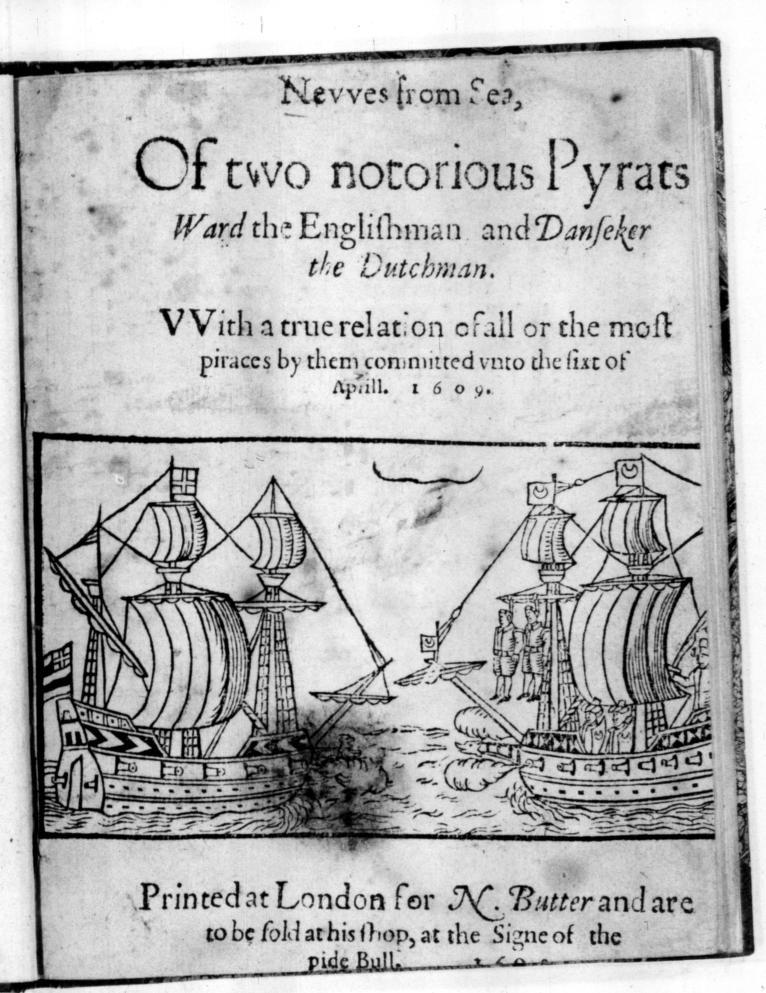
Newes from Sea Cover Page (Internet Archive)
The text generally reflects the anger and hatred of the Christian world toward the Ottomans and seafarers like Ward who converted and joined their ranks ("Turn’d Turke"). Ward’s life is depicted as a constant defiance of Christianity, and he is branded a "notorious thief" who enslaved Christians.
The cover of the pamphlet features a woodcut depicting an execution scene described in the text. On the left is an English-flagged ship; on the right, a Turkish ship bearing crescent flags and men with turbans. Hanging from the masts of both ships are two human figures.
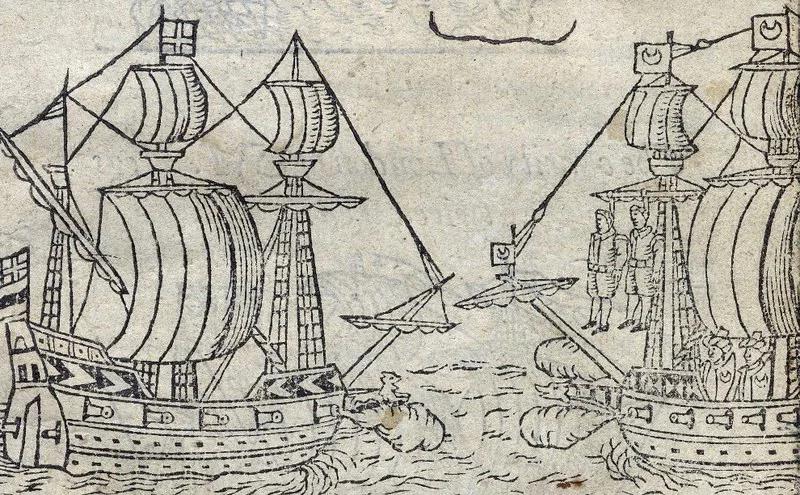
In the Image, Ward and Danseker Are Depicted Hanging from the Masts on the Right Side (Public Domain Review)
In reality, John Ward was never captured by English authorities and lived luxuriously in Tunis. However, in the pamphlet’s preface addressed to readers, the author claims he satisfied public desire to see criminals executed by "hanging them in the sea with black and white ink". In this sense, the image aims not to depict historical reality but to evoke a sense of fictional justice.
The pamphlet functioned as a popular counterpart to King James I’s official royal proclamation of 8 January 1609, issued against pirates—specifically naming John Ward and his associates. While official proclamations addressed crime in a clinical, detached tone focusing on diplomatic, legal, and economic consequences, publications like Newes from Sea satisfied public curiosity by delivering sensational, vivid, and bodily violent details absent from official texts.
Newes from Sea became one of the foundational sources in shaping the pirate image and associated moral and political anxieties in early modern English literature and popular culture. The year the pamphlet was published saw the registration of popular folk ballads "Seamens Song of Captain Ward" and "The Seamans Song of Dansekar", directly derived from its narratives and perspective. Furthermore, the work served as a direct literary source for Robert Daborne’s famous tragedy A Christian turn'd Turke (1612), which treated Ward’s actions and conversion to Islam.
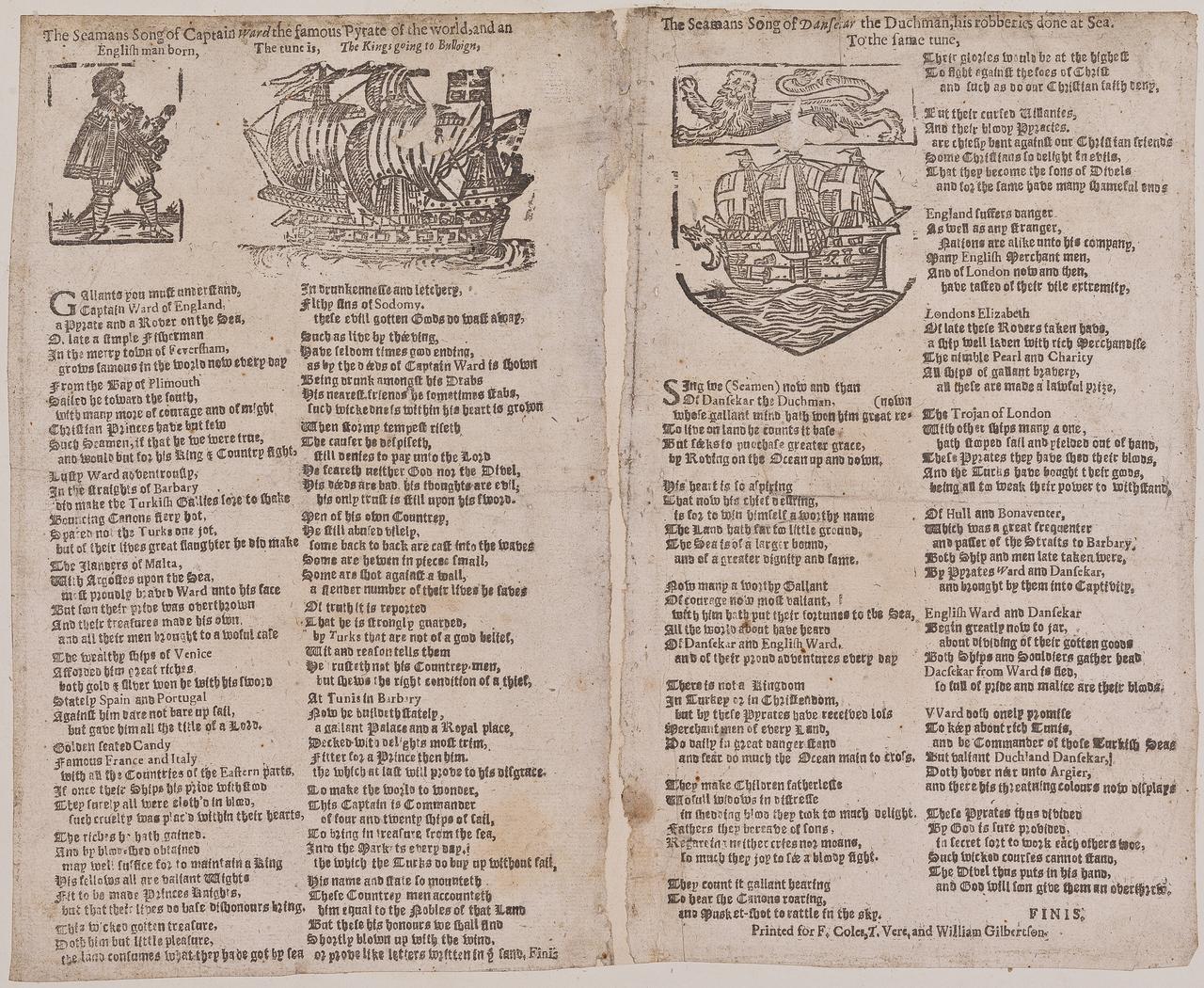
The Kings going to Bulloign Ballad (English Broadside Ballad Archive)
In 17th-century England, where street ballads served as the primary source of news and entertainment for the lower classes, the image of John Ward (Yusuf Reis) was divided between that of an international threat and that of an epic folk hero.
While elite theater and pamphlets branded him a traitor to his homeland, the oppressed English lower classes, through these ballads, elevated him as an legendary "anti-hero" who refused to bow to any master and wrote his own laws.
Estimated to have been composed in the first two decades of the 17th century, the ballad "Captain Ward and the Rainbow" reflects the popular class’s sincere perspective toward Ward and their tendency to view him as a hero, unlike other pamphlets of the era that aimed to deliver moral lessons.【9】The ballad’s plot is built around a confrontation between King James I and Ward. Ward offers the king 30 tons of gold in exchange for a royal pardon (a reference to his 1607 petition for amnesty). King James, rejecting the offer, sends the Rainbow, a ship equipped with 500 sailors and 50 cannons, to capture Ward.【10】
Yet, as described in the ballad, the king’s fleet fails to subdue the "brave Ward". After the battle, Ward openly challenges King James I’s authority, declaring himself the equal of the monarch on land: a "king of the seas". The ballad ends with the king mourning his failure and losses. This glorifying portrayal demonstrates how the public embraced Ward as a figure who built his own power outside institutional authority.

Jack Sparrow (teyit.org)
Today, the most widely known cultural reflection of Yusuf Reis (John Ward) is the popular claim that he directly inspired the iconic main character of the Pirates of the Caribbean film series, Captain Jack Sparrow. This theory, which gained international attention through a 2019 article by writer Giles Milton in BBC History Revealed, focuses on striking similarities between Ward and Sparrow.
Researchers supporting this theory argue that the following core traits of Jack Sparrow were directly drawn from John Ward:
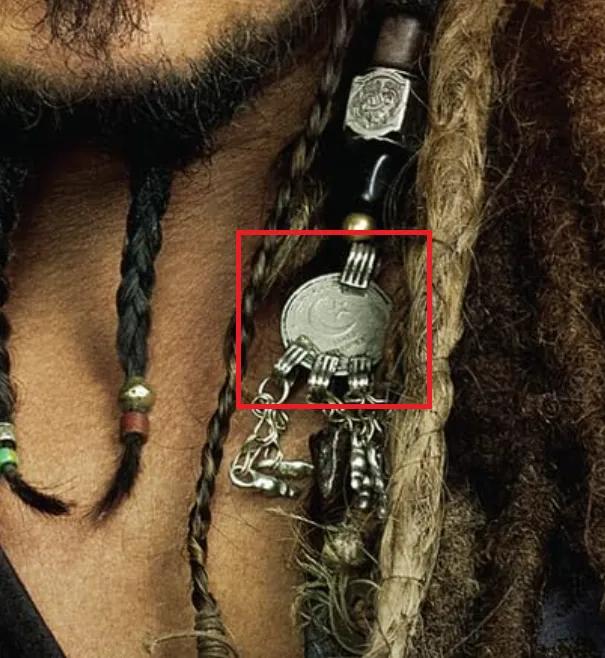
Jack Sparrow’s Earring with the Crescent and Star Motif (teyit.org)
Despite these similarities and popular historical claims, a direct connection has not been substantiated upon objective examination of film history and screenplay development processes. The film’s producers and screenwriters (Ted Elliott, Terry Rossio, and Stuart Beattie) have never mentioned John Ward or Yusuf Reis in their official statements regarding the creation of Jack Sparrow.
The screenwriters have explained that they drew inspiration from a variety of other sources, including general readings on piracy, classic literary works, and cinematic characters. There remains no explicit evidence that Yusuf Reis or John Ward served as direct inspirations for the character.
Aktaş, Adil Batuhan. “Jack Sparrow Türk bir korsandan ilham alınarak mı yaratıldı?” *Teyit*, September 12, 2023. Accessed May 7, 2026. https://teyit.org/analiz/jack-sparrow-turk-bir-korsandan-ilham-alinarak-mi-yaratildi
Cotter, Hayley. “Robbers of the Sea: Piracy in Proclamations and Pamphlets, 1558–1675.” *Journal of Early Modern Studies* 10 (2021): 85–102. Accessed May 7, 2026. https://oajournals.fupress.net/index.php/bsfm-jems/article/download/12541/12109/18045
EBBA 31994. “The Seamans Song of Captain Ward the Famous Pyrate of the World, and an Englishman Born.” University of Glasgow Library - Euing. “The tune is, The Kings Going to Bulloign.” Text transcription. English Broadside Ballad Archive. Accessed May 7, 2026. https://ebba.english.ucsb.edu/ballad/31994/xml
EBBA 31994. “University of Glasgow Library - Euing, Ballad Sheet Facsimile.” English Broadside Ballad Archive. Accessed May 7, 2026. https://ebba.english.ucsb.edu/ballad/31994/image#
EBBA 33731. “A Famous SEA-FIGHT, BETWEEN Captain Ward and the Rainbow.” National Library of Scotland - Crawford. Text transcription. English Broadside Ballad Archive. Accessed May 7, 2026. https://ebba.english.ucsb.edu/ballad/33731/xml
EBBA 33731. “National Library of Scotland - Crawford, Ballad Sheet Facsimile.” English Broadside Ballad Archive. Accessed May 7, 2026. https://ebba.english.ucsb.edu/ballad/33731/image#
Ellinghausen, Laurie. *Pirates, Traitors, and Apostates: Renegade Identities in Early Modern English Writing*. Toronto: University of Toronto Press, 2018. Accessed May 7, 2026. https://dokumen.pub/pirates-traitors-and-apostates-renegade-identities-in-early-modern-english-writing-9781487515782.html
Internet Archive. *Newes from Sea, of Two Notorious Pirates Ward the Englishman and Danseker the Dutchman*. April 1609. Accessed May 7, 2026. https://archive.org/details/bim_early-english-books-1475-1640_newes-from-sea-of-two-n_ward-captain_1609/mode/2up
Milton, Giles. “Pirate John Ward: the Real Captain Jack Sparrow.” *BBC History Revealed*, November 2019. Accessed May 7, 2026. https://www.historyextra.com/period/elizabethan/pirate-john-ward-the-real-captain-jack-sparrow/
Simon, Ed. “Return to Pirate Island.” *JSTOR Daily*, August 4, 2021. Accessed May 7, 2026. https://daily.jstor.org/return-to-pirate-island/
Sisneros, Katie. “Early Modern Memes: The Reuse and Recycling of Woodcuts in 17th-Century English Popular Print.” *The Public Domain Review*, June 6, 2018. Accessed May 7, 2026. https://publicdomainreview.org/essay/early-modern-memes-the-reuse-and-recycling-of-woodcuts-in-17th-century-english-popular-print/#p-3-0
Şahiner, Mustafa, and Güliz Merve Bayraktar. “‘Turned Turk, and Died a Slave’: A New Historicist Reading of Robert Daborne’s *A Christian Turned Turk*.” *Mediterranean Journal of Humanities*, May 15, 2024. Accessed May 7, 2026. https://dergipark.org.tr/en/download/article-file/3823912
Şenlen Güvenç, Sıla. “‘A Foe to All Christians’: The Notorious English Corsair Captain and Ottoman Reis John Ward in Early Seventeenth Century English Literature.” *Çanakkale Araştırmaları Türk Yıllığı*, no. 29 (2020): 35–54. Accessed May 7, 2026. https://dergipark.org.tr/tr/pub/canakkalearastirmalari/article/752221
[1]
Sıla Şenlen Güvenç, "‘A Foe to All Christians’: The Notorious English Corsair Captain and Ottoman Reis John Ward in Early Seventeenth Century English Literature," Çanakkale Araştırmaları Türk Yıllığı, sy. 29 (2020): 37, https://dergipark.org.tr/tr/pub/canakkalearastirmalari/article/752221.
[2]
Giles Milton, "Pirate John Ward: the real Captain Jack Sparrow," BBC History Revealed, November 2019, https://www.historyextra.com/period/elizabethan/pirate-john-ward-the-real-captain-jack-sparrow/.
[3]
Sıla Şenlen Güvenç, "‘A Foe to All Christians’: The Notorious English Corsair Captain and Ottoman Reis John Ward in Early Seventeenth Century English Literature," Çanakkale Araştırmaları Türk Yıllığı, sy. 29 (2020): 44, Erişim tarihi: 7 Mayıs 2026, https://dergipark.org.tr/tr/pub/canakkalearastirmalari/article/752221
[4]
Sıla Şenlen Güvenç, "‘A Foe to All Christians’: The Notorious English Corsair Captain and Ottoman Reis John Ward in Early Seventeenth Century English Literature," Çanakkale Araştırmaları Türk Yıllığı, sy. 29 (2020): 44, Erişim tarihi: 7 Mayıs 2026, https://dergipark.org.tr/tr/pub/canakkalearastirmalari/article/752221
[5]
Sıla Şenlen Güvenç, "‘A Foe to All Christians’: The Notorious English Corsair Captain and Ottoman Reis John Ward in Early Seventeenth Century English Literature," Çanakkale Araştırmaları Türk Yıllığı, sy. 29 (2020): 45, Erişim tarihi: 7 Mayıs 2026, https://dergipark.org.tr/tr/pub/canakkalearastirmalari/article/752221
[6]
Mustafa Şahiner ve Güliz Merve Bayraktar, “'Turned Turk, and died a slave': A New Historicist Reading of Robert Daborne’s A Christian Turned Turk,” Mediterranean Journal of Humanities XIV, no. 1 (2024): 196, Erişim tarihi: 7 Mayıs 2026, https://dergipark.org.tr/en/download/article-file/3823912.
[7]
Mustafa Şahiner ve Güliz Merve Bayraktar, “'Turned Turk, and died a slave': A New Historicist Reading of Robert Daborne’s A Christian Turned Turk,” Mediterranean Journal of Humanities XIV, no. 1 (2024): 197, Erişim tarihi: 7 Mayıs 2026, https://dergipark.org.tr/en/download/article-file/3823912.
[8]
Mustafa Şahiner ve Güliz Merve Bayraktar, “'Turned Turk, and died a slave': A New Historicist Reading of Robert Daborne’s A Christian Turned Turk,” Mediterranean Journal of Humanities XIV, no. 1 (2024): 197, Erişim tarihi: 7 Mayıs 2026, https://dergipark.org.tr/en/download/article-file/3823912.
[9]
Full Text:
Captain Ward and the Rainbow
Strike up you lusty gallants,
With music beat of drum,
For we have got a Rover,
Upon the sea is come:
His name is Captain Ward,
Right well it doth appear,
There has not been such a Rover,
Found out these thousand years.
For he hath sent unto the King,
The sixth of January,
Desiring that he may come in,
With all his company,
And if the King will let me come,
Till I my tale have told,
I will b[e]stow for my ransom,
Full thirty ton of gold.
O nay, O nay, then said the King,
O nay that must not be,
To yield to such a Rover,
Myself will not agree.
He hath deceivd the Frenchmen,
Likewise the King of Spain,
Then how can he be true to me,
Who has been false to twain,
With that the King provided,
A ship of worthy fame,
The Rainbow she is called,
If you would know her name.
And now the gallant Rainbow,
She rolls upon the sea,
Five hundred gallant seamen,
To keep her company,
The Dutchmen and the Spaniards,
She made them for to flee,
Also the bonny Frenchmen,
As she met on the sea.
When as the gallant Rainbow,
Did come where he did lie,
Where is the captain of that ship.
The Rainbow she did cry.
O that am I, says Capt. Ward,
Theres one bids me lie,
And if thou art the Kings fair ship,
Thourt welcome unto me.
Ill tell thee what, said the Rainbow,
Our King is in great grief,
That thou shouldst lie upon the seas,
And play the errant thief.
You will not let our Merchantmen,
Pass as they did before;
Such tidings to our King is come,
Which grieves his heart full fore.
With that this gallant Rainbow,
She shot out of her pride,
Full fifty good brass pieces,
Charged on every side.
And yet these gallant shooters,
Prevailed not a pin,
Tho they were brass on the outside,
Brave Ward was steel within.
Shoot on, Shoot on, said Captain Ward,
Your sport well pleaseth me,
And he that first gives over,
Shall yield unto the sea.
I never wrongd an English ship,
But Turk and King of Spain,
Likewise the blackguard Dutchmen,
Which I met on the main:
If I had known your king,
But two or three days before,
I would have savd Lord Essexs life,
Whose death doth grieve me sore.
Go tell the king of England,
Go tell him this from me,
If he reigns king of all the land,
I will reign king at sea.
With that the gallant Rainbow,
She shot and shot in vain,
Then left the Rovers company,
And home returnd again.
Our royal King of England,
Your ships returnd again,
For Captain Ward he is so strong,
He never will be taen.
Oh! everlasting said the King,
I have lost jewels three,
Which would have gone unto the sea,
And brought proud Ward to me,
The first was Lord Clifford,
Great Earl of Cumberland,
The second was Lord Mountjoy.
As you shall understand.
The third was brave Lord Essex,
From field would never flee;
Who would have gone unto the sea,
And brought proud Ward to me.
English Broadside Ballad Archive (EBBA). "A Famous Sea-Fight, Between Captain Ward and the Rainbow." University of California, Santa Barbara. Erişim tarihi: 7 Mayıs 2026. https://ebba.english.ucsb.edu/ballad/33731/xml
[10]
Sıla Şenlen Güvenç, "‘A Foe to All Christians’: The Notorious English Corsair Captain and Ottoman Reis John Ward in Early Seventeenth Century English Literature," Çanakkale Araştırmaları Türk Yıllığı, sy. 29 (2020): 48, Erişim tarihi: 7 Mayıs 2026, https://dergipark.org.tr/tr/pub/canakkalearastirmalari/article/752221

(Yapay Zeka ile Oluşturulmuştur)
No Discussion Added Yet
Start discussion for "Yusuf Reis (John Ward)" article
Early Life and the Beginning of His Maritime Career
Mutiny and the Start of Outlaw Piracy
North African Period and Ottoman Protection
The Reniera e Soderina Incident
Conversion and Life in Tunis
Literary and Cultural Reflections
"A Christian Turn’d Turk" Play
Plot and Characters
Historical Reality and Fiction
Author’s Purpose and Thematic Function
Brochures and Poems
Cover Image
Fictional Justice
Relation to Royal Proclamations
Cultural and Literary Impact
Ballads
"Captain Ward and the Rainbow" Ballad
Yusuf Reis and the Jack Sparrow Connection