


This article was automatically translated from the original Turkish version.
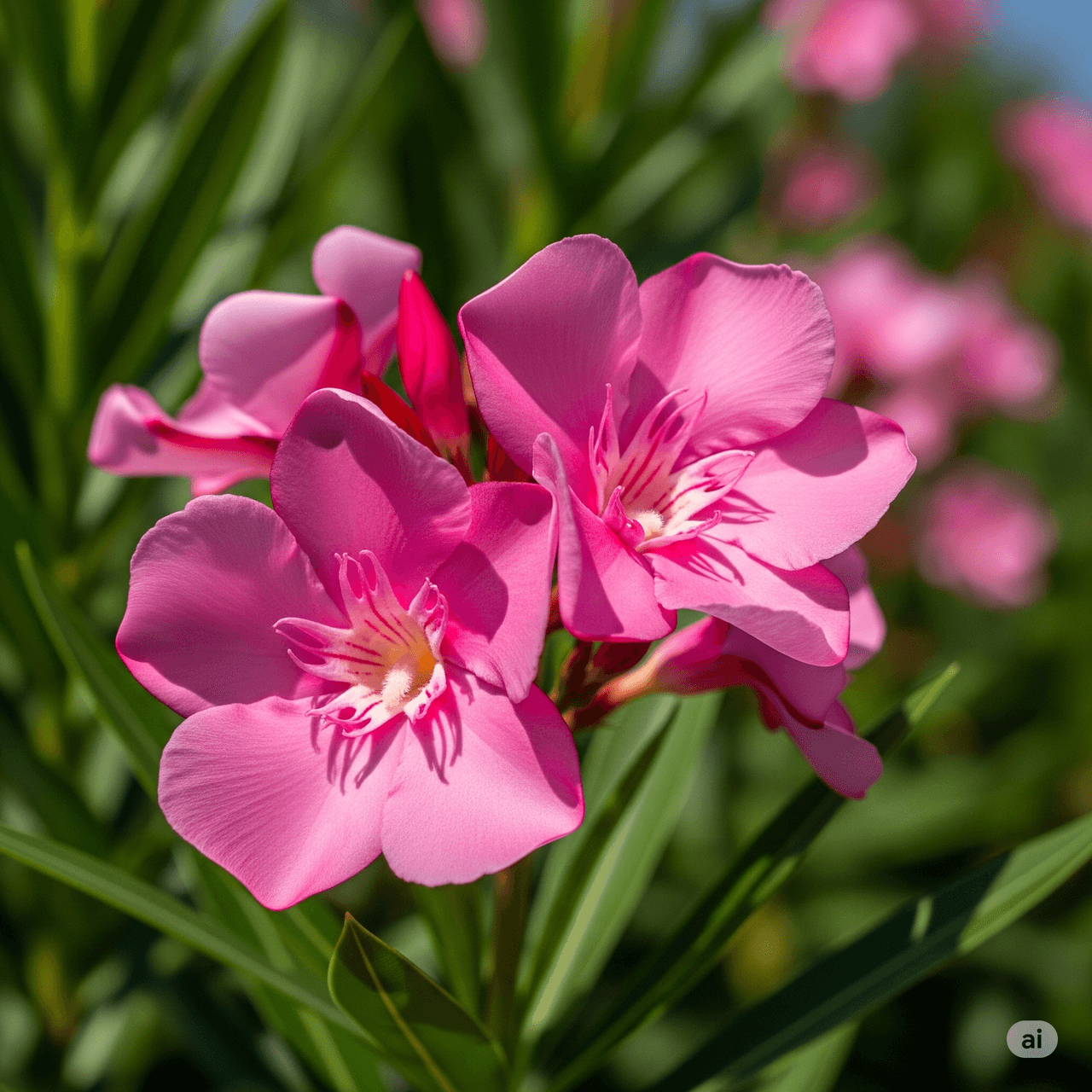
Zakkum (Nerium oleander L.) is an evergreen shrub belonging to the Apocynaceae family. Native to the Mediterranean climate, this plant is widely cultivated as an ornamental species due to its aesthetic appearance and resilience. However, it is a species requiring caution due to its toxic compounds.
Zakkum is a shrub that can grow up to 2 to 6 meters in height, with broadly spreading branches. Its leaves are 10–22 cm long, narrow, pointed at the tip, and have a leathery texture. They typically emerge in groups of three from the stem. The flowers occur in terminal clusters and may be pink, white, or red. These flowers possess microscopic surface sculpturing that increases the surface area of epidermal cells, potentially influencing environmental energy exchange.
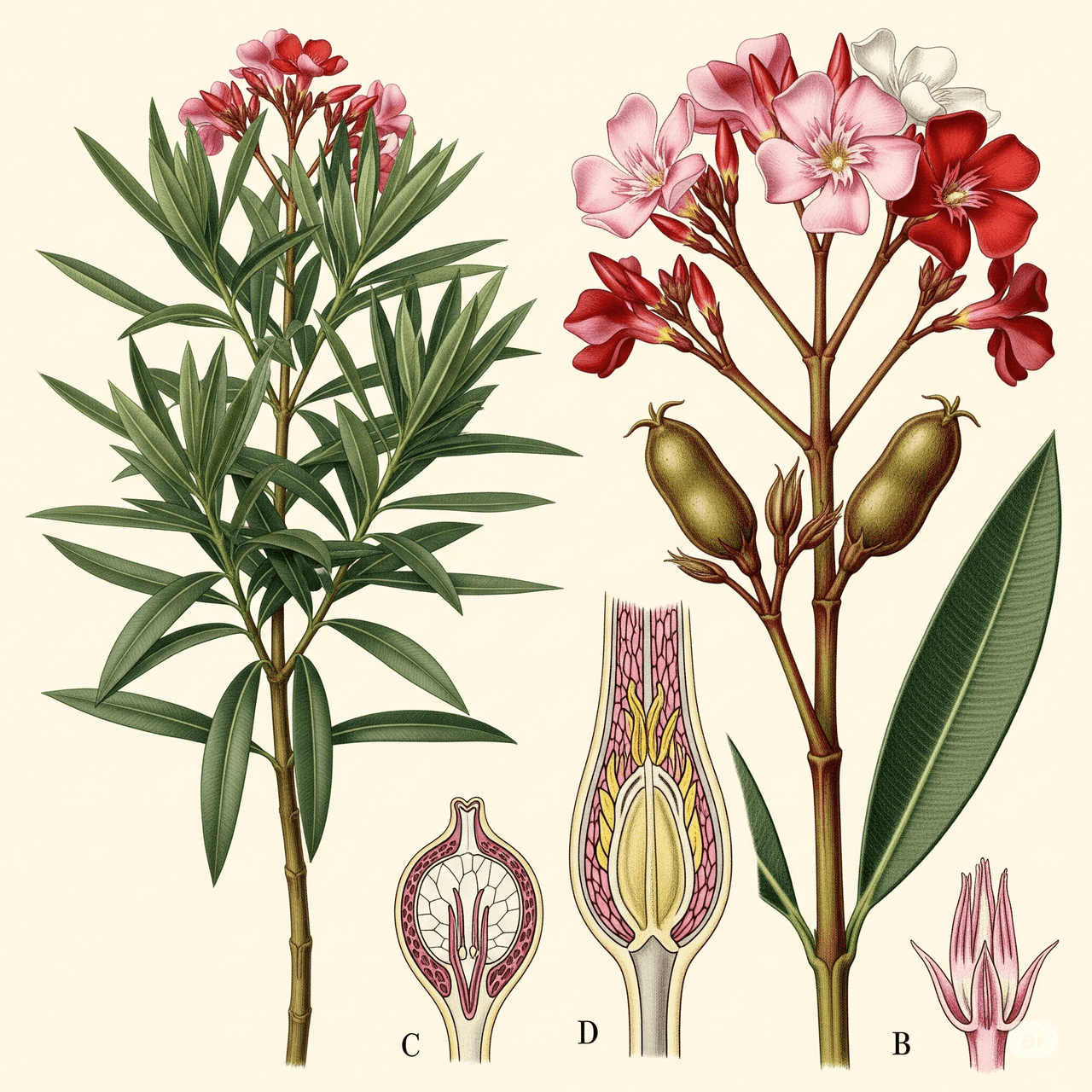
Zakkum Morphological Structure (generated by artificial intelligence)
Zakkum naturally occurs in the Mediterranean region as well as in southern Europe, northern Africa, and southern Asia. Due to its tolerance of drought and salinity, it is commonly preferred as an ornamental plant in urban environments such as roadsides and parks. Additionally, its leaf anatomy enables adaptation to diverse microclimatic conditions, facilitating its wide geographic distribution.
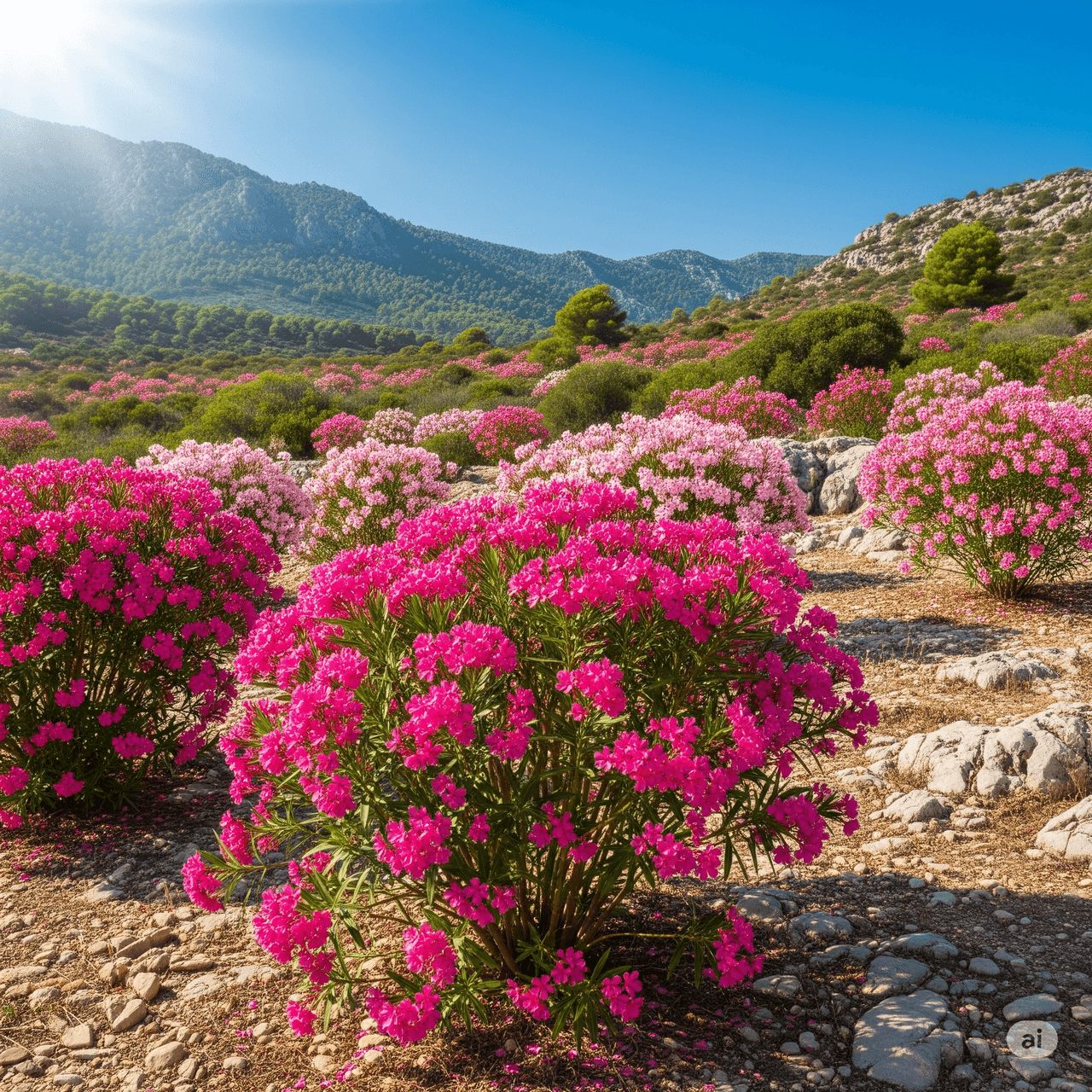
Zakkum (generated by artificial intelligence)
All parts of Zakkum, particularly the leaves and flowers, contain toxic compounds such as cardiac glycosides (e.g., oleandrin and neriin). These compounds exert inotropic effects on cardiac muscle cells by inhibiting the Na⁺/K⁺-ATPase enzyme. Other phytochemicals present in the plant include flavonoids, tannins, saponins, and alkaloids, which have demonstrated antioxidant, antimicrobial, and cytotoxic activities.
The cardiac glycosides in Zakkum can cause severe cardiac and gastrointestinal symptoms when ingested accidentally or intentionally. These symptoms include nausea, vomiting, irregular heartbeat, and even death. Studies on animals have shown that Zakkum induces toxic effects in various organs. Therefore, any medical use of Zakkum must be carefully evaluated.
Zakkum has been used in traditional medicine to treat various ailments. Modern research has indicated that Zakkum extracts may possess anti-inflammatory, analgesic, and anticancer properties. However, further studies are required before these effects can be translated into clinical applications.
Leaf and flower extracts of Zakkum have demonstrated antimicrobial activity against certain bacterial strains. This property is particularly significant in the current era of rising antibiotic resistance, as it highlights potential for developing new antimicrobial agents. Furthermore, certain components of Zakkum have been shown to exert cytotoxic effects on cancer cells, suggesting their potential as anticancer agents.
Argiropoulos, A., and S. Rhizopoulou. “Morphological Features of Petals of *Nerium oleander* L.” *Plant Biosystems* 147, no. 3 (2013): 638–644. Accessed May 24, 2025. https://publicationslist.org/data/sophia.rhizopoulou/ref-153/Plant%20Biosystems%20%20AA%20_%20SR%202013.pdf.
Farooqui, S., and T. Tyagi. “Nerium oleander: It’s Application in Basic and Applied Science: A Review.” International Journal of Pharmacy and Pharmaceutical Sciences 10, no. 3 (2018): 1.0. Accessed May 24, 2025. https://doi.org/10.22159/ijpps.2018v10i3.22505.
Pandey, A., S. Usmani, M. Ahmad, S. Khatoon, S. Wahab, and O. Prakash. “Phytochemical and Pharmacological Attributes of *Nerium oleander*: A Review.” *Current Nutrition & Food Science* 20, no. 5 (2023): 570–585. Accessed May 24, 2025. https://doi.org/10.2174/1573401319666230522160742.
Parashuram, M., et al. “Reproductive Biology Studies in *Nerium* Cultivars (*Nerium oleander* L.).” *International Journal of Current Microbiology and Applied Sciences* 8, no. 7 (2019): 1–10. Accessed May 24, 2025. https://ijcmas.com/8-7-2019/M.%20Parashuram%2C%20et%20al.pdf.

No Discussion Added Yet
Start discussion for "Zakkum (Nerium oleander L.)" article
Morphological Characteristics and Habitat
General Morphology
Habitat and Ecological Adaptations
Chemical Composition and Toxicology
Phytochemical Components
Toxicological Effects
Pharmacological Potential and Applications
Use in Traditional and Modern Medicine
Antimicrobial and Anticancer Activities