


This article was automatically translated from the original Turkish version.
+2 More
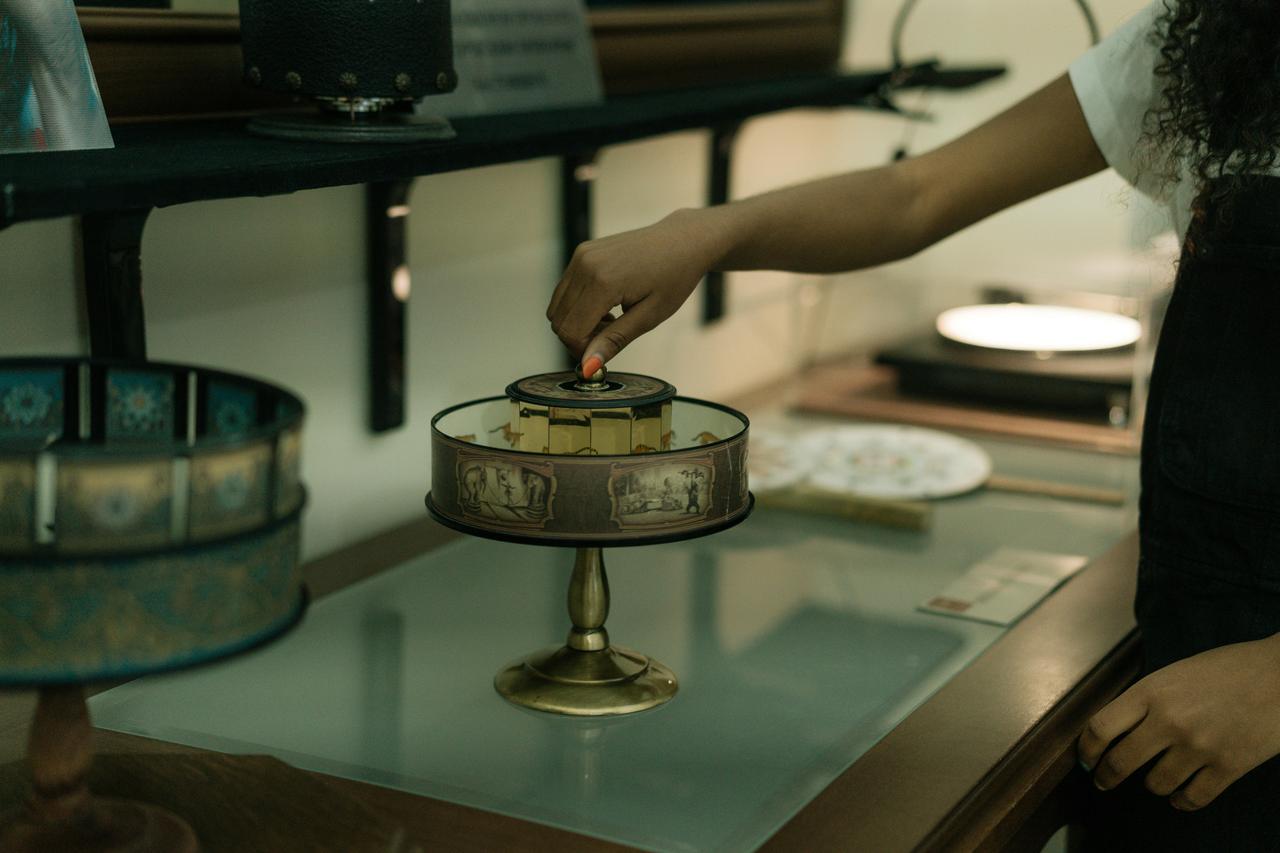
The zoetrope is a device that creates the optical illusion of moving images. It was invented in 1834 by the British mathematician William George Horner. This device enabled the earliest steps in the creation of moving images and made significant contributions to the development of animation and cinema. The zoetrope operates by exploiting the human eye and brain’s ability to perceive a sequence of still images presented rapidly as continuous motion.
The zoetrope typically has a cylindrical structure with a series of sequential images placed along its inner surface. These images represent different stages of a movement. Vertical slits placed around the cylinder’s perimeter serve to create the visual illusion. When the cylinder is rotated, the viewer observes the images as if they are in motion by looking through the slits. The fundamental principle of the zoetrope is based on the human eye’s phenomenon of “persistence of vision.” The human eye perceives transitions between successive images as a single continuous motion. This relies on the principle that an image seen for as little as one eighteenth of a second is retained in the brain and merged with subsequent images. This effect is achieved by the zoetrope’s rapidly spinning cylinder, which combines sequential images and presents the viewer with the impression of motion.
The zoetrope is based on a principle similar to earlier optical toys such as the phenakistiscope, invented by Joseph Plateau in the early 1830s. However, the zoetrope emerged as a more functional and accessible device. While the phenakistiscope could be used by only one person at a time, the zoetrope’s rotating cylinder allowed multiple viewers to observe the moving images simultaneously. The zoetrope was first invented by the British mathematician William George Horner under the name “Doedaleum.” Horner discovered the device’s potential to display moving images through optical illusion. His invention played a critical role in the development of cinema and animation.
The zoetrope laid the foundational principles for early animation and cinema technologies. Although motion picture cameras and photographic devices were developed toward the end of the 19th century, the zoetrope’s ability to display cyclical moving images made important contributions to the evolution of cinematic art. The device operates on a principle similar to “frame-by-frame” presentation and forms the basis of image flow in cinema. The zoetrope enabled the first observation of moving images and thus contributed significantly to the development of cinema.
The zoetrope is also used in education. In modern classrooms, teachers employ it to teach students physical concepts such as rotation, motion, and persistence of vision. By observing the zoetrope, students can learn how moving images are created and better understand its underlying physical principles. The zoetrope serves as a tool that supports abstract learning processes. Students can observe how motion and visual perception function through direct interaction with the device, offering a more visual and experimental learning experience beyond traditional teaching methods. By watching the moving images generated as the zoetrope spins, students learn how the human eye and brain perceive persistence of vision.
The zoetrope has served as an inspiration for modern animation and visual effects technologies. Advances in animation and cinematic technologies are grounded in the principles of visual perception established by the zoetrope. Today, computer-based animation techniques and visual effects rely on the same optical illusion principles that underpinned the zoetrope.
The zoetrope is regarded as one of the earliest examples of animation. It represented a crucial milestone in the development of cinema and animation and had a significant impact on the visual arts. The visual illusions produced by the zoetrope influenced the evolution of cinema and provided the foundation for modern animation techniques. The device remains an important reference for understanding the fundamental principles of cinema and animation.
Zoetrop (YouTube/Damien Monteillard)
IEEE. "Zoetrope Animation Visualization for E-learning." IEEE Xplore Digital Library. Accessed May 13, 2025. https://ieeexplore.ieee.org/abstract/document/9764060
ProQuest Dissertations Publishing. "The Moving Image Before Film: Reinterpreting Pre-Cinematic Optical Devices." ProQuest. Accessed May 13, 2025. https://www.proquest.com/docview/2937178560?pq-origsite=gscholar&fromopenview=true&sourcetype=Dissertations%20&%20Theses
YouTube. "Zoetrope - Animation Optical Toy." Accessed May 13, 2025. https://www.youtube.com/watch?v=_rQrkaExnt4
“1007589-libre.pdf.” Academia.edu. Accessed May 13, 2025. https://d1wqtxts1xzle7.cloudfront.net/102966344/1007589-libre.pdf
“Animasyon Sanatında Stop Motion Tekniklerinin İncelenmesi.” DergiPark. Accessed May 13, 2025. https://dergipark.org.tr/en/download/article-file/4570435
“Canlandırma Sinemasında Anlatı Yapısı ve Gösterim Biçimi Üzerine Bir İnceleme.” DergiPark. Accessed May 13, 2025. https://dergipark.org.tr/en/download/article-file/3651071
“Zoetrope Araması.” Pexels. Accessed May 13, 2025. https://www.pexels.com/tr-tr/arama/zoetrop/

Structural Features and Working Principle of the Zoetrope
Historical Development and Significance
The Zoetrope and the Birth of Cinema
Use in Education and Modern Applications
Connection to Modern Technologies
Cultural and Artistic Significance of the Zoetrope