


Bu içerik Türkçe olarak yazılmış olup yapay zeka ile otomatik olarak İngilizceye çevrilmiştir.
+2 Daha
Afyon Turkish Delight (Afyon Lokumu)
Afyon Lokumu
Type of Geographical İndication | Mahreç Sign | ||||||||
|---|---|---|---|---|---|---|---|---|---|
File Number | C2017/082 | ||||||||
Application Date | 2017-08-07 | ||||||||
Registration Number | 655 | ||||||||
Registration Date | 2021-01-25 | ||||||||
Product / Product Group(s) | Chocolate confectionery and related products | ||||||||
Province(s) | Afyonkarahisar | ||||||||
Applicant/Registrant(s) | Afyonkarahisar Municipality | ||||||||
Status | Registered | ||||||||
Afyon Lokumu is a traditional Turkish sweet with a geographical indication registration, unique to the province of ">Afyonkarahisar in Türkiye. Produced by cooking high-quality starch, sugar, and water, it stands out for its soft texture, intense aroma, and ability to retain freshness for extended periods. Made according to traditional methods, Afyon ">Lokumu is commonly enjoyed in plain, rose-flavored, hazelnut, walnut, or Gaziantep pistachio varieties. It is a traditional Turkish confection officially registered as a geographical indication by the Turkish Patent and Trademark Office.

The geographical boundary of Afyon Lokumu is limited to the province of Afyonkarahisar. The product’s long-standing historical roots, its traditional role in celebrations and hospitality in Afyon, and its location at the intersection of major transportation routes have contributed to its widespread recognition. This association with the region requires that all stages of production occur within the defined geographical boundary.
The history of Afyon Lokumu dates back to the early 1900s. Afyonkarahisar’s central position in Anatolia and its role as a crossroads of trade routes played a key role in spreading this delicacy across broad regions. Candy production, long integrated into the city’s commercial life, has become a craft passed down through generations. Its location at the junction of major transport arteries such as Istanbul-Konya and İzmir-Ankara ensured that travelers became familiar with the product and carried it to other regions.
Afyon Lokumu has also become embedded in the social life of the local community. It is traditionally offered to guests during engagement ceremonies, weddings, holidays, special invitations, and celebrations, forming an integral part of local rituals. As a representative of Turkish culinary culture and a sweet symbol of traditional Turkish hospitality, it is commonly served alongside Turkish coffee to balance its bitterness. The transmission of production knowledge from generation to generation is vital for preserving intangible cultural heritage. This knowledge, conveyed through the master-apprentice relationship, encompasses not only technical skills but also aspects of life philosophy and cultural identity. Geographical indication registration is a crucial step in safeguarding this heritage and ensuring the preservation of traditional production methods and quality standards.

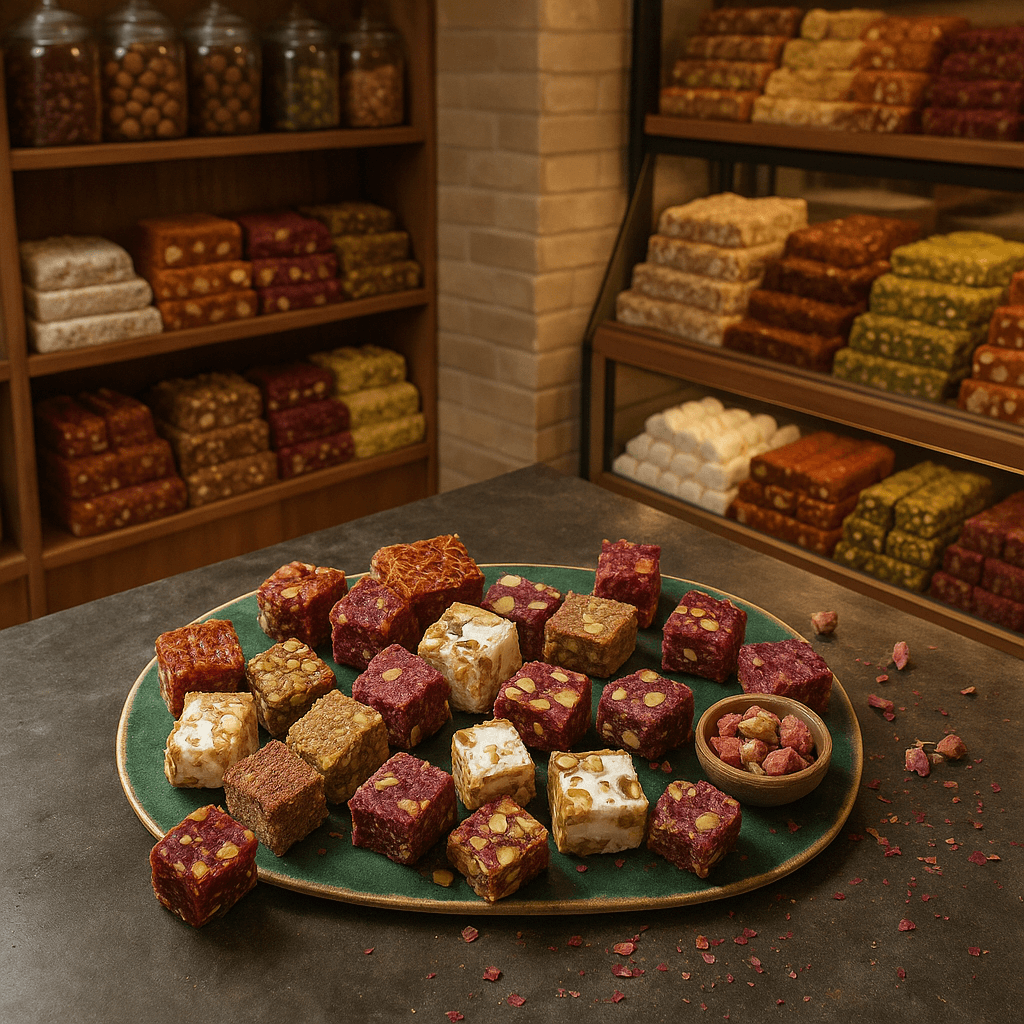
Afyon Lokumu (Generated by Artificial Intelligence)
The most important feature distinguishing Afyon Lokumu from other lokum varieties is the use of region-specific Afyon kaymak and cream sugar. These unique ingredients impart a characteristic creamy texture and distinctive aroma.
White sugar conforming to the Turkish Food Code Sugar Notice, natural corn starch, citric acid, and filler ingredients are used. Derivatives such as glucose or cane sugar are strictly prohibited. Natural corn starch is preferred due to its easy dissolution in cold water, ability to form opaque gels, and high viscosity. Natural corn starch with high amylose content (50–80%) is selected for Afyon Lokumu because it produces white, rapid, and strong gels. Citric acid acts as an auxiliary ingredient to prevent sugar crystallization and facilitate invert sugar formation. Clove extract is preferred for whitening the sugar mass, softening the gel, and creating a spongy, elastic texture through its emulsifying effect; it is used specifically in sultan-type lokum production. Local natural water sources may also influence the flavor of the product.
Afyon Lokumu is produced in four distinct forms: plain/aromatic, sultan-wrapped, wrapped lokum, and flavored lokum/flavored sultan lokum.
It may contain various flavors (plain, rose, gum, orange, lemon, chocolate, etc.) and fillings (shelled walnut, geographical indication-registered Gaziantep pistachio, roasted chickpeas, peanut, hazelnut, coconut, sesame, poppy seeds, fresh or dried fruit candies, coffee, cocoa, etc.).
Afyon Lokumu has a soft yet elastic structure. Although its outer surface may be slightly hardened, the interior must remain soft and moist. It must not exhibit surface cracks, must appear translucent when cut, must not spread or lose its elasticity, and must contain no foreign substances outside the recipe. Its texture must not be “kayışlama”; this term describes a dough that is elastic, feels soft and slippery in the mouth, does not break, and does not stick to the palate.
The production process of Afyon Lokumu is a complex procedure carried out strictly according to traditional methods, requiring specialized skills and regional expertise. Key stages include cooking technique, timing and temperature control, and the sequence of ingredient addition.

Afyon Lokumu (Generated by Artificial Intelligence)
Compliance of Afyon Lokumu with its geographical indication registration is monitored by a three-member inspection body composed of experts from the Afyonkarahisar Municipality, the Afyonkarahisar Provincial Directorate of Agriculture and Forestry, and the Afyonkarahisar Chamber of Tradesmen and Craftsmen, coordinated by the Afyonkarahisar Municipality. Inspections are conducted annually as a routine measure and additionally upon complaint or need. Inspection criteria include the type of sugar and starch used, the use of Afyon kaymak, input ratios in the production method, and the proper use of the geographical indication logo or emblem.
Anadolu Ajansı. “Ramazan Bayramında Ağızları Ekmek Kadayıfı ve Lokum Tatlandıracak.” Accessed May 30, 2025. https://www.aa.com.tr/tr/kultur-sanat/ramazan-bayraminda-agizlari-ekmek-kadayifi-ve-lokum-tatlandiracak/2577077
Ministry of Culture and Tourism of the Republic of Turkey. "Afyon Lokumu." Ministry of Culture and Tourism of the Republic of Turkey. Accessed May 30, 2025. https://www.kulturportali.gov.tr/turkiye/afyonkarahisar/nealinir/afyon-lokumu
Turk Patent and Trademark Office. "Afyon Lokumu." Turk Patent and Trademark Office. Accessed May 30, 2025. https://ci.turkpatent.gov.tr/Files/GeographicalSigns/1027fef7-d02e-4eac-8b69-1117bcc9a9bc.pdf
Türkiye Turizm Ansiklopedisi. "Afyon Lokumu." Türkiye Turizm Ansiklopedisi. Accessed May 30, 2025. https://turkiyeturizmansiklopedisi.com/afyon-lokumu

Afyon Turkish Delight (Afyon Lokumu)
Afyon Lokumu
Type of Geographical İndication | Mahreç Sign | ||||||||
|---|---|---|---|---|---|---|---|---|---|
File Number | C2017/082 | ||||||||
Application Date | 2017-08-07 | ||||||||
Registration Number | 655 | ||||||||
Registration Date | 2021-01-25 | ||||||||
Product / Product Group(s) | Chocolate confectionery and related products | ||||||||
Province(s) | Afyonkarahisar | ||||||||
Applicant/Registrant(s) | Afyonkarahisar Municipality | ||||||||
Status | Registered | ||||||||
Henüz Tartışma Girilmemiştir
"Afyon Lokumu" maddesi için tartışma başlatın
Geographical Boundary and Reputation
Historical and Cultural Significance
Product Definition and Distinctive Characteristics
Production Method
Inspection