
Bu içerik Türkçe olarak yazılmış olup yapay zeka ile otomatik olarak İngilizceye çevrilmiştir.
+1 Daha
Architect(s) | Jean Polak André Polak | ||||||||
|---|---|---|---|---|---|---|---|---|---|
Function(s) | Symbolic City Icon Exhibition Structure | ||||||||
Purpose(s) | Symbol of Science and Technology 1958 Brussels World Fair | ||||||||
Material(s) | Steel Frame Aluminum Cladding | ||||||||
Location | Belgium Brussels | ||||||||
Protection | UNESCO Nomination Belgian Cultural Heritage | ||||||||
Structural Features | 102 m Height Interconnected Tubes 9 Spheres | ||||||||
Engineer | André Waterkeyn | ||||||||
Design Concept | Enlarged Interpretation of the Iron Crystal Atomic Structure | ||||||||
Year of Construction | 1958 | ||||||||
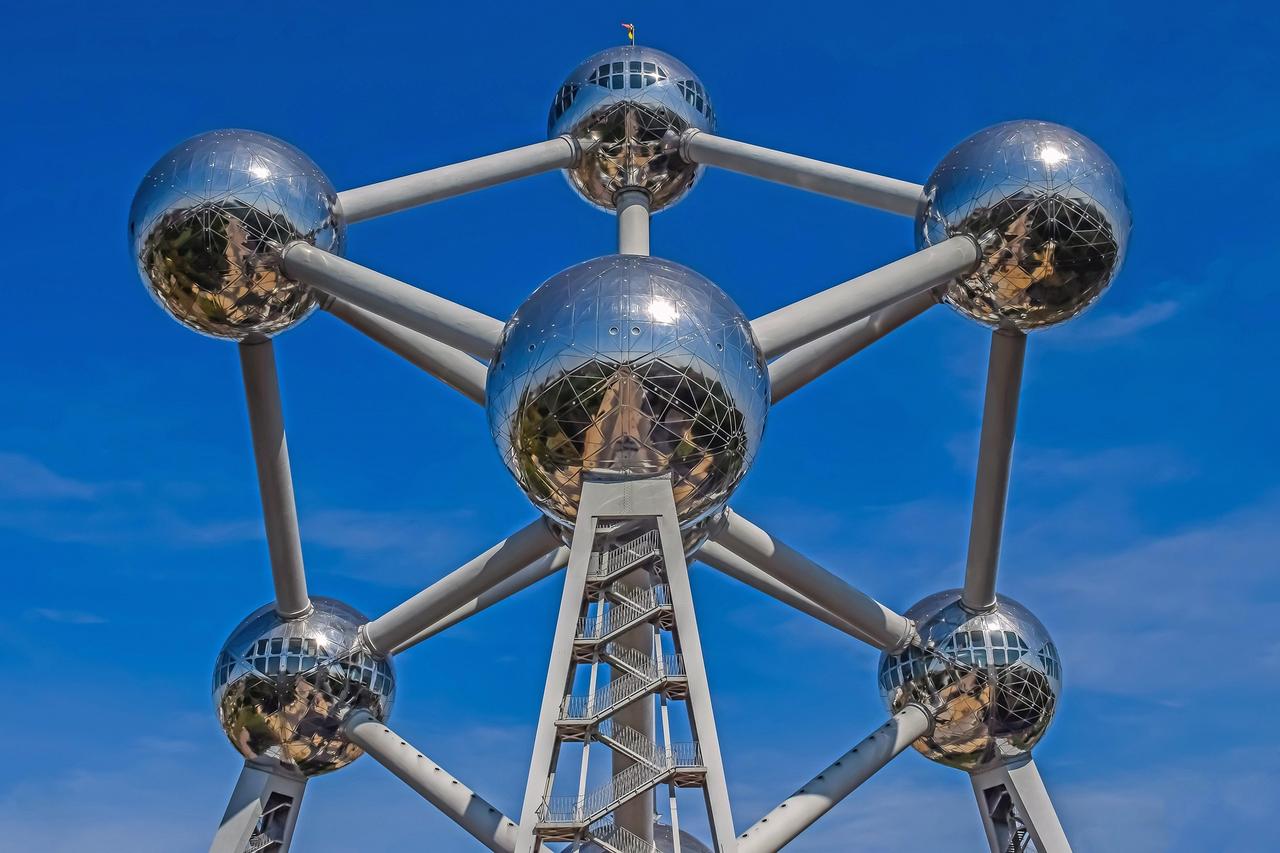
Atomium is a monumental structure located in the city of Brussels, Belgium, constructed as part of the Brussels World’s Fair (Expo 58) in 1958. The structure, designed to represent in enlarged scale the atomic structure of an iron crystal, consists of nine spheres connected by a supporting system of tubes. Although originally conceived as a temporary structure for Expo 58, it was preserved after the fair and gradually acquired functions as an exhibition space, public venue, and tourist attraction, becoming a permanent element of Brussels’ urban fabric. The Atomium is recognized as an architectural example embodying the scientific and technological aspirations of its era and forms part of Expo 58’s physical legacy.

Atomium (Pixabay)
In the early 1950s, Brussels was selected as the host city for the first World’s Fair to be held after World War II, initiating preparations for Expo 58. Belgium, drawing on its experience from previous international fairs, won the right to organize the event, which was conceived around the idea that scientific and technological progress would improve human living conditions. Within this framework, the Atomium was designed as the symbolic centerpiece of the fair, representing Belgium’s industry, particularly its iron and steel production. Its form, based on the atomic arrangement of iron crystals, made Expo 58’s emphasis on science and technology visible at an architectural scale.
Expo 58 took place between April and October 1958 and became one of the most attended international events of its time, with over 41 million visitors.【1】 During the fair, the Atomium served both as a visual focal point and as a venue for displaying scientific content. Although initially intended to be dismantled after the fair due to its temporary nature, its rapid rise in popularity and symbolic value led to the decision to preserve it. Thus, the Atomium became one of the rare structures to survive beyond Expo 58 and emerged as one of the enduring examples of architectural heritage left by world fairs.

Atomium (Pixabay)
The structure developed for the Brussels World’s Fair of 1958 was conceived according to an approach that sought to make scientific and technological progress visible through symbolic architectural expression. This design emerged from the collaboration of architects André and Jean Polak and engineer André Waterkeyn, producing a structure that embodied the technological vision of Expo 58 through the joint effort of architecture and engineering. In this conceptualization, spherical units enlarged from the atomic arrangement of iron crystals, along with connecting elements, were arranged into a cohesive composition. Designed to simultaneously fulfill exhibition and monumental symbolic functions, this architectural arrangement translated Expo 58’s emphasis on industry and technology into spatial form. Although intended as a temporary fair structure, it was designed to create a powerful visual landmark within the fairgrounds.
The load-bearing system comprises a central vertical tube, steel skeletons supporting six lower spheres, connecting tubes linking the spheres, and three peripheral supports that stabilize the structure. The lower spheres and the staircases providing access to them are supported by two-legged structural elements that transfer loads to the ground and accommodate circulation systems. The upper spheres are mounted onto the connecting tubes via metal frames and were not designed for interior use. The overall structural system was designed as an isostatic configuration in accordance with the engineering capabilities of the 1950s, with certain connection elements resolved using movable joints to allow for thermal and structural movement. This system established the fundamental structural framework that enabled the Atomium to function both as an exhibition space and as a monumental structure enduring over time.
The engineering solutions aimed to translate the technological capabilities of the era into a symbolic architectural scale. The structure reaches a height of approximately 102 meters and consists of nine spheres, each with a diameter of about 18 meters; the connections between spheres are made via tubes approximately 23 meters in length.【2】 The primary structural material is steel, and the exterior cladding was originally made of aluminum panels, replaced during the 2004–2006 renovation with stainless steel. Vertical circulation is provided by an elevator system located at the center, moving at a speed of approximately five meters per second; at the time of its opening, this elevator was among the fastest in Europe. The structure is equipped with movable connection details to accommodate wind loads and thermal expansion; tolerances at the sphere-tube junctions were precisely calculated through engineering analysis. During the renovation, energy efficiency was improved, and insulation and climate control systems were upgraded, ensuring the structure met contemporary safety and usability standards.

Atomium Interior Stairs (Pixabay)
The interior spaces are organized in layers and according to functional needs, adapting to the original geometry of the spherical volumes. Each sphere is defined by circular platforms, staircases, and connecting passageways; visitor flow maintains continuity through the tubes linking the spheres. Exhibition areas were designed to convey the themes of science, technology, and Expo 58; displays, panels, and multimedia surfaces were mounted on lightweight structures that avoid damage to the spherical surfaces. The upper spheres offer broader views of the city, while the lower spheres feature informative and narrative-focused arrangements. Natural light was used sparingly in the interior design; artificial lighting was provided through a system compatible with the metal surfaces and designed to control reflections, enhancing spatial perception.
During Expo 58, the structure was organized as a public attraction and served as the symbolic heart of the fairgrounds. The spheres and connecting tubes functioned as circulation spaces enabling visitors to engage with the exhibition narratives; the Atomium became a reference point guiding the movement of international visitors throughout the fair. Beyond its exhibition and representational roles, the Atomium provided a spatial framework that made visible Expo 58’s emphasis on progress, science, and the future; in this sense, it was not merely a physical structure but also a functional space supporting the thematic content of the fair.

Atomium (Pixabay)
The comprehensive renovation carried out between 2004 and 2006 enabled the structure to continue existing as a permanent urban symbol despite its original conception as a temporary fair structure. During this process, the original aluminum cladding was entirely removed and replaced with stainless steel, ensuring both aesthetic continuity and enhanced long-term durability. The interior spaces were reconfigured to meet contemporary requirements for safety, accessibility, and visitor circulation; elevator and moving staircase systems were modernized. Simultaneously, lighting, climate control, and technical infrastructure systems were upgraded to current standards, equipping the structure to sustain its exhibition and public functions without interruption. This renovation established a transformative threshold that preserved the Atomium’s historical identity while adapting it to contemporary cultural and technical needs.
The conservation of the structure has not been limited to preserving its physical integrity; its symbolic and cultural value has also been central to its preservation. The Atomium is regarded as a structure reflecting Belgium’s modernization ideals and the scientific, technological, and progressive ethos of Expo 58; therefore, interventions have consistently adhered to the original design principles as the primary criterion. This approach, extending from material selection to spatial organization, has made the structure’s historical identity visible while safeguarding the layers of meaning it has acquired over time.
The concept of continuity is tied to the understanding of the Atomium as a living structure. Regular maintenance, technical inspections, and controlled updates ensure its compatibility with evolving safety standards and public expectations. Furthermore, this continuity is supported by cultural events, exhibitions, and educational programs, enabling the Atomium to remain not merely a monument of the past but an active participant in contemporary urban and cultural life.

Atomium Night Lights (Pixabay)
Today, the Atomium is one of the most recognizable symbols of Brussels and Belgium, enjoying strong visibility both nationally and internationally. The structure, which welcomes hundreds of thousands of visitors annually, functions not only as a tourist destination but also as an exhibition space, cultural meeting point, and vantage point for experiencing the city’s panorama. The observation deck in the upper sphere allows visitors to perceive different layers of the city, while exhibitions held within the interior spaces continuously reinforce the Atomium’s connection with contemporary culture.
Its current use presents a framework that does not contradict its historical origins but rather illuminates this heritage. Content designed to communicate the symbolic narrative of Expo 58 to today’s visitors transforms the Atomium from a mere representative of the past into a living monument. In this sense, the Atomium remains both a architectural heritage recalling the 20th century’s vision of progress and an active platform for contemporary cultural production and public experience.
Atomium. "Expo 58." Atomium – Discover Expo 58. Accessed February 8, 2026. https://atomium.be/expo58
Atomium. "Home / Index." Atomium – Welcome to the Atomium. Accessed January 8, 2026. https://www.atomium.be/home/Index
Atomium. "Le concept." Atomium – Design Concept. Accessed January 8, 2026. https://atomium.be/design/Concept.html#
Dimitrisvetsikas1969. “Atomium Bina Küre Görseli.” Pixabay. Accessed February 8, 2026. https://pixabay.com/tr/photos/atomium-bina-k%c3%bcre-top-cazibe-6915775/
Gabriels, Bjorn. “Hand in Hand? Documentary Film and the Paradox of a Belgo-Congolese Union at Expo 58.” *Studies on National Movements* 12, no. 1 (2023): 42-70. Accessed February 8, 2026. https://www.researchgate.net/publication/378346498_Hand_in_hand_Documentary_film_and_the_paradox_of_a_Belgo-Congolese_union_at_Expo_58
Nys, Charlotte. “The Atomium of Brussels – ‘Irreparably Improved’?” *ICOMOS – Hefte des Deutschen Nationalkomitees*, Bd. 73 (2020): 59-62. Accessed February 8, 2026. https://journals.ub.uni-heidelberg.de/index.php/icomoshefte/article/view/75097
Polat, Bengi, and Senem Tezcan. “Bir Expo Mirası Olarak Mimarlığın Kentler Üzerindeki Etkileri.” *Yüzüncü Yıl Üniversitesi Sosyal Bilimler Enstitüsü Dergisi* 62 (2023): 111–127. Accessed February 8, 2026. https://dergipark.org.tr/tr/pub/yyusbed/article/1338600
Unknown artist. "Atomium Brüksel Belgium Image." Pixabay. Accessed February 8, 2026. https://pixabay.com/tr/photos/atomium-br%c3%bcksel-bel%c3%a7ika-mimari-6566391/
Unknown artist. "Belçika Brüksel Atomium Görseli." Pixabay. Accessed February 8, 2026. https://pixabay.com/tr/photos/bel%c3%a7ika-br%c3%bcksel-atomium-ak%c5%9fam-1540141/
Unknown author. "Atomium BrükselPark Görseli." Pixabay. Accessed February 8, 2026. https://pixabay.com/tr/photos/atomium-br%c3%bcksel-park-d%c3%b6n%c3%bcm-noktas%c4%b1-6826004/
Unknown author. "Atomium Dönüm Point Brussels Image." Pixabay. Accessed February 8, 2026. https://pixabay.com/tr/photos/atomium-d%c3%b6n%c3%bcm-noktas%c4%b1-br%c3%bcksel-6826001/
Waldomiguez. “Belçika Brüksel Atomium Görseli.” Pixabay. Accessed February 8, 2026. https://pixabay.com/tr/photos/bel%c3%a7ika-br%c3%bcksel-atomium-1138448/
Walkerssk. "Brüksel Atom Atomyum Görseli." Pixabay. Accessed February 8, 2026. https://pixabay.com/tr/photos/br%c3%bcksel-atom-atomyum-950651/
[1]
Atomium, “Expo 58,” Atomium – Discover Expo 58, Last Access: 8 February 2026, https://atomium.be/expo58
[2]
Charlotte Nys, “The Atomium of Brussels – ‘Irreparably Improved’?,” ICOMOS – Hefte des Deutschen Nationalkomitees 73 (2020): 59, Last Access: 8 February 2026, https://journals.ub.uni-heidelberg.de/index.php/icomoshefte/article/view/75097

Architect(s) | Jean Polak André Polak | ||||||||
|---|---|---|---|---|---|---|---|---|---|
Function(s) | Symbolic City Icon Exhibition Structure | ||||||||
Purpose(s) | Symbol of Science and Technology 1958 Brussels World Fair | ||||||||
Material(s) | Steel Frame Aluminum Cladding | ||||||||
Location | Belgium Brussels | ||||||||
Protection | UNESCO Nomination Belgian Cultural Heritage | ||||||||
Structural Features | 102 m Height Interconnected Tubes 9 Spheres | ||||||||
Engineer | André Waterkeyn | ||||||||
Design Concept | Enlarged Interpretation of the Iron Crystal Atomic Structure | ||||||||
Year of Construction | 1958 | ||||||||
Henüz Tartışma Girilmemiştir
"Atomium" maddesi için tartışma başlatın
Historical Development
Architectural Design
Structural System
Engineering Features
Interior Layout
Functional Uses
Renovation Process
Conservation and Continuity
The Atomium Today