
Bu içerik Türkçe olarak yazılmış olup yapay zeka ile otomatik olarak İngilizceye çevrilmiştir.
Also known as the Bogside Massacre, Bloody Sunday (Irish: Domhnach na Fola) occurred on 30 January 1972 in the Bogside neighborhood of Derry, a city in Northern Ireland, which was then part of the United Kingdom. The area had a predominantly Catholic population. During a peaceful civil rights march, soldiers from the British Army’s Parachute Regiment opened fire on unarmed demonstrators and bystanders, resulting in the deaths of a total of 14 civilians. Thirteen people were killed on the day of the incident; one man died months later from his injuries and is recognized as the fourteenth victim.
From the late 1960s onward, Northern Ireland’s Catholic population reported systematic discrimination in housing, employment, and political representation. This situation gave rise to a nonviolent civil rights movement. The British government’s introduction of internment without trial during this period further intensified social tensions. Despite bans on protests and marches, the Northern Ireland Civil Rights Association organized a large-scale demonstration in Derry on 30 January 1972 to protest internment and discrimination.
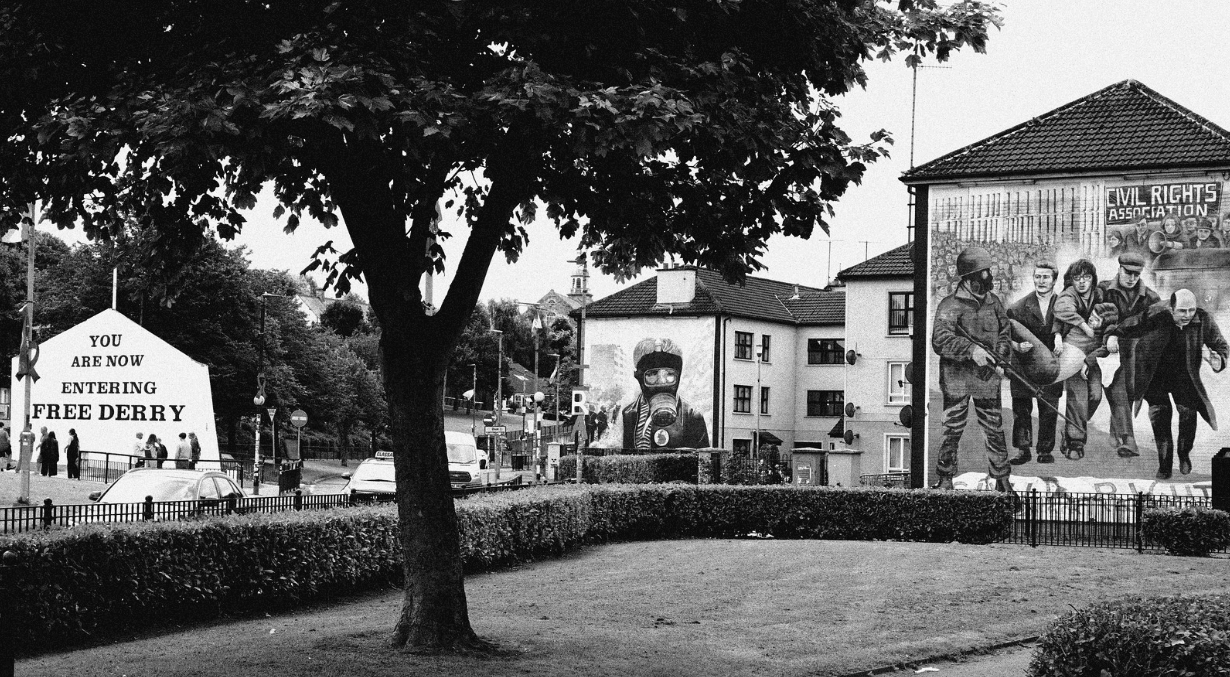
The civil rights march, attended by approximately 15,000 people, began in the Creggan area on the morning of 30 January 1972. The demonstrators intended to march toward the city center but were blocked by British Army barricades, effectively halting their planned route. As a result, the crowd moved toward the Bogside neighborhood, gathering at the area known as “Free Derry Corner” (Free Derry Corner).

British Army Facing Protesters (Flicker)
At this stage, intervention was carried out by the British Parachute Regiment. After soldiers advanced into the crowd with the aim of arresting some demonstrators, they quickly opened fire with live ammunition. According to findings from the Saville Inquiry, the soldiers gave no warning before firing. During this approximately ten-minute military operation, thirteen civilians were shot dead at the scene.
All those killed in Bloody Sunday were unarmed civilians. Later investigations found that a significant number of victims were shot in the back as they fled. The ages of the deceased ranged from 17 to 41, and six of them were 17 years old.
John Johnston, who was seriously wounded on the day of the event, died in hospital several months later from his injuries, bringing the total death toll from Bloody Sunday to 14. The names of the civilians killed are: John Duddy, Patrick Doherty, Gerald Donaghey, Hugh Gilmour, Michael Kelly, Kevin McElhinney, John Young, Michael McDaid, William Nash, James Wray, Gerald McKinney, William McKinney, Bernard McGuigan and John Johnston.

The Civilian Victims (Anadolu Agency)
Immediately after Bloody Sunday, British official authorities claimed that soldiers had fired in self-defense. The Widgery Report, prepared and published later that year, adopted this stance and largely exonerated the British Army soldiers. The report suggested that some of the deceased might have been armed and implied that the soldiers’ use of force could have been justified under the circumstances.
The Widgery Report was strongly rejected by the victims’ families. They argued that the report excluded the testimonies of civilian witnesses, interpreted evidence in a biased manner, and obscured the material reality of the events. As a result, for many years the Widgery Report was widely regarded by the public and especially by the victims’ families as a document of “whitewashing” and became the primary obstacle to achieving justice for Bloody Sunday.
In response to mounting criticism of the Widgery Report and sustained demands for justice over the years, a second and far more comprehensive investigation was launched in 1998. Known as the Saville Inquiry, this process lasted twelve years and was completed in 2010.
The Saville Report clearly established that none of the civilians killed on Bloody Sunday posed any threat to British soldiers, that all victims were unarmed, and that soldiers opened fire without issuing any warning. The report also noted that some soldiers had given false testimony during earlier investigations. These findings invalidated the core claims of the Widgery Report and fundamentally altered the official narrative of the events.

A Group of Civilians Carrying the Body of Jack Duddy. (Flicker)
Following the publication of the Saville Report in 2010, then Prime Minister of the United Kingdom David Cameron delivered a speech in the House of Commons on 15 June 2010. Cameron stated that the findings of the report were clear and unequivocal, declared that what had occurred on Bloody Sunday was “unjustified and unjustifiable”, and offered an official apology on behalf of the British state to the victims’ families. In this address, the state acknowledged that its forces had acted wrongly and affirmed that the government bore ultimate responsibility for what had happened.
With this official acknowledgment, the unarmed and innocent status of the civilians killed on Bloody Sunday was formally confirmed at the state level, and the victims’ names were publicly vindicated. However, this apology and acceptance of responsibility did not lead to any criminal prosecutions.
Following the publication of the Saville Report, legal actions were initiated against soldiers identified as involved in the events. Eighteen soldiers were named in complaint files, but only one soldier, referred to by the code name “Soldier F”, was charged with prosecution. Soldier F was accused of murdering James Wray and William McKinney and attempting to kill four others.
After years of legal proceedings and debates over the admissibility of evidence, the trial concluded on 23 October 2025. The court acquitted Soldier F on all charges. As a result, no soldier or official has ever been sentenced to imprisonment in connection with Bloody Sunday.
Bloody Sunday is regarded as one of the most significant events during the approximately thirty-year conflict in Northern Ireland known as “The Troubles.” The incident had a decisive impact on the development of the civil rights movement, state-society relations, and the dynamics of conflict. Political and social developments in the region following the event reinforced its central position in Northern Irish history.
The events left lasting scars on relations between the United Kingdom administration and the Catholic community in Northern Ireland, as well as on the overall security environment of the region. In this sense, Bloody Sunday has become one of the fundamental reference points in Northern Ireland’s historical narrative.
In the city of Derry, particularly in the Bogside neighborhood, various monuments and memorial sites have been established to honor the civilians killed in the event. Annual commemorative marches and ceremonies held on 30 January keep the memory of the incident alive, ensuring that the names of the victims and the events of that day remain part of the collective social memory.
What Happened on Bloody Sunday 1972? (On Demand News)
AA (Anadolu Ajansı). "Hurt from Northern Ireland's Bloody Sunday Runs Deep." [Photo Gallery]. January 30, 2022. https://www.aa.com.tr/en/pg/photo-gallery/northern-ireland-remembers-bloody-sunday-on-35th-anniversary
AA (Anadolu Ajansı). "Kuzey İrlanda'da Kanlı Pazar'ın Acısı Hala Taze." January 30, 2022. https://www.aa.com.tr/tr/dunya/kuzey-irlandada-kanli-pazarin-acisi-hala-taze-/2489173
Amara. "Bloody Sunday - Jan 30 1972." Flickr, October 21, 2010. https://www.flickr.com/photos/toomuchrock4onehand/5102166873/
BBC News Türkçe. "Kanlı Pazar'ın 50. yıldönümü: Kuzey İrlanda'nın Derry Kentinde Neler Yaşanmıştı?" January 30, 2022. https://www.bbc.com/turkce/haberler-dunya-60168442
BBC News Türkçe. "Kuzey İrlanda: Kanlı Pazar'a 40 Yıl Sonra Soruşturma." December 20, 2012. https://www.bbc.com/turkce/haberler/2012/12/121220_bloodysunday
Bianet. "İngiltere Kanlı Pazar İçin 38 Yıl Sonra Özür Diledi." Accessed June 16, 2010. https://bianet.org/haber/ingiltere-kanli-pazar-icin-38-yil-sonra-ozur-diledi-122767
Brady, Adrian. "BLOODY SUNDAY- 38YEARS LATER THE BRITISH STATE FINALLY ADMIT TO MASS MURDER." Flickr. Accessed January 12, 2026. https://www.flickr.com/photos/furiobrady/4705457911/
On Demand News. "Bloody Sunday 1972: The Day's Events Explained." YouTube, 3:23. March 14, 2019. https://www.youtube.com/watch?v=CquBS2hnLNI
Ziller, Markus. "[1972] Bloody Sunday January 30 1972 The British Army faces off against protesters in Derry Northern Ireland." Flickr, September 23, 2015. https://www.flickr.com/photos/markusziller/21472195710/
pix-4-2-day. "Derry, Northern Ireland." Flickr. Accessed January 12, 2026. https://www.flickr.com/photos/pix-4-2-day/54793821290/
Özgüden, Doğan. "51 Yıl Önce Bugün Günlerden Pazardı: Kanlı Pazar." Academia.edu. 2020. Accessed January 12, 2026. https://www.academia.edu/41984433/51_y%C4%B1l_%C3%B6nce_bug%C3%BCn_g%C3%BCnlerden_pazard%C4%B1_Kanl%C4%B1_Pazar
Henüz Tartışma Girilmemiştir
"Bloody Sunday (Bogside Massacre)" maddesi için tartışma başlatın
Before the Event: Social and Political Context
The Day of the Event: 30 January 1972
The Victims
Initial Reactions and the Widgery Report
The Saville Inquiry
United Kingdom’s Acknowledgment of Guilt and Official Apology
Legal Proceedings and Impunity
Impact on Northern Irish History
Commemoration and Memory Sites