


Bu içerik Türkçe olarak yazılmış olup yapay zeka ile otomatik olarak İngilizceye çevrilmiştir.
Scientific Name(s) | Caretta caretta | ||||||||
|---|---|---|---|---|---|---|---|---|---|
Common Name | Loggerhead Sea Turtle | ||||||||
Family | Cheloniidae | ||||||||
Distribution(s) | Mediterranean Sea Pacific and Indian Oceans Atlantic | ||||||||
Habitat | sandy beaches open seas Coastal waters | ||||||||
Diet(s) | marine plants jellyfish crustaceans mollusks Omnivorous | ||||||||
Reproduction(s) | Every 2–3 years 100–120 eggs per nest 3–5 nests per season | ||||||||
Conservation Status | Endangered (IUCN) | ||||||||
Major Threats | climate change fishing activities marine pollution Habitat loss | ||||||||
Caretta caretta is one of the large sea turtle species belonging to the family Cheloniidae. This species is widely distributed in tropical and subtropical seas, particularly observed in the Mediterranean, Atlantic, Indian, and Pacific Oceans. The Mediterranean coasts of Türkiye, especially Dalyan, Belek, and Patara, are among the important nesting areas for this species. Classified as "Endangered" by the International Union for Conservation of Nature (IUCN), Caretta caretta plays a vital role in marine ecosystems.
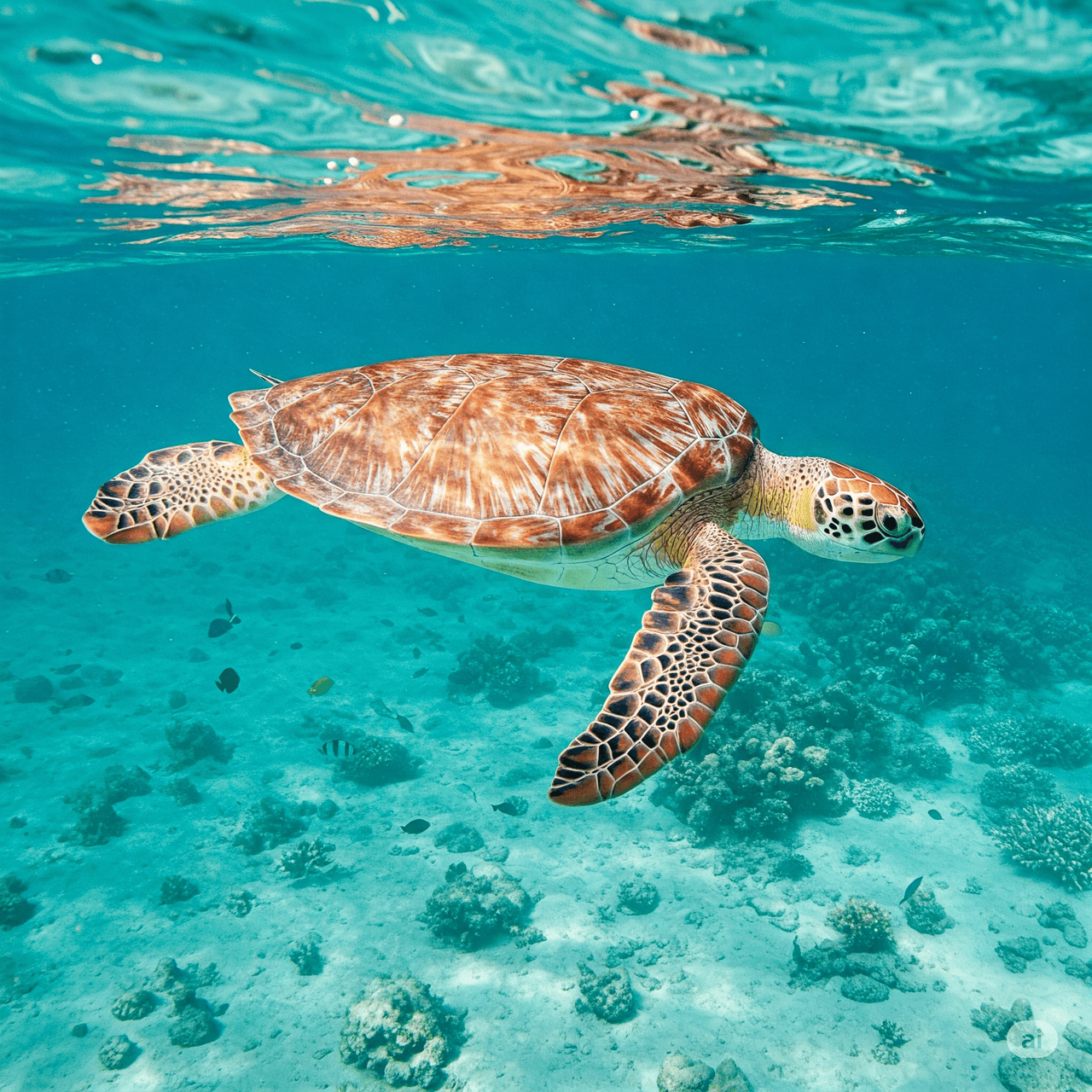
Caretta caretta is recognized by its large head and powerful jaws. Adults typically measure 70–95 cm in length and weigh between 70–170 kg. The carapace (upper shell) is thick and heart-shaped, ranging in color from reddish-brown to yellowish-brown. The plastron (lower shell) is usually pale yellow. The front flippers are paddle-shaped, enhancing swimming ability. This species lacks external morphological features for sex determination; sex identification generally requires examination of internal organs.

Caretta Caretta (Generated by Artificial Intelligence)
Caretta caretta typically inhabits shallow coastal waters but can also be found in open seas. Hatchlings spend several years in pelagic (open ocean) zones after entering the sea. Adults primarily feed in coastal areas and return to their natal beaches during nesting seasons. The Mediterranean is one of the most important nesting regions for this species; in particular, the coasts of Greece, Türkiye and Cyprus are known as dense nesting areas.
Caretta caretta has an omnivorous diet, consuming mollusks, crustaceans, jellyfish and marine plants. Its strong jaws allow it to easily crush hard-shelled organisms. Feeding habits may vary depending on the region and available food resources.
Caretta caretta reaches sexual maturity between 17 and 33 years of age. Females nest every two to three years and may lay eggs three to five times in a single season. Each nest contains an average of 100–120 eggs. Eggs are buried at a depth of approximately 40–60 cm in sand, with incubation lasting between 45 and 70 days depending on temperature. Sex determination is temperature-dependent; higher temperatures favor female hatchlings while lower temperatures promote male development.

Caretta Caretta Laying Eggs (Generated by Artificial Intelligence)
Caretta caretta is a species capable of long-distance migration. After reaching the sea, hatchlings head toward open ocean areas and remain in pelagic zones for several years. Adult females return to their natal beaches during nesting seasons. This navigational ability is enabled by their capacity to detect Earth’s magnetic fields. Migration routes may vary between feeding grounds and nesting areas.
Caretta caretta is classified as "Endangered" by the IUCN. Major threats include habitat loss, light pollution, marine pollution, fishing activities and climate change. Particularly, the degradation of nesting beaches due to tourism and urban development negatively impacts reproductive success. Additionally, plastic pollution in the oceans threatens the feeding behavior and health of this species.
Various national and international efforts are underway to protect Caretta caretta. In Türkiye, especially along the Mediterranean coast, several projects have been implemented to conserve nesting areas. These include monitoring nesting sites, protecting eggs and raising public awareness. At the international level, agreements such as CITES and the Bern Convention have taken significant steps toward the conservation of this species.
Margaritoulis, D. 2005. “Nesting Activity and Reproductive Output of Loggerhead Sea Turtles (Caretta caretta) over 19 Seasons (1984–2002) at Laganas Bay, Zakynthos, Greece: The Largest Rookery in the Mediterranean.” Chelonian Conservation and Biology 4(4): 916–929. https://www.researchgate.net/publication/228646252.
Perez, M. A., C. J. Limpus, K. Hofmeister, T. Shimada, A. Strydom, E. Webster, and M. Hamann. 2022. “Satellite Tagging and Flipper Tag Recoveries Reveal Migration Patterns and Foraging Distribution of Loggerhead Sea Turtles (Caretta caretta) from Eastern Australia.” Marine Biology 169(80). https://link.springer.com/article/10.1007/s00227-022-04061-8

Scientific Name(s) | Caretta caretta | ||||||||
|---|---|---|---|---|---|---|---|---|---|
Common Name | Loggerhead Sea Turtle | ||||||||
Family | Cheloniidae | ||||||||
Distribution(s) | Mediterranean Sea Pacific and Indian Oceans Atlantic | ||||||||
Habitat | sandy beaches open seas Coastal waters | ||||||||
Diet(s) | marine plants jellyfish crustaceans mollusks Omnivorous | ||||||||
Reproduction(s) | Every 2–3 years 100–120 eggs per nest 3–5 nests per season | ||||||||
Conservation Status | Endangered (IUCN) | ||||||||
Major Threats | climate change fishing activities marine pollution Habitat loss | ||||||||
Henüz Tartışma Girilmemiştir
"Caretta Caretta" maddesi için tartışma başlatın
Morphological Characteristics and Taxonomy
Habitat and Distribution
Feeding Ecology
Reproductive Biology
Migration and Navigation
Conservation Status and Threats
Conservation Efforts