


Bu içerik Türkçe olarak yazılmış olup yapay zeka ile otomatik olarak İngilizceye çevrilmiştir.
+2 Daha
Ceyhan is a district in southern Türkiye, linked to Adana, and is a settlement notable for its depth, geographical location, and economic functionality. Located in the East section of the Mediterranean Region within place area, Ceyhan holds a strategic position in terms of both agricultural production and energy and industry investments. Due to its establishment along the Ceyhan River, the district has historically hosted important settlements and trade routes.

Ceyhan River (Source: Anadolu Agency)
The district of Ceyhan has been inhabited since ancient times. In antiquity, the region known as “Kastabala” was home to numerous civilizations including the Hittites, Assyrians, Persians, Hellenistic kingdoms, Romans, and Byzantines like who sustained judgment cultures over centuries. During the Ottoman period, with the opening of Çukurova for settlement, the Nogai Turks were first settled in the region in 1865; subsequently, groups of different ethnic origins such as Crimean Tatars, Circassians, Balkan migrants, and Papaks also established themselves in the district. Following social unrest in 1909, the settlement known as “Örfiye” region was granted district status under the name “Ceyhan” on 3 May 1929.
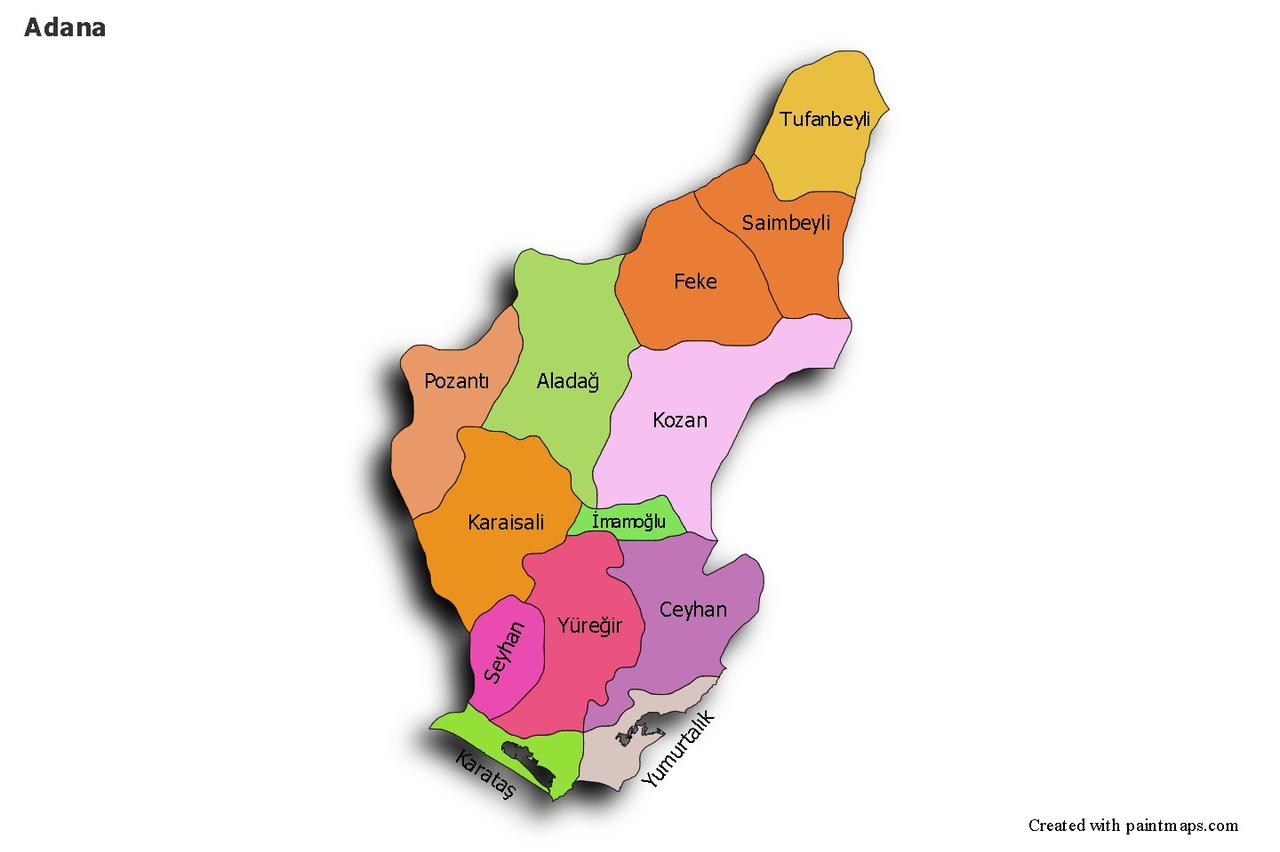
Ceyhan is situated east of the city center of Adana, on the fertile plains of Çukurova. The district covers an area of 1,427 km². To its east lie Osmaniye Province and the Erzin district of Hatay; to the north, the districts of Kozan and Kadirli; to the west, Yüreğir and İmamoğlu; and to the south, Yumurtalık district. The most important river flowing through the district is the Ceyhan River. Additional watercourses such as Mercin Suyu, Karaçay, Handeresi, and Çeperce Deresi also contribute to the district’s hydrological structure. The Misis (Nur) Mountains lie in the southwest, and parts of the district feature gently undulating terrain.

Ceyhan District and neighboring districts (Source: Paintmaps)
The dominant climate type in the district is Mediterranean. Summer months are hot and dry, while winter months are mild and rainy. The annual average temperature is around 18.7 °C. Average annual rainfall in the plain areas ranges between 600 and 750 mm, while in mountainous regions it can reach up to mm. Rainfall peaks during winter. The district’s natural plant cover consists primarily of maquis formations, with scattered pine forests. Reforestation efforts involving species such as eucalyptus and poplar are also notable.
Due to historical migration movements, Ceyhan has a multicultural and ethnically diverse population structure. Communities such as the Nogai Turks, Circassians of Caucasian origin, Crimean Tatars, Balkan migrants, and Papaks, settled in the region from the 19th century onward, form the foundational elements of its demographic makeup. As of 2024, according to data from the Turkish Statistical Institute (TÜİK), the total population of Ceyhan is approximately 155,000. The majority of the population resides in the district center.
The economy of Ceyhan is largely based on agriculture, animal husbandry, and industry. Productive Çukurova soils yield cotton, wheat, maize, peanuts, and citrus. In recent years, industrial activities—particularly in energy transportation and petrochemical investments—have transformed the district’s economic structure. The Ceyhan Terminal owned by BOTAŞ and the oil pipelines connecting Ceyhan-Kirkuk and Baku-Tbilisi-Ceyhan have established Ceyhan as a critical center in international energy transportation.

Baku-Tbilisi-Ceyhan Pipeline (Source: Anadolu Agency)
Ceyhan is a district with significant tourism potential due to its historical heritage. The ancient city of Kastabala, Yılan Castle, and Kurtkulağı Caravanserai are among its most prominent historical structures. Particularly, Yılan Kale, a defensive structure dating from the Crusades period, holds important archaeological value. The area around the Ceyhan River is also evaluated for nature tourism due to its natural beauty.

Yılan Kale (Source: Culture Portal)
The cultural structure of the district has been shaped by the accumulated heritage of the communities settled throughout its history. F "translation": "Folk dances"}, traditional wedding customs, and oral people literature reflect this diversity. Various festivals and cultural events are organized in the district, and local cultural activities are supported through community education centers, culture houses, and libraries.
Ceyhan cuisine reflects the distinctive characteristics of Adana cuisine. Meat dishes such as kebabs, içli köfte, analı-kızlı çorbası, and şalgam are commonly consumed in the district. The diversity of agricultural products is reflected in the variety of vegetables and fruits available in local markets.

Analı Kızlı Çorbası (Source: Culture Portal)
Ceyhan is a key center in Türkiye’s energy corridor projects. The ports and pipelines located in the district play a critical role in both Türkiye’s energy security and international energy trade. In addition, the district’s logistics infrastructure further supports this status.
BOTAŞ Genel Müdürlüğü. "Ceyhan Terminali Hakkında Bilgi." BOTAŞ Enerji Kurumu. Accessed April 16, 2025. https://www.botas.gov.tr
Ceyhan Kaymakamlığı. "Ceyhan İlçesi Coğrafi Yapısı." T.C. Adana Valiliği. Accessed April 16, 2025. https://www.ceyhan.gov.tr
Ceyhan Kaymakamlığı. "Ceyhan İlçesi Tarihçesi." T.C. Adana Valiliği. Accessed April 16, 2025. https://www.ceyhan.gov.tr
Ministry of Culture and Tourism. "Kastabala Antik City and Yılan Kale." General Directorate of Cultural Heritage and Museums. Accessed April 16, 2025. https://www.ktb.gov.tr
Türkiye İstatistik Kurumu (TÜİK). "Adrese Dayalı Nüfus Kayıt Sistemi Sonuçları 2024." TÜİK Resmî Web Sitesi. Accessed April 16, 2025. https://www.tuik.gov.tr

Henüz Tartışma Girilmemiştir
"Ceyhan (District)" maddesi için tartışma başlatın
Historical Development and Archaeological Heritage
Geographical Location, Topography, and Natural Resources
Climate Characteristics and Vegetation Cover
Population Structure and Demographic Features
Economic Activities and Sectoral Structure
Tourism Potential and Historical Monuments
Cultural Structure and Artistic Activities
Traditional Culinary Culture and Local Dishes
Strategic Importance and Notable Features