

Bu içerik Türkçe olarak yazılmış olup yapay zeka ile otomatik olarak İngilizceye çevrilmiştir.
Children with Toy-Like Keyboards, Realistic Dreams
Imagine this…
A child sits quietly in front of a screen. When you ask what they are doing, they do not say “I am playing a game.”
They say, “I am writing a game.”
At that very moment, something changes.
Because this child is not merely consuming.
They are creating, imagining, coding, and shaping the future.
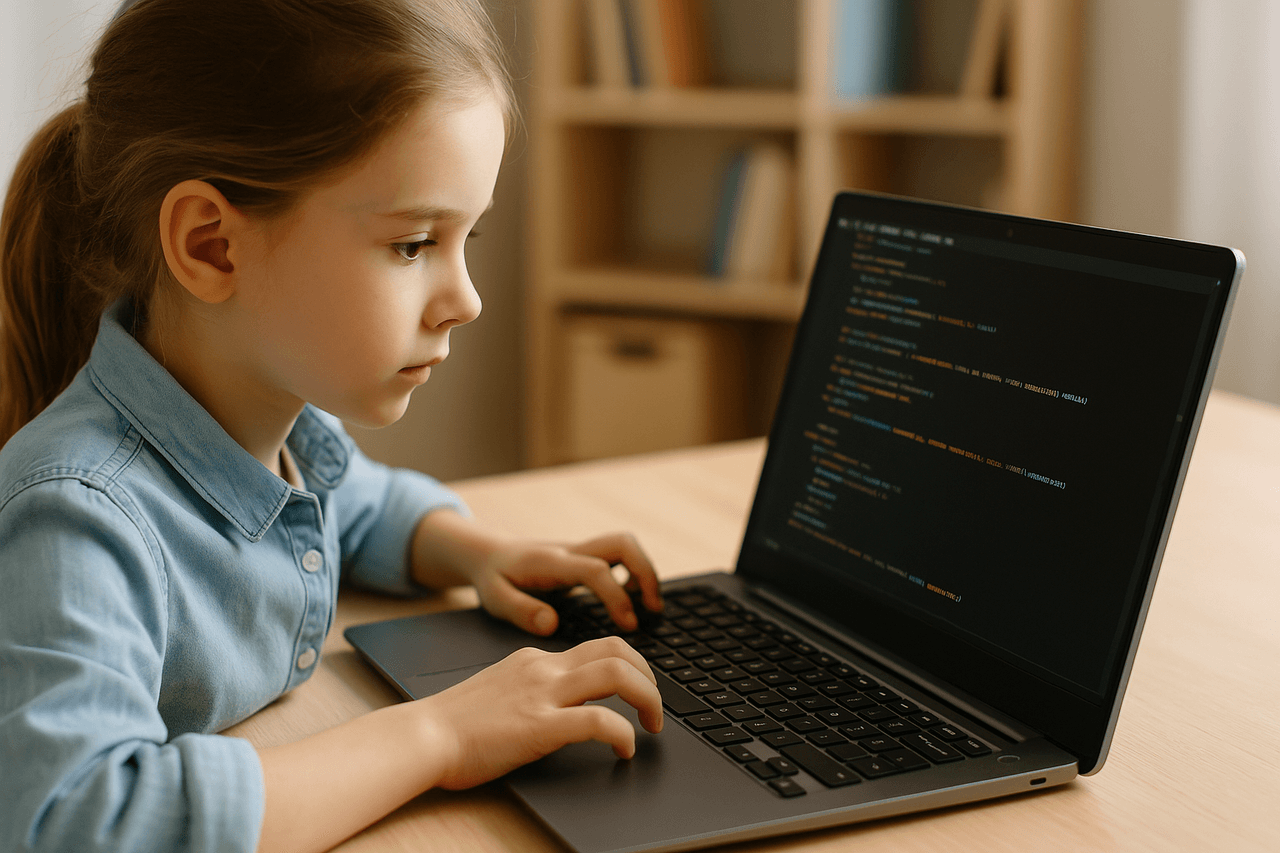
Generated by artificial intelligence.
We are now talking about a generation born into technology. Yes, they are exposed to phones, tablets, and screens at a very young age. But their eyes are not just fixed on the screen—they are also curious about what lies beyond it, asking, “How does this work?”
A child learning to code is not only acquiring a computer language but also developing the ability to read and write the future. Because in this era, creation begins with lines of code.
Perhaps a complex screen or adults thinking like computer engineers. But this image is changing.
Coding can also mean a seven-year-old turning their own story into an interactive experience.
A nine-year-old girl designing characters using Scratch…
An eleven-year-old programming a robotic arm…
The secret is this: coding is not merely a “professional skill.”
It teaches thinking, experimenting, and starting over without giving up.
Children who code the future;
Do not say “It cannot be done,” they ask, “Why not?”
They are not afraid of making mistakes—they learn to debug.
Instead of giving up after every failure, they write “one more line.”
Instead of getting lost inside a game, they wonder how it was written.
Perhaps the most valuable thing of all:
Being a creator, not just a user.
Creativity: They can transform a blank page into a colorful world.
Problem-solving skills: Every error opens a path to a solution.
Focus: They learn the patience of progressing step by step.
Collaboration: They discover how to develop projects together and embrace teamwork.
Self-confidence: They learn to say “Let me try” instead of “I can’t do it.”
These qualities are not just related to computers—they are essential to life itself.
These children will code the future, yes. But first, they need our guidance.
As parents: Instead of saying “You’re staring at the screen again,” we can ask, “What are you learning?”
As educators: We can encourage exploration over memorization.
As a society: We can launch initiatives to ensure every child has the chance to learn coding.
As institutions: We can support them through workshops, scholarships, and competitions.
Coding is not a privilege—it is now a fundamental literacy, just like reading and writing. It is every child’s right.
Perhaps your child will one day write artificial intelligence for agriculture.
Perhaps another’s child will program a robot for search and rescue after an earthquake.
Or perhaps they will simply code their own game and feel the pride of saying, “I made this.”
In any case, one truth remains:
Those who write the future are sitting at keyboards today.
And as we give them space, offer them confidence, and provide support…
That future will become brighter.
Children are not just our future—they are the minds designing the future.
Code, create, share, experiment, think, and rise again.
This is how the future is being written.
Because a game written in lines of code…
May just change a child’s life.
And yes…
A child can code the world.
The New Generation Is Not Just Digital, But Creative
What Comes to Mind When We Hear “Coding”?
Big Dreams Are Written with Small Fingers
What Does a Child Gain by Learning to Code?
What About Us? What Can We Offer Them?
We Must Prepare Today for Those Who Will Code the Future
