
Bu içerik Türkçe olarak yazılmış olup yapay zeka ile otomatik olarak İngilizceye çevrilmiştir.
+2 Daha
Other Name(s) | Şeytan İncili Dev Kitap | ||||||||
|---|---|---|---|---|---|---|---|---|---|
Place of Writing | Benedictine Monastery in Podlažice Bohemia (modern-day Czech Republic) | ||||||||
Period of Writing | Early 13th century (circa 1204–1230) | ||||||||
Dimension(s) | 92 x 50.5 x 22 cm | ||||||||
Weight(s) | Approximately 75 kg | ||||||||
Material(s) | Parchment | ||||||||
Number of Pages | Original version: 320 leaves (640 pages), 310 leaves (620 pages) survive to the present | ||||||||
Language of Text | Latin | ||||||||
Current Location | National Library of Sweden, Stockholm | ||||||||
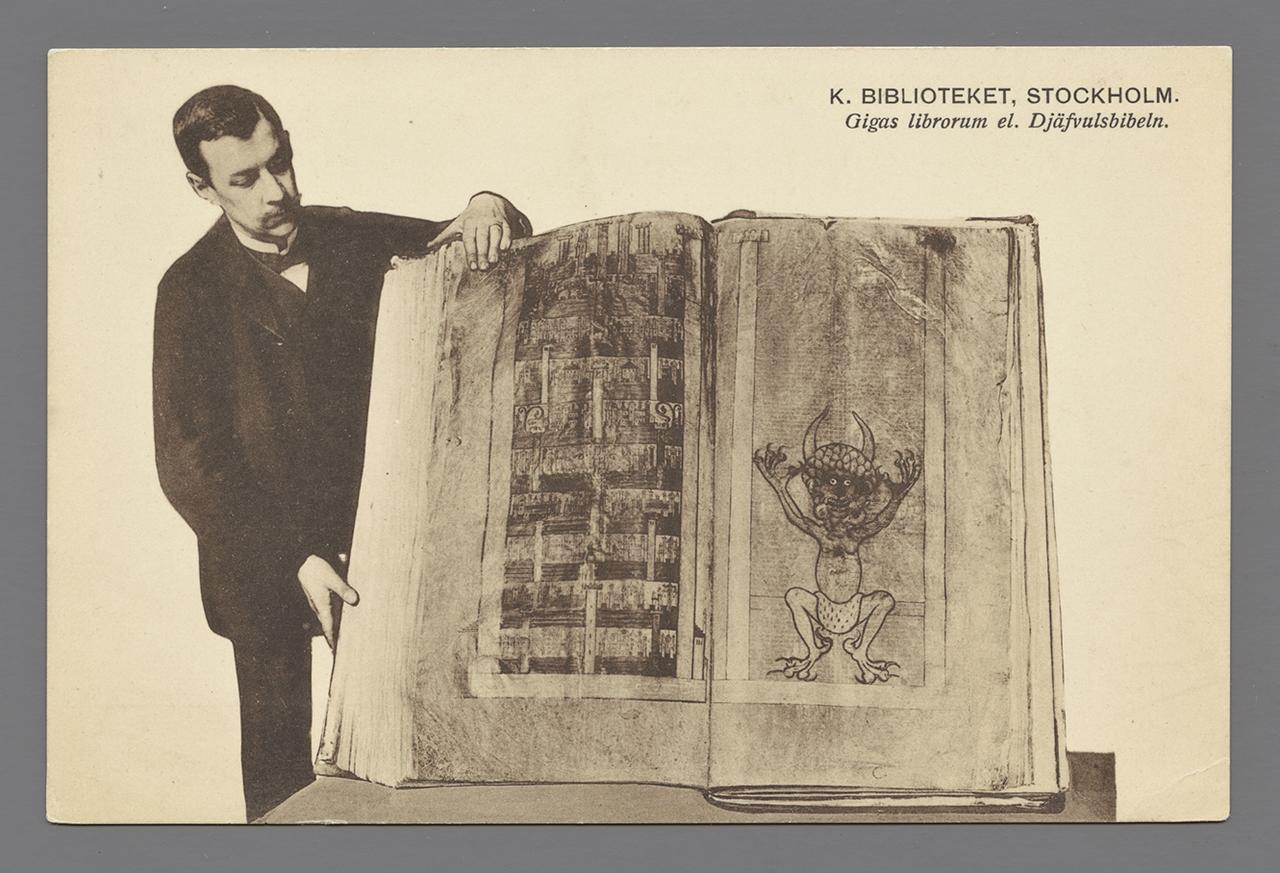
Codex Gigas is the largest surviving medieval manuscript. It is also known alternatively as The Devil’s Bible. It is believed to have been written in the early 13th century in Bohemia (modern-day Czech Republic). The manuscript attracts attention due to its size, content, decorations, and origins.

Codex Gigas located in the National Library of Sweden (Adolphson, Per B-KB)
Codex Gigas stands out for its physical dimensions. The modern binding from the 19th century measures 920×505×22 mm. The pages themselves measure 890×490 mm. The manuscript weighs approximately 75 kg. It is written on parchment, believed to be made from calf skin. Originally thought to have consisted of 320 folios, only 310 have survived; it is unknown when or why the eight missing folios were removed. Some sources suggest the missing pages may have contained the Rule of Saint Benedict. It is estimated that around 160 animal skins were used for the entire manuscript. The binding was renewed in the 19th century and is covered in white leather with metal decorations. Remnants of a mechanism designed to chain the manuscript to a piece of furniture can still be seen on the cover.
The text is in Latin and written in late Carolingian minuscule script. Pages are typically arranged in two columns of 105 to 106 lines. Paleographic analysis indicates that the majority of the text and decorations were produced by a single scribe. The absence of significant stylistic variation or deterioration over time suggests the manuscript was completed in a relatively short period or that the writer maintained a consistent style. It is estimated that the completion of the entire work required at least five years of continuous effort by one person, but likely took between 20 and 30 years. In certain sections such as the penitential and magical formulas, different font sizes, colors, or capital letters were employed.
Codex Gigas is academically notable for bringing together a wide variety of texts in a single volume and has been described as a kind of “one-volume library.” Its main contents include:
Based on the calendar and necrology entries within the manuscript, Codex Gigas is generally accepted to have been written in Bohemia between 1204 (the year Saint Procopius was canonized) and 1230 (the year of the death of King Přemysl Otakar I, which is not recorded). Its first known owner was the Benedictine monastery at Podlažice. However, it is debated whether the monastery possessed the resources to undertake such a massive project; some archaeological findings suggest it may have been wealthier than previously assumed. The identity of the scribe remains unknown, but one theory proposes that it may have been a monk named Herman, mentioned in the necrology and described as “inclusus” (enclosed or secluded), though this is not certain.
Due to financial difficulties, the monks of Podlažice pledged the manuscript to the Cistercian monastery at Sedlec. In 1295 it was reclaimed by Bavor of Nečtiny, abbot of the Břevnov Benedictine Monastery in Prague. During the Hussite Wars of the 15th century, it was moved to the Broumov Monastery for safekeeping and remained there for approximately 170 years. During this time it became a local attraction, and visitors left their signatures on the calendar pages. In 1594 it was incorporated into the Kunstkammer, the art and curiosity collection of the Prague Castle, by Holy Roman Emperor Rudolf II, likely acquired through loan without intent to return.
At the end of the Thirty Years’ War, in 1648, the manuscript was seized as war booty when Prague was captured by Swedish forces. It was brought to Stockholm and added to the library of Queen Christina. When Queen Christina abdicated and moved to Rome, the manuscript remained in Sweden. In 1697, during a fire at the Tre Kronor Castle in Stockholm, it was saved by being thrown out of a window, though its binding was damaged. After the fire, it was stored in various locations before being transferred in 1768 to the newly reconstructed Royal Palace. In 1878 it was moved to the newly built National Library of Sweden (Kungliga biblioteket – KB) in Humlegården Park, where it is still preserved under the archival reference A 148. Between 2007 and 2008 it was temporarily loaned to the Czech Republic for an exhibition in Prague.
A widespread legend explains the origin of the name “The Devil’s Bible.” According to the tale, a monk condemned to be walled alive for a grave sin vowed to produce the largest book in the world, containing all human knowledge, in a single night to escape his punishment. At midnight, realizing the task was impossible, he called upon the Devil for help in exchange for his soul.
The Devil completed the book, and in gratitude, the monk added a full-page portrait of the Devil to the manuscript. Scholars agree that this legend has no historical basis, but acknowledge its significant role in the manuscript’s fame. It has also been suggested that the legend may be linked to the monk “Hermanus Inclusus” mentioned in the necrology and to a misinterpretation of the term “inclusus.”

The Famous Full-Page Portrait of the Devil in Codex Gigas (Adolphson, Per B-KB)
The decorations in Codex Gigas are also believed to have been executed by the same scribe who wrote the text. The decorations are relatively limited in scope compared to the overall size of the manuscript. The primary colors used are red, blue, green, and yellow; gold, black, and white are also occasionally employed.
These appear at the beginning of sections or texts. They range from simple single-color (red/green) initials to two-color botanical motifs, initials with contrasting outlines, and especially elaborate multi-colored and detailed initials found in the Scripture sections. Six of these are full-page in size and represent the largest known initials; two of them incorporate gold. The main motif is typically a spiral vegetal design.
Two small illustrations accompany the texts of Josephus Flavius: a portrait of the author and two spheres representing the earth and the heavens. The most famous decorations are two full-page illustrations on facing pages. One depicts the Heavenly City of Jerusalem (or, according to some interpretations, an earthly city such as Babylon), and the other portrays the Devil. The depiction of the Heavenly City features a symmetrical composition filled with towers, walls, and buildings. The Devil is shown as a crouching figure with a green face, double tongue, red horns and claws, and a detailed ermine-trimmed cloak. This portrayal differs significantly from other contemporary depictions of the Devil.
Codex Gigas has attracted the interest of various researchers over the centuries.
Early studies were conducted by figures such as Marquard Freher (early 17th century), Josef Dobrovský (1792), Josef Pečírka (1850), Beda Dudík (mid-19th century), George Stephens (1847), and Johannes Belsheim (1879).
Researchers including Josef Plaček (1907), Antonín Friedl (1929), Carl Nordenfalk (1975–1987), Jaroslav Kolár (1991), and Michael Gullick (2007) have studied the manuscript’s dating, content, artistic features, and paleography. In particular, Gullick’s pigment and paleographic analyses have supported the theory of a single scribe.
Before the 2007 Prague exhibition, a high-resolution digitization project was undertaken to increase public access and reduce conservation risks. Led by Per B. Adolphson and Claes Jansson, the process involved capturing detailed images of every page using specialized equipment and creating large digital files. These digital copies are now available online through the National Library of Sweden’s website, the World Digital Library, the Internet Archive, and Manuscriptorium.
Codex Gigas is currently preserved at the National Library of Sweden (Kungliga biblioteket) in Stockholm. It is displayed in a section known as the “Treasure Room” (Skattkammaren). Due to its fragile condition, physical access to the original is highly restricted and requires special permission. However, thanks to the high-resolution digital scans, the entire manuscript is accessible online for study.
Because the manuscript was taken as war booty in 1648, the question of its return to the Czech Republic has occasionally been raised. However, no restitution has occurred, partly because the practice of claiming war booty was considered legally acceptable under international law at the time (as articulated by Hugo Grotius), and partly because of the symbolic value the manuscript holds for both nations’ cultural heritage. Digitization is viewed as a means of ensuring universal access to the manuscript, independent of such ownership disputes.
Adolphson, Per B. "Close-up of the Devil." Stockholm: Kungliga biblioteket (The Swedish National Library). Accessed October 19, 2025. https://www.kb.se/eng/the-codex-gigas/selected-images.html.
Adolphson, Per B. "Codex Gigas." Stockholm: Kungliga biblioteket (The Swedish National Library). Accessed October 19, 2025. https://www.kb.se/eng/the-codex-gigas/selected-images.html.
Cerecero Lucio, Alejandro Rafael. “Codex Gigas: La Biblia del Diablo Recopilación Bibliográfica.” Universidad Nacional Autónoma de México. (2023). Accessed October 26, 2025. https://ru.dgb.unam.mx/server/api/core/bitstreams/e9e16750-0f76-40bf-8d8e-1617e7aa4791/content.
Hobža, Jakub. “Codex Gigas: Největší Rukopisná Kniha Světa ve Švédské Národní Knihovně.” Bakalářská práce. Praha: Univerzita Karlova, Filozofická Fakulta, Ústav Informačních Studií a Knihovnictví, 2015. Accessed October 26, 2025. https://dspace.cuni.cz/handle/20.500.11956/63826?locale-attribute=en.
Lif, Jessica. “Codex Gigas (Djävulsbibeln): Auran i det Digitala Rummet.” Umeå University, Faculty of Arts, Department of Culture and Media Studies. (2025). Accessed October 26, 2025. https://www.diva-portal.org/smash/record.jsf?pid=diva2%3A1954009&dswid=6257.
Research Works
The Swedish National Library (Kungliga biblioteket). "The Codex Gigas – Devil’s Bible." The Swedish National Library Website. Accessed October 26, 2025. https://www.kb.se/eng/the-codex-gigas/the-codex-gigas---devils-bible.html.
Visuals

Other Name(s) | Şeytan İncili Dev Kitap | ||||||||
|---|---|---|---|---|---|---|---|---|---|
Place of Writing | Benedictine Monastery in Podlažice Bohemia (modern-day Czech Republic) | ||||||||
Period of Writing | Early 13th century (circa 1204–1230) | ||||||||
Dimension(s) | 92 x 50.5 x 22 cm | ||||||||
Weight(s) | Approximately 75 kg | ||||||||
Material(s) | Parchment | ||||||||
Number of Pages | Original version: 320 leaves (640 pages), 310 leaves (620 pages) survive to the present | ||||||||
Language of Text | Latin | ||||||||
Current Location | National Library of Sweden, Stockholm | ||||||||
Henüz Tartışma Girilmemiştir
"Codex Gigas (The Devil's Bible)" maddesi için tartışma başlatın
Physical Characteristics
Content
History
Origin and Dating
Bohemian Period
Swedish Period
Legends Surrounding the Manuscript (The Devil’s Bible)
Decorations
Initials
Illustrations
Research and Digitization
Early Research (17th–19th Century)
Modern Research (20th–21st Century)
Digitization
Current Location and Access