

Bu madde henüz onaylanmamıştır.
Cubism is an early-20th-century avant-garde art movement that revolutionized modern art. In Cubism, an object or person is represented as a set of geometric shapes, and multiple viewpoints are shown at the same time.
The style breaks objects into parts, analyzes them, and reassembles them in an abstract form.
Cubism is considered the most influential art movement of the 20th century, shaping developments in painting, sculpture, architecture, music, ballet, and even literature.
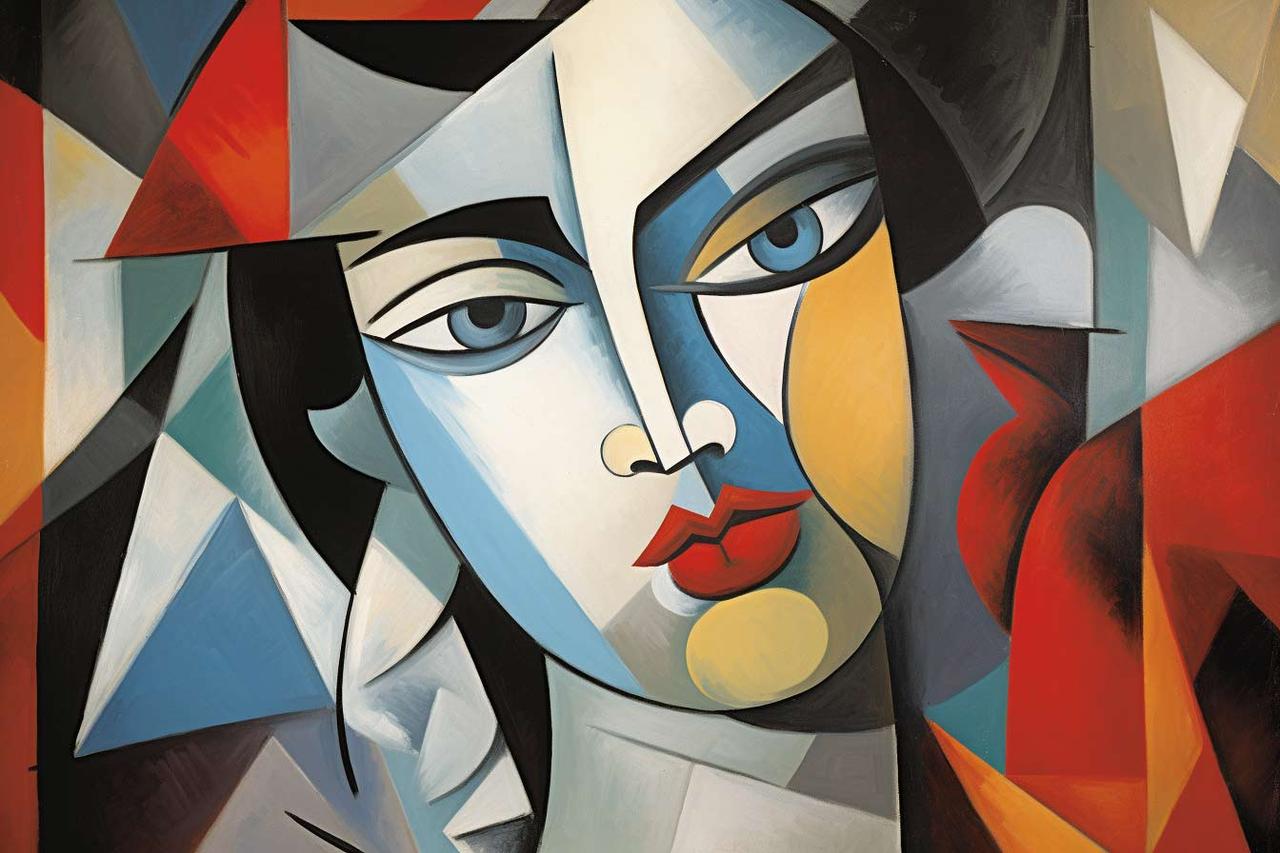
Cubism - synthetic
Cubism began in Paris between 1907 and 1914.
The movement was pioneered by Pablo Picasso and Georges Braque, later joined by Jean Metzinger, Albert Gleizes, Robert Delaunay, Henri Le Fauconnier, Juan Gris, and Fernand Léger.
One of the strongest inspirations was the late work of Paul Cézanne, whose paintings explored three-dimensional form through simplified geometric shapes.
His retrospectives at the Salon d’Automne in 1904, 1905, 1906, and again in 1907 (after his death) deeply affected Picasso and Braque.
The term “Cubism” comes from critic Louis Vauxcelles, who described Braque’s 1908 painting Houses at L’Estaque as consisting of “cubes.”
Picasso’s Les Demoiselles d’Avignon, with its fractured and angular female figures, is considered the painting that announced the Cubist style.
Like Cézanne, Picasso used color to create perspective: warm tones advanced, cool tones receded.
Objects are shown from many angles at once.
This challenges traditional single-point perspective and creates a new sense of reality.
Forms are:
•analyzed,
•broken into geometric units,
•and recomposed as abstract structures.
Cubists emphasized the flat surface of the canvas.
They rejected:
•traditional perspective
•foreshortening
•modeling
•chiaroscuro (light–shadow contrast)
Art was not meant to imitate nature.
Early Cubist works used mostly monochromatic tones:
•tan
•brown
•gray
•cream
•muted green and blue
The purpose was to focus on form, not decorative color.
Cubism introduced collage into modern art.
Artists used newspapers, tobacco wrappers, printed letters, and other materials to question the boundary between reality and illusion.
Picasso and Braque’s styles became so similar that their works were nearly indistinguishable.
Features:
•objects broken into small, overlapping planes
•right angles and straight lines
•nearly monochromatic color
•dense forms at the center, expanding toward edges
•common motifs: musical instruments, bottles, glasses, newspapers, human faces
Examples:
Picasso’s Girl with a Mandolin (1910), Portrait of Ambroise Vollard (1909–10).
This phase emphasized combining forms rather than breaking them down.
Features:
•brighter and stronger colors
•larger, flatter shapes
•decorative surfaces
•use of collage and foreign materials
•mixture of painted and pasted elements (papier collé)
Synthetic Cubism posed new questions:
What is real? What is illusion?
Artists influenced
•Fernand Léger
•Robert and Sonia Delaunay
•Juan Gris
•Roger de la Fresnaye
•Albert Gleizes
•Jean Metzinger
Sculpture
Cubism shaped 20th-century sculpture through:
•Alexander Archipenko
•Raymond Duchamp-Villon
•Jacques Lipchitz
Architecture
Swiss architect Le Corbusier adopted Cubist aesthetics, visible in the geometric forms of his houses in the 1920s.
Many modern movements emerged partly in response to Cubism, including:
•Dada
•De Stijl
•Art Deco
•Orphism
•Purism
Early Futurism shared Cubism’s interest in multiple perspectives, simultaneity, and the fusion of past and present.
Cubism is a groundbreaking modern art movement that:
•analyzes objects into geometric shapes,
•shows multiple perspectives simultaneously,
•rejects traditional techniques,
•and creates a new visual language based on fragmentation and reassembly.
Born in Paris, created by Picasso and Braque, and influenced by Cézanne, Cubism became the foundation for many 20th-century artistic innovations.
Cambridge Dictionary. s.v. “Cubism.” Erişim tarihi 25 Kasım 2025. https://dictionary.cambridge.org/dictionary/english/cubism.
Encyclopaedia Britannica, s.v. “Cubism,” accessed November 25, 2025, https://www.britannica.com/art/Cubism.
Wikipedia, s.v. “Cubism.” Last modified November 24, 2025. https://en.wikipedia.org/wiki/Cubism.

Henüz Tartışma Girilmemiştir
"Cubism" maddesi için tartışma başlatın
CUBISM
Definition
Origins and Historical Background
Influence of Paul Cézanne
Naming of Cubism
A Key Work: Les Demoiselles d’Avignon (1907)
Characteristics of Cubism
1. Multiple Perspectives
2. Geometric Fragmentation
3. Two-Dimensionality
4. Limited Color (early phase)
5. Introduction of Collage
Periods of Cubism
1. Analytical Cubism (1910–1912)
2. Synthetic Cubism (after 1912)
Legacy and Influence
Cubism deeply influenced many artists and later art movements.
Other Movements Affected
Summary
Bu madde yapay zeka desteği ile üretilmiştir.