

This article was automatically translated from the original Turkish version.
+2 More
Founder(s) | Kazimir Malevich (1878–1935) | ||||||||
|---|---|---|---|---|---|---|---|---|---|
Origin(s) | Supreme (Latin: en yüce) | ||||||||
Feature(s) | Abstract geometric painting style | ||||||||
Purpose(s) | Pure art independent of nature | ||||||||
Vision | Cosmic reality | ||||||||
Suprematism is an art movement introduced by Kazimir Malevich in the early 20th century, based entirely on abstraction. The term derives from “supreme,” signifying the pursuit of art’s “highest” or “purest” form. This movement aimed to strip art of objective representation and transform it into a completely abstract language that emphasized emotion, intuition, and pure form.
Malevich’s fundamental goal was to reach the “zero point” of art, establishing a visual language independent of objects and thereby creating a new aesthetic dimension that directly appealed to sensory and experiential perception.
Suprematism (TRT2)
The core philosophy of Suprematism is to sever art entirely from the external world and material objects, elevating it to a spiritual and intuitive dimension. Malevich conceived art not as imitation of nature but as an autonomous realm generating its own inner reality. In this context, objective representation gives way to “pure sensation” and “inner energy” as the central concerns of artistic expression.
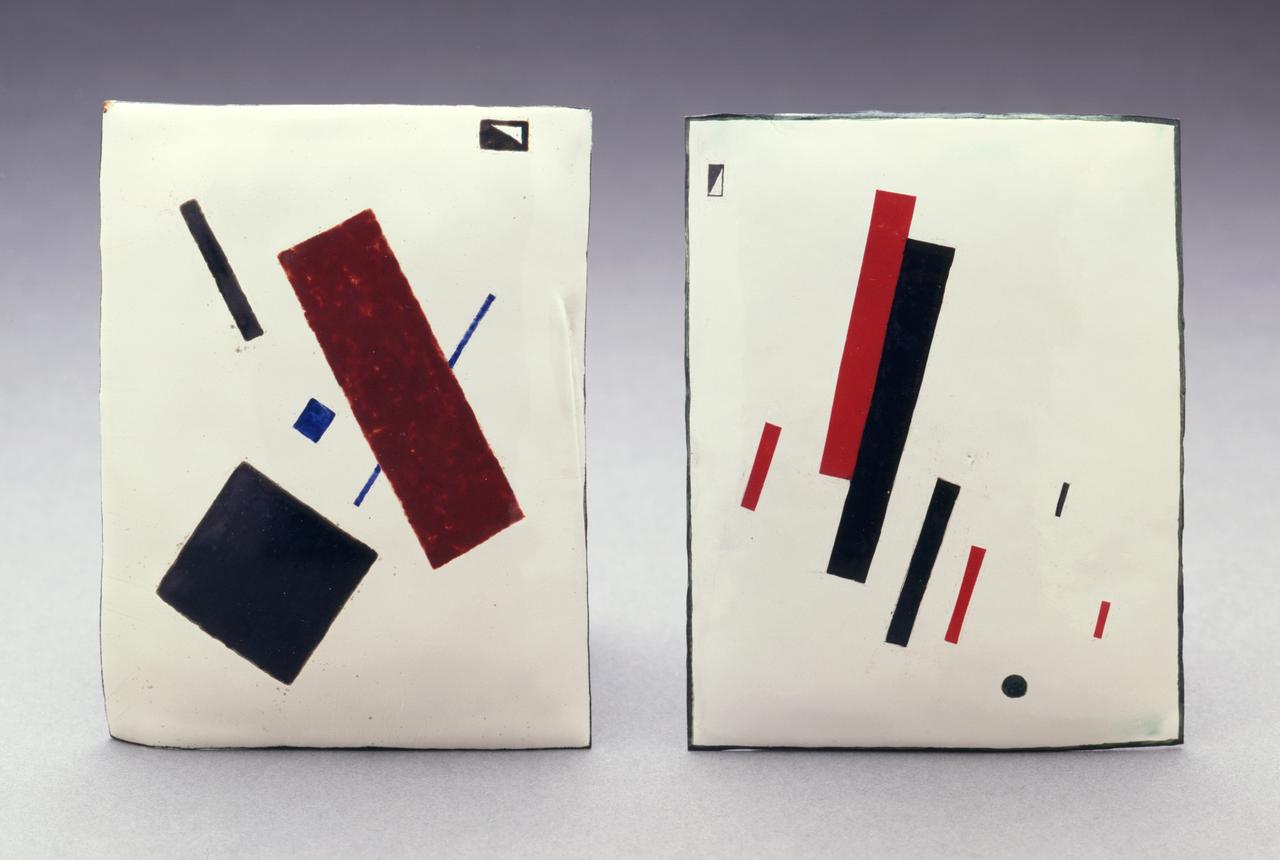
Under this principle, Suprematist works contain no recognizable figures or subjects; compositions are constructed from geometric forms. Shapes such as squares, circles, rectangles, and triangles, combined with flat colors and plain surfaces, create a minimalist aesthetic. The visual energy of these forms reaches the viewer directly through perception, without conveying any narrative or representation.

Suprematism (Generated by Artificial Intelligence)
Suprematism is characterized by the use of basic geometric shapes—particularly the black square, circle, and cross—and flat colors. Colors are typically intense, pure, and highly contrasting; formal elements appear as if floating on a blank background. This visual arrangement imparts a sense of weightlessness to the works and evokes in the viewer a feeling of spatial freedom.
In Malevich’s artistic vision, space is not constructed using classical perspective with depth. Instead, a system known as “inverse perspective,” associated with the ideas of Pavel Florensky, is adopted. This perspective does not fix the viewer’s gaze but directs it toward multiple and dynamic perceptions. This grants Suprematist works a conception of space distinct from the single-point perspective dominant in traditional Western art.

Mähende Frau (Zhnitsa), Kazimir Malevich (rawpixel)
Suprematist art was also informed by concepts such as the fourth dimension and metageometry. Charles Hinton’s ideas about multidimensional universes and P.D. Uspensky’s book Tertium Organum serve as important references in this context. For Malevich, matter is essentially pure energy, and movement is its intrinsic nature. Within this framework, geometric forms are not static but dynamically configured within space.
Malevich’s transition to Suprematism occurred through several stages. First came his Neo-Primitivist period, influenced by Russian icon traditions and folk art, in which stylized figures, traditional flat planes, and folk aesthetics were combined. Subsequently, under Cubo-Futurist influence, he developed a style in which objects were fragmented and multiple movements were rendered. Both periods were crucial steps in Malevich’s move toward abstract art.
The visual and conceptual foundations of Suprematism first appeared in the stage and costume designs created in 1913 for the opera “Victory Over the Sun.” However, the first work to assume the status of a manifesto was “Black Square,” exhibited in 1915. This painting, consisting of a black square on a white ground, represents the “zero point” of Suprematist art. Displayed in 1915 at the “0.10 Last Futurist Exhibition” on the wall corner traditionally reserved for religious icons, it marked a profound aesthetic and intellectual shift in the history of art.
Other significant works include “Suprematist Composition: White on White” (1918) and “The Pictorial Reality of the Child with a Backpack.” In these works, spatial perception becomes even more abstracted, and geometric forms appear to float freely within spatial emptiness. At the same time, El Lissitzky’s work “Beat the Whites with the Red Wedge” exemplifies how Suprematism was fused with political and revolutionary implications.
Suprematist principles were not confined to painting; they were also applied in architecture, stage design, graphic arts, textiles, and industrial design. Nikolai Suetin’s porcelain works and Lazar Khidekel’s architectural designs are important examples of this expansion.
Upon its emergence, Suprematism provoked strong reactions due to its radical nature. “Black Square” was dismissed by traditional art circles as “meaningless” or even “blasphemous,” and critics such as Alexandre Benois openly rejected the work. Malevich responded to these criticisms by defining his square as “the icon of its time.”
The movement also encountered ideological divisions. A disagreement arose between Malevich and Constructivist artist Vladimir Tatlin over whether art should serve individual expression or social utility. Tatlin argued that art must be functional, while Malevich maintained that art must be autonomous within itself.
Despite all these debates, Suprematism became one of the most influential abstract art movements of the 20th century and established itself as one of the foundational pillars of modern art. Its principles of geometric abstraction, minimalism, and contemporary visual design continue to exert influence today.
Bulut, Ümran, and Ebru Kaya. “Maleviç’in Siyah Kare tablosunun Rus avangardındaki yeri.” *Uluslararası Disiplinlerarası ve Kültürlerarası Sanat* 4, no. 8 (2019): 153–170. Accessed August 16, 2025. https://dergipark.org.tr/en/download/article-file/1497007
Rawpixel. “Mähende Frau (Zhnitsa), 1913 by kazimir malevich JPG.” Accessed August 16, 2025. https://www.rawpixel.com/image/18946984/mahende-frau-zhnitsa-1913-kazimir-malevich
Rawpixel. “Two Brooches by Kazimir Malevich 1879 1935 also active Russia JPG.” Accessed August 16, 2025. https://www.rawpixel.com/image/11801211/photo-image-art-phone-public-domain
TRT2. "Sanat terimleri | ‘Süprematizm’ | 35. Bölüm." YouTube. Accessed August 16, 2025. https://www.youtube.com/watch?v=93NTgjHJbGY
Yılmaz, Evren, and Ayla Ödekan. “Yeni-primitivizmden süprematizme Maleviç’in sanatında tersten perspektif dördüncü boyut ilişkisi.” *İTÜDERGİSİ/b* 6, no. 2 (2011). Accessed August 16, 2025. http://itudergi.itu.edu.tr/index.php/itudergisi_b/article/viewFile/1095/1084


Founder(s) | Kazimir Malevich (1878–1935) | ||||||||
|---|---|---|---|---|---|---|---|---|---|
Origin(s) | Supreme (Latin: en yüce) | ||||||||
Feature(s) | Abstract geometric painting style | ||||||||
Purpose(s) | Pure art independent of nature | ||||||||
Vision | Cosmic reality | ||||||||
Philosophical Background and Artistic Approach
Formal Characteristics, Geometric Language, and Spatial Construction
Historical Development, Key Works, and Applications
Reactions, Criticisms, and Place in Art History