



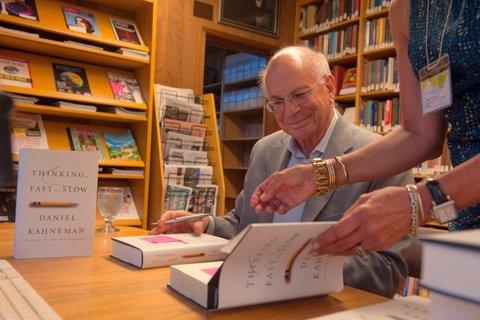
Daniel Kahneman
Ölüm tarihi | 1934-03-05 | ||||||||
|---|---|---|---|---|---|---|---|---|---|
Eş | Anne Treisman Daniel Kahneman | ||||||||
Doğum tarihi | 2024-03-27 | ||||||||
Nationality | Israeli-American | ||||||||
Profession(s) | Psychologist Professor Emeritus Author Economist | ||||||||
Education | Hebrew University of Jerusalem (BA: Psychology and Mathematics) Berkeley (PhD: Psychology) University of California | ||||||||
Important Awards | Nobel Prize in Economics (2002), American Psychological Association Distinguished Scientific Contribution Award (1982), University of Louisville Grawemeyer Award in Psychology (2002), Presidential Medal of Freedom (USA, 2013) | ||||||||
Daniel Kahneman (5 March 1934, Tel Aviv – 27 March 2024, New York) was an Israeli-American psychologist and economist renowned for his contributions to behavioral economics. Kahneman’s research on human judgment and decision-making mechanisms integrated findings from cognitive psychology into economic analysis, establishing him as one of the founders of behavioral economics. In 2002, he was awarded the Nobel Memorial Prize in Economic Sciences jointly with Vernon L. Smith for his work integrating psychological insights into economic science, particularly regarding human judgment and decision-making under uncertainty. His most famous work is the international bestseller Thinking, Fast and Slow, and he has been dubbed the “grandfather of behavioral economics.”
Daniel Kahneman was born on 5 March 1934 in Tel Aviv, then under British Mandate, to a Lithuanian Jewish family. His family had migrated from Lithuania to Paris in the 1920s, and Kahneman spent a significant part of his childhood in Paris, where his father worked as head of research for a chemical company owned by L’Oréal. During the Nazi occupation, he and his family went into hiding to survive. His father, Efraim, died in 1944 from diabetes. These traumatic experiences are believed to have shaped his early interest in human nature, risk perception, and decision-making processes. In 1948, shortly before the establishment of the State of Israel, he returned to Palestine with his mother and sister.
Kahneman completed his undergraduate studies in 1954 at the Hebrew University of Jerusalem, majoring in psychology and minoring in mathematics. After graduation, he served in the Israel Defense Forces (IDF) in the psychology division. There, he spent one year as an infantry team leader and then three years developing assessment tests and interview systems to evaluate officer candidates and determine soldiers’ suitability for specific roles such as combat pilot training. These experiences led him to reflect on the reliability of intuitive judgments versus statistical predictions, themes that would become central to his later work. Deciding to pursue an academic career, he moved to the United States and earned his PhD in psychology from the University of California, Berkeley, in 1961.
After completing his doctorate, Kahneman began his academic career in 1961 as a faculty member at the Hebrew University of Jerusalem, where he worked until 1970. From 1968 to 1969, he was a visiting researcher at the Center for Advanced Study in the Behavioral Sciences (CASBS) at Stanford University, where he met Amos Tversky, who would become his most important collaborator. Their partnership lasted until Tversky’s death in 1996. Kahneman later served as a professor at the University of British Columbia (1978–1986) and at the University of California, Berkeley (1986–1994). In 1993, he joined Princeton University as Professor of Psychology and Public Affairs, retiring in 2007 with the titles of Eugene Higgins Professor of Psychology Emeritus and Professor of Psychology and Public Affairs Emeritus, though he continued his research as an emeritus professor.
Daniel Kahneman’s most renowned achievement was the 2002 Nobel Memorial Prize in Economic Sciences, which he shared with Vernon L. Smith. The prize was awarded for their integration of insights from psychological research into economic science, especially concerning human judgment and decision-making under uncertainty. Amos Tversky’s death in 1996 prevented him from receiving the Nobel Prize, as the award is not given posthumously. Kahneman frequently emphasized that he viewed the prize as shared with Tversky.
Other notable awards include the American Psychological Association’s Distinguished Scientific Contribution Award (1982, with Tversky), the University of Louisville’s Grawemeyer Award in Psychology (2002, with Tversky), and the Presidential Medal of Freedom, awarded by U.S. President Barack Obama in 2013.
Kahneman’s most fundamental contributions to science were identifying systematic errors in human judgment and decision-making (cognitive biases) and the mental shortcuts (heuristics) underlying them. His collaborative work with Amos Tversky challenged the traditional rational actor model and laid the foundations of behavioral economics. He also contributed to hedonic psychology through concepts such as the “experiencing self” and the “remembering self.” His research has reshaped fields ranging from economics and finance to medicine and public policy.
Daniel Kahneman’s first marriage was to educational psychologist Irah Kahn (later Kahneman), with whom he had two children: daughter Lenore Shoham and son Michael Kahneman. That marriage ended in divorce. He later married Anne Treisman (1935–2018), a leading cognitive psychologist known for her work on attention. They remained married until her death in 2018. In his later years, his companion was Barbara Tversky, the widow of Amos Tversky. Kahneman had four grandchildren. He described his friendship and collaboration with Amos Tversky as one of the most important and formative relationships of his life.
Even in advanced age, Daniel Kahneman continued his academic work, writing, and giving lectures around the world. His 2021 book, Noise: A Flaw in Human Judgment, demonstrated his ongoing commitment to advancing thinking about decision-making. As an emeritus professor at Princeton University, he continued to support emerging researchers. Kahneman died on 27 March 2024 in Manhattan, New York, at the age of 90.
Daniel Kahneman’s work has profoundly influenced numerous fields, including psychology and economics, as well as medicine, law, public policy, business management, finance, artificial intelligence, and personal development. He is widely regarded as one of the founding figures of behavioral economics and played a pivotal role in challenging traditional assumptions about human rationality, helping to establish an entirely new school of thought.
CASBS Stanford. *Daniel Kahneman (1934–2024): Nobel Prize Winner, CASBS Legend.* CASBS Stanford University Blog. Accessed May 23, 2025. https://casbs.stanford.edu/news/daniel-kahneman-1934-2024-nobel-prize-winner-casbs-legend.
Nobel Prize Outreach AB. "Daniel Kahneman – Biographical." NobelPrize.org. Accessed May 23, 2025. Accessed Linki: https://www.nobelprize.org/prizes/economic-sciences/2002/kahneman/biographical/.
Shafir, Eldar. *Daniel Kahneman, Nobel laureate and father of behavioural economics, dies.* Nature, April 12, 2024. Accessed May 23, 2025. https://www.nature.com/articles/d41586-024-01344-6.

Daniel Kahneman
Ölüm tarihi | 1934-03-05 | ||||||||
|---|---|---|---|---|---|---|---|---|---|
Eş | Anne Treisman Daniel Kahneman | ||||||||
Doğum tarihi | 2024-03-27 | ||||||||
Nationality | Israeli-American | ||||||||
Profession(s) | Psychologist Professor Emeritus Author Economist | ||||||||
Education | Hebrew University of Jerusalem (BA: Psychology and Mathematics) Berkeley (PhD: Psychology) University of California | ||||||||
Important Awards | Nobel Prize in Economics (2002), American Psychological Association Distinguished Scientific Contribution Award (1982), University of Louisville Grawemeyer Award in Psychology (2002), Presidential Medal of Freedom (USA, 2013) | ||||||||
Henüz Tartışma Girilmemiştir
"Daniel Kahneman" maddesi için tartışma başlatın
Early Life and Education
Childhood and Youth
Educational Background
Career and Achievements
Career Path
Key Achievements
Key Works and Contributions
Major Works and Projects
Personal Life
Private Life
Legacy and Impact