

+1 Daha

Deep Space Network (DSN)
Stations | Canberra (Australia) Madrid (Spain) Goldstone (USA) | ||||||||
|---|---|---|---|---|---|---|---|---|---|
Key Missions Supported | Voyager and New Horizons Missions Mars Missions (including Perseverance and Curiosity) Artemis Moon Missions Apollo 13 Rescue | ||||||||
Technical Component | Signal Processing Centers Transmitters Antenna Arraying Receivers: Cryogenically cooled for optimal performance 26 m Antennas: Older generation models 34 m Antennas: Equipped with beam waveguide systems 70 m Antennas: Goldstone's DSS-14 | ||||||||
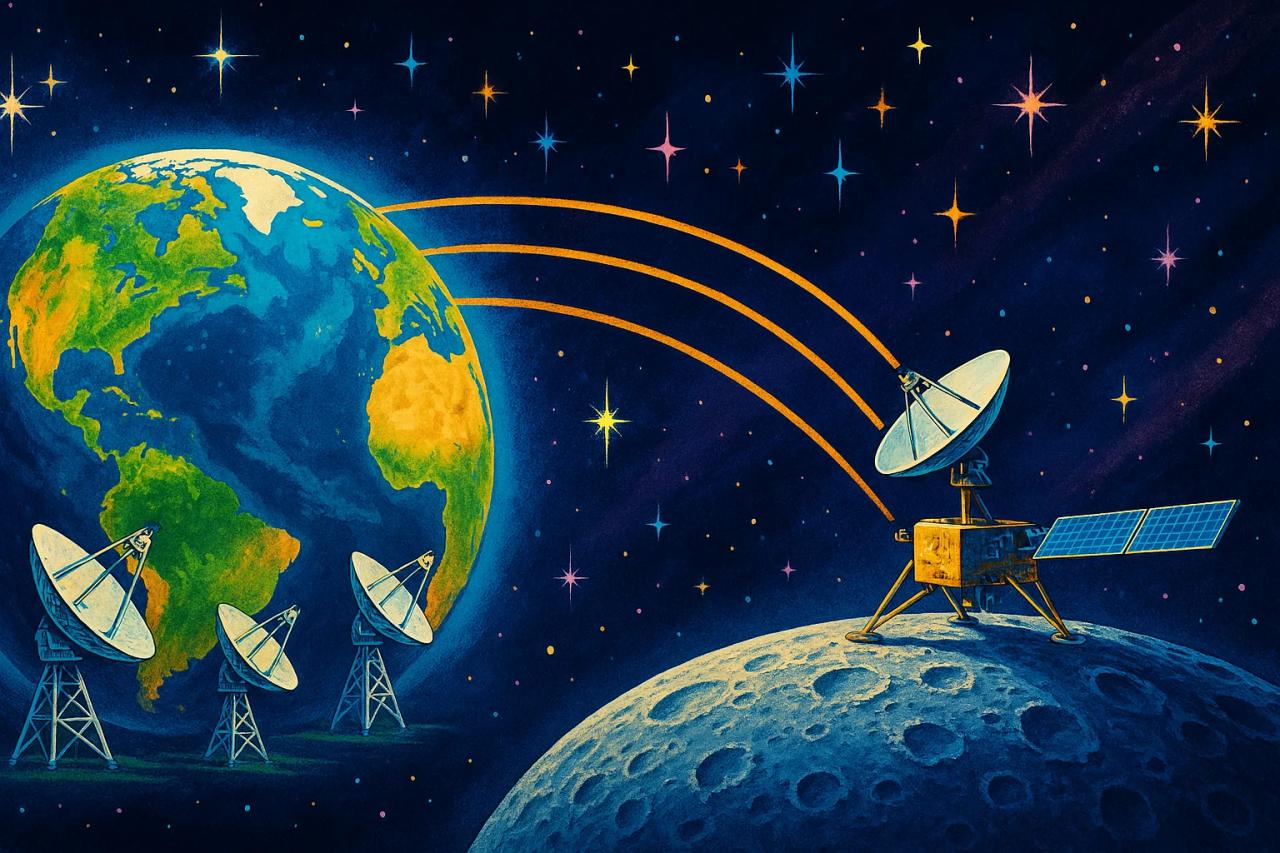
The Deep Space Network (DSN) is an international network of radio antennas operated by NASA’s Jet Propulsion Laboratory (JPL) that provides communication support for interplanetary space missions. Its mission is to perform essential communication functions such as telemetry (data reception), command transmission, tracking, and scientific data collection with spacecraft in space.
It consists of massive antenna facilities located at three strategic points on Earth – Goldstone (California, USA), Madrid (Spain), and Canberra (Australia). These three stations are placed approximately 120° apart, allowing any spacecraft to be continuously tracked by at least one DSN station as the Earth rotates.
The foundations of the Deep Space Network (DSN) trace back to the dawn of the space age. In the late 1950s, the accelerating space efforts fueled by the Cold War led the United States to take significant steps toward space exploration. In this context, the historical development of the DSN can be examined in three main phases:
In January 1958, while still operating under the U.S. Army, the Jet Propulsion Laboratory (JPL) established portable radio tracking stations in Nigeria, Singapore, and California to track the orbit of Explorer 1, the first successful American satellite. This was DSN’s first attempt at receiving telemetry data and signal tracking. Later that year, on October 1, 1958, NASA was founded to unify U.S. space research under a single civilian agency.
On December 3, 1958, JPL was transferred from the U.S. Army to NASA. During this period, NASA adopted the idea of establishing a shared, centralized communication network so that each space mission would not have to build its own communication infrastructure. Based on this vision, the DSN was established as a unified communication system for all interplanetary missions. In 1963, the system was officially introduced under the name “Deep Space Network” and became operational.
During this period, the DSN became not just a technical infrastructure but also a significant player in digital signal processing, low-noise receivers, and space navigation. One of its major innovations was the use of large parabolic dish antennas capable of receiving extremely weak signals.
The role of the DSN was not limited to uncrewed missions. The Apollo missions—especially Apollo 11 in 1969—played a major role in DSN’s history. Normally, the Manned Space Flight Network (MSFN) was used for crewed missions. However, some missions—such as the Apollo 11 Moon landing and the Apollo 13 accident—required the more powerful antennas of the DSN.
In particular, during the Apollo 13 mission, the spacecraft's limited power supply and damaged antennas meant that signals could only be received through DSN’s massive antennas. This demonstrated the DSN’s technical capabilities and strategic importance in space exploration.
Additionally, with a model called “DSN-Wing,” MSFN control rooms were added next to DSN stations, allowing them to be rapidly adapted for crewed missions when needed. This strategy enabled both robotic and human missions to be managed through the same infrastructure.
NASA’s Deep Space Network (DSN) not only receives signals from distant spacecraft but also performs a wide range of functions to ensure the continuity and safety of these missions. These functions span from communication and data analysis to scientific experiments and spacecraft tracking.
Telemetry refers to the transmission of data from a spacecraft to control centers on Earth. Spacecraft continuously send scientific data (such as temperature, magnetic fields, atmospheric pressure) and engineering data (like battery status, propulsion system health, processor condition, etc.) via radio signals using onboard sensors and instruments.
The DSN captures these signals and performs decoding, filtering, and data validation. For example, a temperature value sent by a rover on the surface of Mars is first received as a signal, then converted into digital data by the DSN, and delivered to scientists. Telemetry data provides critical insights into spacecraft health, scientific discoveries, and the detection of anomalies.
To issue instructions such as orientation, task execution, or mode changes to a spacecraft, a process known as command uplink is used. DSN functions as the “control panel” of space missions. Commands are prepared in the form of digital codes and transmitted to spacecraft via DSN antennas. Command operations may include:
Although commands travel at the speed of light, it can still take over 20 hours to reach distant spacecraft like Voyager 1. DSN precisely manages these timings.
For a spacecraft to successfully carry out its mission, its position and trajectory must be accurately known. The DSN uses several methods in this tracking process:
By combining these methods, the spacecraft’s three-dimensional position and velocity can be calculated with high precision.
Beyond data transmission, the DSN also enables scientific research through the signals themselves. Radio science provides valuable information about planetary atmospheres, internal structures, and gravitational effects. As a signal passes through a celestial body, it may be bent, delayed, or deflected. By analyzing these changes, scientists can infer the internal composition, density, and structure of that body. The rings of Saturn, the atmosphere of Mars, and Jupiter’s interior have all been studied using this technique. Einstein’s General Theory of Relativity has also been tested through DSN-supported radio experiments.
DSN antennas are also used for direct observation of celestial objects in the universe.
The DSN also acts as a rescue platform for malfunctioning or unresponsive spacecraft during missions.
In such crises, the DSN collaborates with international agencies, forming a global communication network.
Today, DSN is expanding its infrastructure to include laser-based communication in addition to radio waves. One of the new antennas, DSS-23, is being equipped to receive both radio and laser signals.
Laser communication enables higher bandwidth data transmission from distant planets like Mars. For example, the upcoming Psyche mission is designed to communicate via both traditional radio and laser systems.
The Deep Space Network (DSN) is not merely a system of large antennas. It is an integrated communication platform equipped with complex, high-precision electronic hardware, software infrastructure, and advanced engineering solutions.
The DSN consists of antennas of various sizes, each serving specific functions. These antennas are capable of both receiving and transmitting signals.

Deep Space Station 43 (DSS-43), a 230-meter antenna located at the Canberra Deep Space Communications Complex near Canberra, Australia. (Credit: Scitech Daily)

A 112-foot (34-meter) beam waveguide antenna at the Goldstone Deep Space Communications Complex near Barstow, California. (Credit: NASA)

The first antenna built at the Canberra Deep Space Communications Complex tracking station site. (Credit: NASA)
Each DSN complex hosts a signal processing center responsible for receiving antenna signals, sending commands to spacecraft, and directing antenna movements. Within these centers, the following operations are carried out:
Once signal processing is complete, the data is transmitted to NASA’s Jet Propulsion Laboratory (JPL), where it is forwarded to research teams for scientific analysis.
The selection and design of each DSN complex are based on geophysical factors such as:
New DSN antennas are being designed to receive not only radio waves but also laser signals (optical data). The DSS-23 antenna is one of the first of its kind. It is equipped with advanced mirror systems, laser detectors, and high-precision optical filters.
Previously, the DSN operated on a manpower-based model with three shifts per station to maintain 24/7 global coverage. However, increasing mission volume, rising personnel costs, and maintenance challenges made this model unsustainable.
On November 6, 2017, NASA implemented a new model called “Follow the Sun.” In this model, each DSN complex is only fully active during its local daytime hours, taking turns managing the entire DSN system:
During nighttime hours, facilities switch to passive listening mode or handle pre-scheduled data transmissions. This reduces personnel requirements and costs without compromising mission continuity.
The "Follow the Sun" model has so far supported missions including:
It is considered a key step toward handling the growing demand of future missions and enhancing DSN's scalability.
Apollo 13 was a challenging space mission due to a serious technical failure. Launched on April 11, 1970, it was intended to land on the Moon. However, 56 hours after launch, an oxygen tank in the Service Module exploded, causing severe damage. The Moon landing was aborted, and the new goal became returning the crew safely to Earth.
Due to the damage:
NASA turned to the DSN's largest and most sensitive antennas—especially the 70-meter dish at Goldstone—as an emergency solution.
Cooperation was also established with the Parkes Observatory in Australia. As a result:
Today’s space missions require the Deep Space Network (DSN) to support not only distant planetary exploration but also human missions and Moon–Mars-based exploration efforts. This calls for a highly versatile and evolving infrastructure.
NASA’s Artemis program aims to return humans to the Moon. The first phase involves landing the first woman and the next man on the lunar surface. The mission includes not just a landing but also the establishment of permanent lunar bases. DSN will provide the communication and navigation infrastructure for these missions.
Key operations such as Moon–Earth data transfer, monitoring of surface equipment, life support systems, and scientific data transmission will all be handled via the DSN.
Mars is currently one of DSN’s most active targets. Missions like Perseverance, Curiosity, InSight, and the Mars Reconnaissance Orbiter (MRO) continuously transmit data via the DSN. Every day, the DSN receives terabytes of data from these spacecraft, including imagery, surface analysis, and atmospheric information.
Thanks to the DSN, Voyager 1 and 2 are still able to communicate with Earth. After passing Pluto, New Horizons has continued its journey into the Kuiper Belt, with DSN maintaining the link.
Future missions—such as Europa Clipper, Dragonfly (Titan mission), and LUVOIR—will place even more demand on DSN resources. As a result, the DSN is constantly expanding and modernizing its infrastructure.
For the DSN to operate without interruption, its infrastructure must be both technologically up to date and well-maintained. However, some antennas have been in use for nearly 50 years, posing potential risks for modern space missions.
The DSS-43 antenna in Canberra is a key component of the DSN and has been in operation for decades.
Maintenance Period (2020–2021)
DSS-43 underwent an extensive 11-month maintenance period during which new commands could not be sent to Voyager 2. The spacecraft was placed in “quiet mode,” continuing to transmit data without receiving instructions.
The modernization process included:
DSS-43 is now prepared to support future Mars missions and Artemis explorations.
DSS-23 is the newest antenna being added to the DSN, currently under construction in Goldstone. It will be capable of receiving both radio and laser-based (optical) data. Laser communication from Mars is expected to enable data transmission up to 10 times faster than traditional methods. The first test will be conducted as part of the Psyche mission.
Deep Space Network Overview Video
Lunarand Planetary Institute. "The Deep Space Network: NASA's Link to the Solar System." Lunarand Planetary Institute. Son erişim: 27 Mart 2025. Erişim Adresi.
Microwaves101. "Deep Space Network". Microwaves101. Son erişim: 27 Mart 2025. Erişim Adresi.
Monaghan, Heather. “History of the Deep Space Network” nasa.gov. Son erişim: 27 Mart 2025. Erişim Adresi.
Monaghan, Heather. “What is the Deep Space Network?” nasa.gov. Son erişim: 27 Mart 2025. Erişim adresi.
Monaghan, Heather. Catherine G, Manning. “What Does the DSN Do?” nasa.gov. Son erişim: 27 Mart 2025. Erişim Adresi.
Monaghan, Heather. “Antennas of the Deep Space Network” nasa.gov. Son erişim: 27 Mart 2025. Erişim Adresi.
NASA Facts. "Deep Space Network". Jet Propulsion Laboratory. Son erişim: 27 Mart 2025. Erişim Adresi.
NASA Jet Propulsion Laboratory. "Where is NASA's Deep Space Network Located?" Scitech Daily. Son erişim: 27 Mart 2025. Erişim Adresi.
The Planetary Society. "Deep Space Network". The Planetary Society. Son erişim: 27 Mart 2025. Erişim Adresi.

Deep Space Network (DSN)
Stations | Canberra (Australia) Madrid (Spain) Goldstone (USA) | ||||||||
|---|---|---|---|---|---|---|---|---|---|
Key Missions Supported | Voyager and New Horizons Missions Mars Missions (including Perseverance and Curiosity) Artemis Moon Missions Apollo 13 Rescue | ||||||||
Technical Component | Signal Processing Centers Transmitters Antenna Arraying Receivers: Cryogenically cooled for optimal performance 26 m Antennas: Older generation models 34 m Antennas: Equipped with beam waveguide systems 70 m Antennas: Goldstone's DSS-14 | ||||||||
Henüz Tartışma Girilmemiştir
"Deep Space Network" maddesi için tartışma başlatın
History
Early Experiments and Military Origins (1958)
Transition to NASA and Institutionalization of the DSN (1958–1963)
The Role of DSN in Human Space Missions (1960–1972)
The Missions and Functions of the Deep Space Network
Telemetry
Command Transmission
Tracking and Navigation
Scientific Analysis of Signal Data
Radio Astronomy and Radar Observations
Emergency Support
Laser-Based (Optical) Communication
Components and Technical Structure of the Deep Space Network
Antenna Systems
70-Meter Antennas
34-Meter Antennas
26-Meter Antennas
Antenna Arraying Systems
Receiver Systems
Transmitter Systems
Signal Processing Centers and Control Systems
Physical Location and Geophysical Criteria
Optical Communication Infrastructure
“Follow the Sun” Operations Model
Operational Successes
Apollo 13 and the Role of the DSN
Communication Crisis
DSN Steps In
Modern Space Exploration and DSN’s Expanding Role
Artemis Program
Mars Missions
From Voyager to the Kuiper Belt
Technological Advancement and Ongoing Maintenance
DSS-43 in Canberra
DSS-23 and Optical Communication