

Bu içerik Türkçe olarak yazılmış olup yapay zeka ile otomatik olarak İngilizceye çevrilmiştir.
Bayram Alayı was the highest-level official protocol ceremony performed by Ottoman sultans during their processions to and from the mosque for the Ramadan (Eid al-Fitr) and Eid al-Adha prayers, showcasing the military, bureaucratic, and religious grandeur of the state to the public.【1】 Instituted legally during the reign of Fatih Sultan Mehmed through the "Teşkilat Kanunnamesi," this tradition served not only as a political symbol demonstrating the power of the sultanate to both subjects and foreign envoys but also as a central cultural phenomenon uniting all segments of society.【2】 All details of the ceremony were planned months in advance by the Teşrifat Kalemi, and official invitation documents were sent to participants.【3】
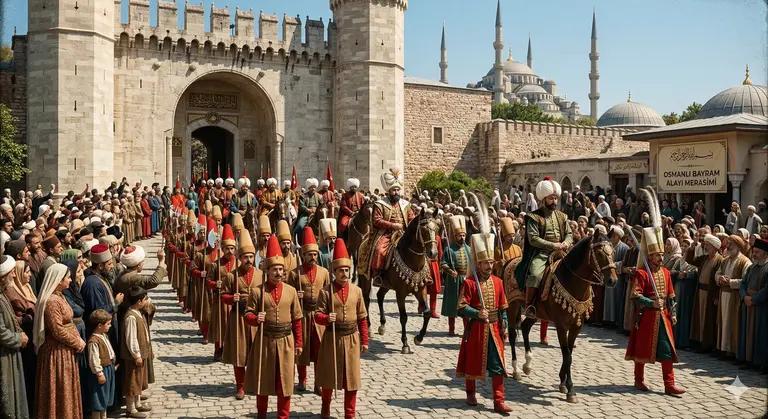
Bayram Alayı Depiction (Generated by Artificial Intelligence)
In the Ottoman period, the official start of the holiday was determined by the sighting of the Shawwal crescent or the completion of Ramadan’s thirty days (tekmil-i selasin). This determination was the responsibility of the Kadı of Istanbul, who received a substantial tip upon delivering the news to the palace.【4】 On the eve of the holiday, starting in the afternoon, cannons fired from the Tersane and Donanma announced the arrival of the holiday to the city.【5】
Preparations in the palace began after the afternoon prayer on Arife day with the Arife Divanı, held before the Arife Tahtı placed in the second courtyard of the palace. The sultan received congratulations from Birun and Enderun officials, during which horses from the Has Ahır were displayed adorned with jeweled trappings.【6】 On the night of the holiday, lanterns were hung from mosque minarets, and banners inscribed with phrases such as "Elveda Ramazan" or holiday greetings were displayed.
The principal official ceremony, Muayede, took place on the morning of the holiday on the ornate Bayram Tahtı erected before the Bâbüssaâde. After performing the morning prayer in the Hırka-i Saadet Chamber within the palace, the sultan donned special ceremonial attire and took his seat on the throne.【7】
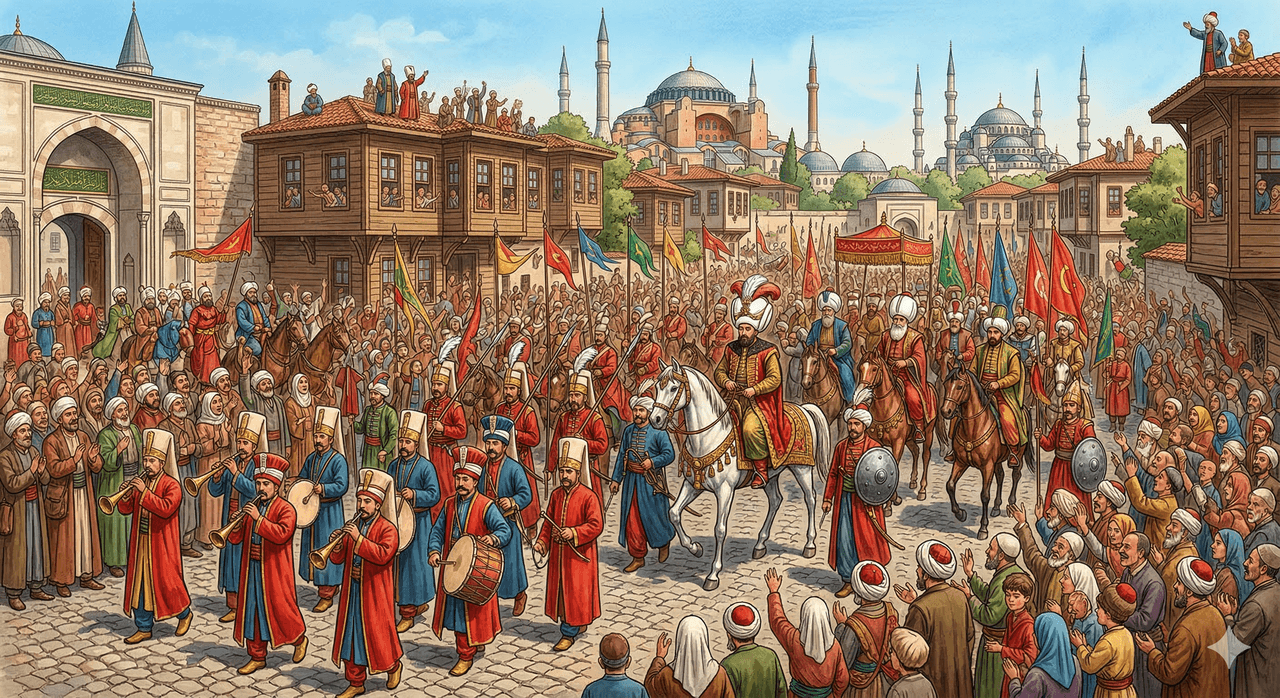
Bayram Alayı (Generated by Artificial Intelligence)
After the formal congratulations at the palace, the sultan typically mounted his horse to proceed to either Hagia Sophia or Sultan Ahmed Mosque.【11】 The Bayram Alayı was the most anticipated spectacle of the year for the people of Istanbul; crowds filled streetsides, windows, and balconies. Foreign observers such as French traveler Gérard de Nerval likened the procession to "a walking forest" and noted that the sultan’s horse was adorned with diamonds.【12】
A strict hierarchy governed the procession: foot attendants from the palace led the way, followed by mounted defterdars, nişancıs, and viziers; the Grand Vizier, flanked on either side by newyçeri çorbacıları bearing spears, marched immediately before the sultan. Around the sultan were hasekis, peyks, and solaks dressed in red-draped attire, followed closely by high-ranking members of the retinue such as the Silahdar Ağa and Kızlar Ağası. This visual splendor functioned as a legitimizing mechanism reinforcing public loyalty to the sultan.【13】
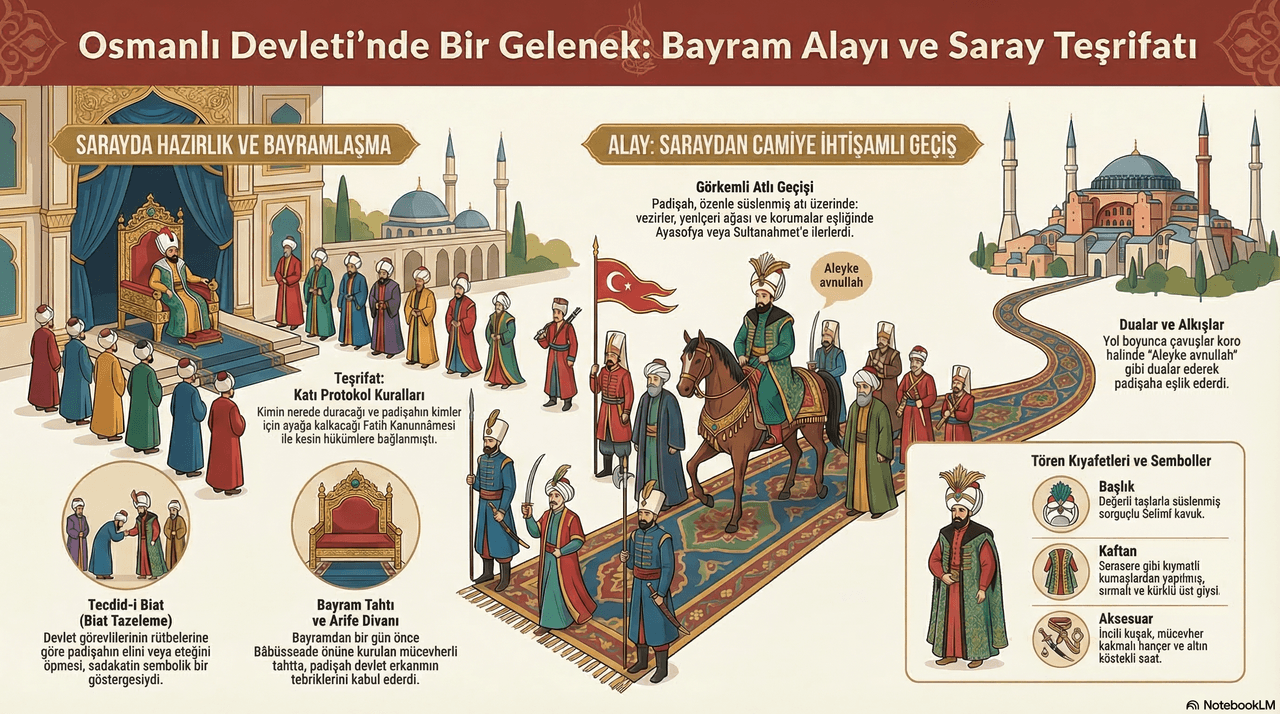
Bayram Alayı Infographic (Generated by Artificial Intelligence)
The sermons delivered after the holiday prayer were among the most important elements reinforcing the religious and political legitimacy of the ceremony. In the classical period, the sermon served as a symbol of legitimacy by invoking the name of the Islamic ruler and offering prayers for him. The content of the sermon included religious advice as well as invocations for the sultan’s and state’s well-being and the army’s victory.【14】
From the 19th century onward, sermon content expanded to include social and political issues, incorporating elements aimed at calming public sentiment during periods of state modernization and wartime. During the early Republican period, a profound transformation occurred in the language of sermons; beginning in 1927, sermons were delivered in Turkish.【15】
Although the two holidays shared similar ceremonial protocols, Eid al-Adha featured a distinctive Sacrifice Ceremony that set it apart.【16】 Upon returning from the mosque, the sultan personally slaughtered several rams prepared for him before the mounted stone at the palace gate. Nine sacrificial animals, their horns gilded and their wool dyed with henna, were sacrificed; the Darüssaâde Ağası was presented with a ceremonial robe, and the first animal’s kidney was grilled for the sultan’s consumption.【17】 In contrast, Ramadan Bayramı was primarily marked by the distribution of sweets and sugar treats (Şeker Bayramı) and the giving of fitre.
Holidays occupied a central place in the extensive system of almsgiving and gift-giving within the Ottoman palace and society at large. One of the most enduring traditions was the sultan’s distribution of a month’s salary as an ıydiyye to officers and officials; however, during periods of financial strain, this amount was sometimes halved or entirely suspended. For the religious class, cash and in-kind payments known as "kürk bahası" or "iftariye" were made to the sheikhs of major mosques and prominent ulema.【18】 Military personnel, especially janissaries, received food offerings such as soup, lamb meat, halva, and sugar served on silver trays outside the palace kitchens.
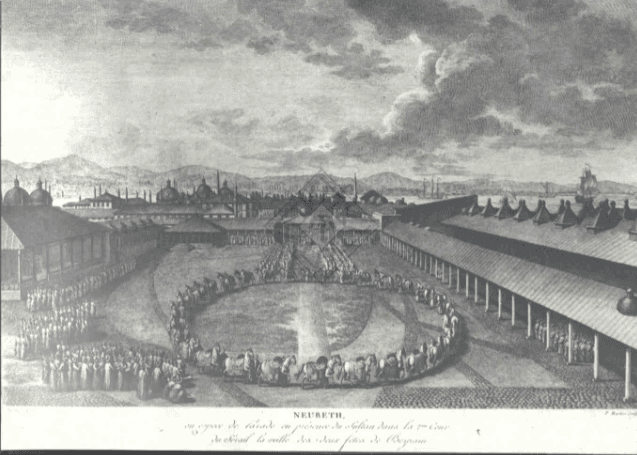
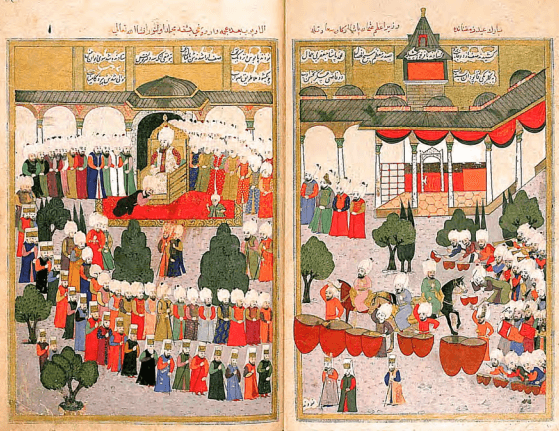
A Holiday Ceremony in the Second Courtyard of Topkapı Sarayı (Turkish Historical Society)
The tradition of gift-giving continued within the palace through the presentation of silk garments and jewelry to women, while socially, the joy of the holiday was extended through initiatives such as pardons for prisoners and the sending of halva to prisons. During the Republican era, these traditional acts of charity evolved into modern social welfare activities. In this period, holiday badges were sold in support of institutions such as Himaye-i Etfal and Tayyare Cemiyeti, with proceeds directed toward public-benefit initiatives like the education and care of orphaned and needy children.【19】
Ottoman holiday processions underwent various transformations over the centuries in parallel with the empire’s modernization efforts and spatial changes. Originally conducted around Topkapı Palace in the classical period, these ceremonies were relocated from 1845 onward to the Muayede Salonu in Dolmabahçe Palace and to newly constructed mosques in Western style.【20】 Under Mahmud II, traditional kaftans were replaced by trousers and fezzes, and a military band was added alongside the mehter ensemble. During the reign of Abdülhamid II, security concerns led to the restriction of processions to the Hamidiye Mosque near Yıldız Palace.【21】
With the proclamation of the Republic and the separation of religion and state affairs, the official protocol significance of the holiday processions was gradually diminished. The prayer held at Hacı Bayram Mosque in Ankara in 1924 and the subsequent official reception marked a turning point, replacing the former imperial splendor with the new state’s simplicity.【22】 Beginning in 1926, the state officially ceased conducting religious ceremonies; although holidays retained their status as official holidays, they became part of social life outside state protocol. The transformation initiated by the adoption of Turkish for sermons was completed by the reforms of 1932, ensuring that while holidays retained their religious character, they were formally removed from the realm of state protocol as a requirement of the secular state structure.【23】
Afyoncu, Erhan. "Bayram dediğin sarayda kutlanır". Türk Gençlik Vakfı. Accessed March 18, 2026. http://www.turkgenclikvakfi.org/makaleler/?key=185
Diyanet Haber. "Bir Osmanlı geleneği: Bayram Alayı." Accessed March 18, 2026. https://www.diyanethaber.com.tr/bir-osmanli-gelenegi-bayram-alayi
Ertuğ, Zeynep Tarım. "Osmanlı İstanbul'unda Merasim ve Teşrifata Dair Kaynaklar." *Türkiye Araştırmaları Literatür Dergisi* 8, no. 16 (2010): 131-148. Accessed March 18, 2026. https://dergipark.org.tr/en/download/article-file/652819
Haral, Hesna. "Minyatürde Osmanlı Bayramı." *Din ve Hayat* 5 (2008): 84–85. Accessed March 18, 2026. https://isamveri.org/pdfdrg/D03292/2008/2008_5/2008_5_HARALH.pdf
Karateke, Hakan T. *Padişahım Çok Yaşa: Osmanlı Devlet Teşrifatında Merasimler*. İstanbul: Kitap Yayınevi, 2004. Accessed March 18, 2026. https://www.scribd.com/document/846062593/Hakan-T-Karateke-Padis-ah%C4%B1m-C-ok-Yas-a-Kitap-Yay%C4%B1nevi
Nutku, Özdemir. "Bayram Alayı." TDV İslâm Ansiklopedisi, Volume 5, pp. 265-266. 1992. Accessed March 18, 2026. https://islamansiklopedisi.org.tr/bayram-alayi
Preyger, Firuze. "Bayram Tahtı." Accessed March 18, 2026. https://dergipark.org.tr/en/download/article-file/2158429
Tinas, Samet. "İmparatorluk Sarayında Bayram Merasimi." *Derin Tarih*, June 2018, pp. 54–58. https://www.academia.edu/117327576/Osmanl%C4%B1da_Bayram_Merasimi
Turk TarihKurumu Arşivi. "Bayram Alayı," Photo No. 9918. Accessed March 18, 2026. https://arsiv.ttk.gov.tr/details?id=9918&materialType=F&query=Bayram+Alay%C4%B1#gallery-13.
Yaşar, Beyzanur. "Osmanlı'dan Cumhuriyet'e İstanbul'da Ramazan." *Tarih Kritik* 5 (April 2019): 146–147. Accessed March 18, 2026. https://dergipark.org.tr/tr/pub/tarihkritik/article/550481
İbiş, Mine. "Meşrutiyet’ten Cumhuriyet’e Geleneksel ve Dini Bayramlar (1908-1938)." Master's thesis, Dokuz Eylül Üniversitesi, 2022. pp. 1-126. Accessed March 18, 2026. https://avesis.deu.edu.tr/dosya?id=a8123d72-ffd4-4c14-9269-1f7cc381ef9a
İstanbul Ansiklopedisi. "Bayram Alayı ve Osmanlı Sarayında Bayram Tebriki Merasimi." Volume 4, pp. 2292-2296. Accessed March 18, 2026. https://istanbulansiklopedisi.org/handle/rek/6252
Şimşirgil, Ahmet. "Sarayda Bayramlaşma". ADEMDER. Accessed March 18, 2026. https://www.ademder.org.tr/blog/ahmet-%C5%9Fim%C5%9Firgil/ahmet-simsirgil-makaleleri/saraydabayramlasma
[1]
Özdemir Nutku, "Bayram Alayı", TDV İslâm Ansiklopedisi, Volume 5 (Istanbul: 1992), 265. Accessed 18 March 2026, https://islamansiklopedisi.org.tr/bayram-alayi
[2]
Mine İbiş, "Meşrutiyet’ten Cumhuriyet’e Geleneksel ve Dini Bayramlar (1908-1938)" (Master’s Thesis, Dokuz Eylül University, 2022), 10. Accessed 18 March 2026, https://avesis.deu.edu.tr/dosya?id=a8123d72-ffd4-4c14-9269-1f7cc381ef9a
[3]
Ahmet Şimşirgil, "Sarayda Bayramlaşma", ADEMDER, Access Date: 18 March 2026, https://www.ademder.org.tr/blog/ahmet-%C5%9Fim%C5%9Firgil/ahmet-simsirgil-makaleleri/saraydabayramlasma
[4]
Erhan Afyoncu, "Bayram dediğin sarayda kutlanır", Türk Gençlik Vakfı, Access Date: 18 March 2026, http://www.turkgenclikvakfi.org/makaleler/?key=185
[5]
Mine İbiş, "Meşrutiyet’ten Cumhuriyet’e Geleneksel ve Dini Bayramlar (1908-1938)". Master’s Thesis, Dokuz Eylül University, 2022, 35. Accessed 18 March 2026, https://avesis.deu.edu.tr/dosya?id=a8123d72-ffd4-4c14-9269-1f7cc381ef9a
[6]
Zeynep Tarım Ertuğ, "Osmanlı İstanbul'unda Merasim ve Teşrifata Dair Kaynaklar", Türkiye Araştırmaları Literatür Dergisi 8, no. 16 (2010): 132. Accessed 18 March 2026. https://dergipark.org.tr/en/download/article-file/652819
[7]
Özdemir Nutku. "Bayram Alayı". TDV İslâm Ansiklopedisi. Volume 5. Istanbul: 1992. Accessed 18 March 2026. https://islamansiklopedisi.org.tr/bayram-alayi
[8]
Firuze Preyger, "Bayram Tahtı", Sarayda Bayram Merasimleri, Access Date: 18 March 2026, 72. https://dergipark.org.tr/en/download/article-file/2158429
[9]
Hakan T. Karateke, Padişahım Çok Yaşa: Osmanlı Devlet Teşrifatında Merasimler (Istanbul: Kitap Yayınevi, 2004), 119. Accessed 18 March 2026. https://www.scribd.com/document/846062593/Hakan-T-Karateke-Padis-ah%C4%B1m-C-ok-Yas-a-Kitap-Yay%C4%B1nevi
[10]
Ahmet Şimşirgil, "Sarayda Bayramlaşma", ADEMDER, Access Date: 18 March 2026, https://www.ademder.org.tr/blog/ahmet-%C5%9Fim%C5%9Firgil/ahmet-simsirgil-makaleleri/saraydabayramlasma
[11]
Diyanet Haber, "Bir Osmanlı geleneği: Bayram Alayı", Access Date: 18 March 2026, https://www.diyanethaber.com.tr/bir-osmanli-gelenegi-bayram-alayi
[12]
Mine İbiş, "Meşrutiyet’ten Cumhuriyet’e Geleneksel ve Dini Bayramlar (1908-1938)". Master’s Thesis, Dokuz Eylül University, 2022, 36. Accessed 18 March 2026, https://avesis.deu.edu.tr/dosya?id=a8123d72-ffd4-4c14-9269-1f7cc381ef9a
[13]
Hesna Haral, "Minyatürde Osmanlı Bayramı", Din ve Hayat 5 (2008): 85. Accessed 18 March 2026 https://isamveri.org/pdfdrg/D03292/2008/2008_5/2008_5_HARALH.pdf
[14]
Mine İbiş. "Meşrutiyet’ten Cumhuriyet’e Geleneksel ve Dini Bayramlar (1908-1938)". Master’s Thesis, Dokuz Eylül University, 2022, 38. Accessed 18 March 2026. https://avesis.deu.edu.tr/dosya?id=a8123d72-ffd4-4c14-9269-1f7cc381ef9a
[15]
Beyzanur Yaşar, "Osmanlı'dan Cumhuriyet'e İstanbul'da Ramazan", Tarih Kritik 5 (April 2019): 146. Accessed 18 March 2026. https://dergipark.org.tr/tr/pub/tarihkritik/article/550481
[16]
Mine İbiş. "Meşrutiyet’ten Cumhuriyet’e Geleneksel ve Dini Bayramlar (1908-1938)". Master’s Thesis, Dokuz Eylül Üniversitesi, 2022, 36. Accessed 18 March 2026. https://avesis.deu.edu.tr/dosya?id=a8123d72-ffd4-4c14-9269-1f7cc381ef9a
[17]
Mine İbiş. "Meşrutiyet’ten Cumhuriyet’e Geleneksel ve Dini Bayramlar (1908-1938)". Master’s Thesis, Dokuz Eylül Üniversitesi, 2022, 37. https://avesis.deu.edu.tr/dosya?id=a8123d72-ffd4-4c14-9269-1f7cc381ef9a
[18]
Erhan Afyoncu, "Bayram dediğin sarayda kutlanır", Türk Gençlik Vakfı, Access Date: 7 May 2026, http://www.turkgenclikvakfi.org/makaleler/?key=185
[19]
Mine İbiş, "Meşrutiyet’ten Cumhuriyet’e Geleneksel ve Dini Bayramlar (1908-1938)" (Master’s Thesis, Dokuz Eylül University, 2022), 97. Accessed 7 May 2026. https://avesis.deu.edu.tr/yonetilen-tez/ad65f738-a4dd-4618-94c7-0b16cb0e72cb/mesrutiyetten-cumhuriyete-geleneksel-ve-dini-bayramlar-1908-1938
[20]
İstanbul Ansiklopedisi, "Bayram Alayı ve Osmanlı Sarayında Bayram Tebriki Merasimi", 2296. Accessed 7 May 2026. https://istanbulansiklopedisi.org/handle/rek/6252
[21]
Hakan T. Karateke Padişahım Çok Yaşa: Osmanlı Devlet Teşrifatında Merasimler. Istanbul: Kitap Yayınevi, 2004. 130. Accessed 7 May 2026. https://www.scribd.com/document/846062593/Hakan-T-Karateke-Padis-ah%C4%B1m-C-ok-Yas-a-Kitap-Yay%C4%B1nevi
[22]
Mine İbiş, "Meşrutiyet’ten Cumhuriyet’e Geleneksel ve Dini Bayramlar (1908-1938)" (Master’s Thesis, Dokuz Eylül University, 2022), 89. Accessed 7 May 2026. https://avesis.deu.edu.tr/yonetilen-tez/ad65f738-a4dd-4618-94c7-0b16cb0e72cb/mesrutiyetten-cumhuriyete-geleneksel-ve-dini-bayramlar-1908-1938
[23]
Beyzanur Yaşar. "Osmanlı'dan Cumhuriyet'e İstanbul'da Ramazan". Tarih Kritik 5 (April 2019): 146. Accessed 7 May 2026. https://dergipark.org.tr/tr/pub/tarihkritik/article/550481

Henüz Tartışma Girilmemiştir
"Festival Procession" maddesi için tartışma başlatın
The Beginning of the Holiday and the Arife Ceremony
Muayede (Palace Holiday Ceremony) and Protocol Order
Organization of the Bayram Alayı and Public Participation
Eid Sermons and Religious Content
Differences Between Ramadan and Eid al-Adha Processions
Holiday Alms and Gifts
Historical Transformation and the End of the Ceremonies