
Bu içerik Türkçe olarak yazılmış olup yapay zeka ile otomatik olarak İngilizceye çevrilmiştir.
The Galiçnik Wedding is a traditional wedding ceremony unique to the Mijak (Mijaç) ethnographic region, held for centuries in the mountain village of Galiçnik, within the boundaries of the Mavrovo and Rostuše Municipality in western North Macedonia. Historically linked to the village’s socio-economic structure, patterns of migration, belief systems, and collective memory, this wedding takes place around Saint Peter and Paul Day (12 July) according to the Orthodox Christian calendar. Today, the Galiçnik Wedding is recognized as a public cultural event that functions both as a living ritual and as a festival, forming an integral part of North Macedonia’s cultural heritage.
Content related to the Galiçnik Wedding (TRT News)
The Galiçnik Wedding is a ceremonial practice shaped not by the physical characteristics of the village settlement but by the Mijak community’s understanding of marriage, belief system, and social organization. This wedding tradition, performed around Saint Peter and Paul Day (12 July) in the Orthodox Christian calendar, became possible due to the seasonal return of men who spent most of the year working as migrant laborers outside the village. As a result, the wedding emerged as a concentrated collective marriage practice; historically, multiple weddings took place on the same day, with rituals extending over several days, transforming it into a major social event.
From the mid-20th century onward, increased migration led to a decline in the village population and disruptions in traditional weddings. To counter this cultural loss, local entrepreneurs proposed in the late 1950s a symbolic reenactment of the wedding rituals; 1963 marks the year the Galiçnik Wedding was officially recognized as a cultural event.【1】 Rituals were shortened to two days and presented within defined frameworks. Improved transportation after 1973 enabled the event to become regular, and from 1991 onward, weddings were once again performed as actual ceremonies for real couples.【2】

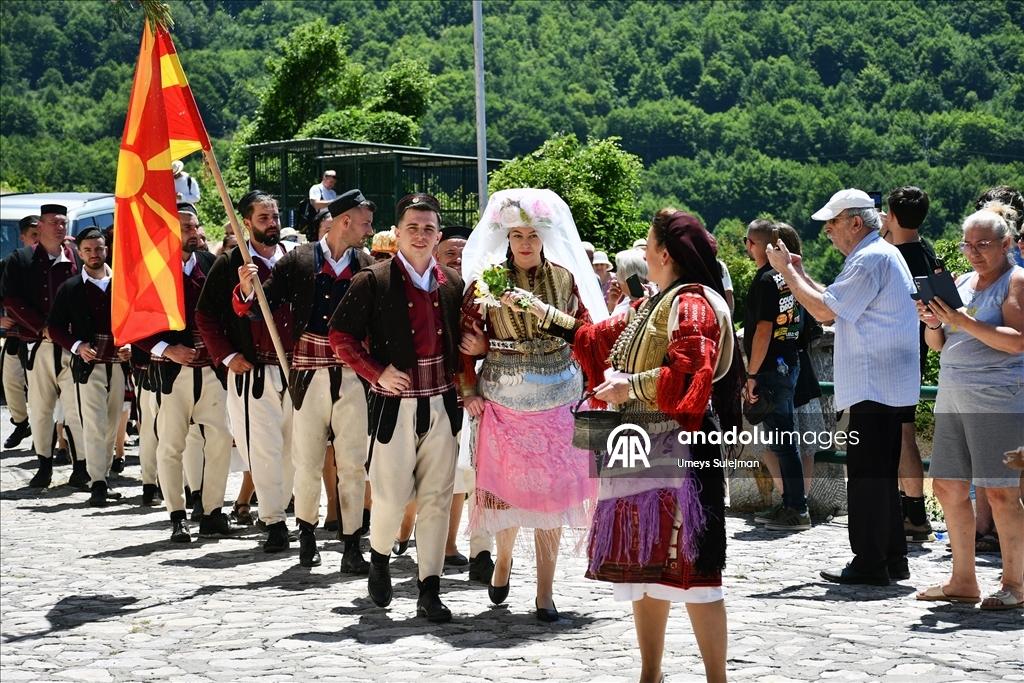
The Bride Being Brought to the Groom’s House on Horseback (Anadolu Agency)
Traditionally, the Galiçnik Wedding lasts two days. The first day begins with flag decorations, the welcoming of musicians, and various folk dances. The second day features rituals laden with symbolic meaning. Processions accompanied by drum and zurna transform into festive gatherings involving the entire village community. In this way, the complete set of rituals forms a ceremonial sequence that keeps the community’s collective memory alive.
The wedding process consists of approximately 25 distinct rituals. Celebrations begin with the raising of flags at the groom’s house and the firing of guns, followed by the welcoming of musicians accompanied by drum and zurna (zurla). On Saturday night, rituals include torchlight processions and the bride filling water from three fountains. On Sunday morning, participants visit the cemetery in a ritual known as “inviting the dead,” seeking permission from the spirits of deceased relatives and offering prayers for their well-being.【3】 The shaving of the groom in front of the entire village symbolizes his transition from childhood to adulthood and his assumption of family leadership, while practices such as the bride being brought to the groom’s house on horseback and being welcomed by her mother-in-law represent fertility and adherence to family hierarchy.

The Groom Being Shaved in Front of the Village Community (Anadolu Agency)
The Galiçnik Wedding is renowned for its distinctive folk dances of the Mijak region. Nevestinsko oro (Bride’s Dance) and Svekrvinsko oro (Mother-in-Law’s Dance) feature movements specific to women, while Teshkoto oro, performed exclusively by men, is one of the symbolic dances of Macedonian folklore, characterized by its heavy, deliberate steps. Musical accompaniment is provided by traditional instruments such as the drum and zurna. Among the folk dances performed during the ceremony, “Teshkoto” holds a special place. This dance, performed only by men, expresses through its weighty and solemn movements the hardships, longing for home, and pursuit of freedom experienced by the Mijak people over centuries. The Bride’s Dance, in contrast, symbolizes the grace of the woman and her dignified status within society.【4】
The Teshkoto Dance Performed at the Galiçnik Wedding (MirceJ)
Traditional costumes are among the most defining visual elements of the Galiçnik Wedding. The bride wears two separate outfits, one representing her unmarried status and the other her married status. These garments, crafted with intricate metal embroidery, natural fabrics, and hand-decorated embellishments, are often family heirlooms. Men’s attire is simpler but features heavy fabrics and accessories. Women’s costumes weigh approximately 24 kilograms, while men’s consist of white woolen trousers and thick tunics, weighing around 8 kilograms.【5】
Galiçnik is one of the oldest and most symbolic settlements of the Mijak ethnographic region. The Mijak people have made significant contributions to North Macedonia’s cultural history through their architecture, woodcarving, iconography, and traditional dress. They developed unique rituals and incorporated these elements into various rites of passage. The Galiçnik Wedding is a ceremonial manifestation of this cultural identity.
Today, the Galiçnik Wedding has become an essential component of state-sponsored cultural and tourism policies. Thousands of domestic and international visitors experience North Macedonia’s folkloric heritage through this event. The festival temporarily revitalizes depopulated or abandoned rural areas and contributes to the development of alternative and culture-based tourism.
Anadolu Ajansı. "Dağların Eteğinde Asırlık Bir Şölen: Galiçnik Düğünü." Accessed December 23, 2025. https://www.aa.com.tr/tr/yasam/daglarin-eteginde-asirlik-bir-solen-galicnik-dugunu/3629727
Crevar, Alex. “Look Inside Europe’s Most Traditional Wedding Festival.” National Geographic. Accessed December 23, 2025. https://www.nationalgeographic.com/travel/article/things-to-do-galicnik-wedding-festival
Kragueva, Sandra. “The Wedding of Galicnik – Macedonian Tradition with Worldwide Presentation on YouTube.” UKLO Proceedings, 139–147. Accessed December 23, 2025. https://www.researchgate.net/publication/396876790_THE_WEDDING_OF_GALICNIK_-_MACEDONIAN_TRADITION_WITH_WORLDWIDE_PRESENTATION_ON_YOUTUBE
Mirce, J. "Galicnik wedding 2017: Teshkoto." YouTube Video. July 21, 2018. Accessed December 23, 2025. https://www.youtube.com/watch?v=HotpkPNdPhY
North Macedonia Timeless. “Galiçnik Düğünü 12th July.” Accessed December 23, 2025. https://macedonia-timeless.com/tur/yaplacakeyler/duyulararaclylamakedonyayahissetmek/sespgelenekveorganizasyonlarp/kltreletkinlikler/galinikdn12thjuly
Samardjiev, Aleksandar. “Galičnik Wedding: Guardians of the Traditions of Macedonian Migrant Workers.” *Osservatorio Balcani e Caucaso Transeuropa.* Accessed December 23, 2025. https://www.balcanicaucaso.org/en/cp_article/galicnik-wedding-guardians-of-the-traditions-of-macedonian-migrant-workers/
TRT Haber. "Kuzey Makedonya'nın geleneksel Galiçnik düğünü yaşatılıyor." Accessed December 23, 2025. https://www.trthaber.com/haber/dunya/kuzey-makedonyanin-geleneksel-galicnik-dugunu-yasatiliyor-696818.html
TRT Haber. "Kuzey Makedonya'nın geleneksel Galiçnik düğünü yaşatılıyor." YouTube Video. Date Published: July 24, 2022. Accessed December 23, 2025. https://www.youtube.com/watch?v=Q6HrvfYCkEw
[1]
Sandra Kragueva, “The Wedding of Galicnik – Macedonian Tradition with Worldwide Presentation on YouTube,” sayfa 140, erişim 23 Aralık 2025.
[2]
Sandra Kragueva, “The Wedding of Galicnik – Macedonian Tradition with Worldwide Presentation on YouTube,” sayfa 140, erişim 23 Aralık 2025.
[3]
Alex Crevar, “Look Inside Europe’s Most Traditional Wedding Festival,” National Geographic, erişim 23 Aralık 2025, https://www.nationalgeographic.com/travel/article/things-to-do-galicnik-wedding-festival
[4]
Sandra Kragueva, “The Wedding of Galicnik – Macedonian Tradition with Worldwide Presentation on YouTube,” sayfa 140, erişim 23 Aralık 2025.
[5]
Aleksandar Samardjiev, “Galičnik Wedding: Guardians of the Traditions of Macedonian Migrant Workers,” Osservatorio Balcani e Caucaso Transeuropa, erişim 23 Aralık 2025, https://www.balcanicaucaso.org/en/cp_article/galicnik-wedding-guardians-of-the-traditions-of-macedonian-migrant-workers/

Henüz Tartışma Girilmemiştir
"Galiçnik Wedding" maddesi için tartışma başlatın
Historical Background
The Festivalization Process
General Structure of the Wedding Rituals
Main Rituals
Dances and Music
Traditional Costumes
The Mijak Community and Cultural Identity
Tourism and Contemporary Significance