


Bu içerik Türkçe olarak yazılmış olup yapay zeka ile otomatik olarak İngilizceye çevrilmiştir.
+1 Daha
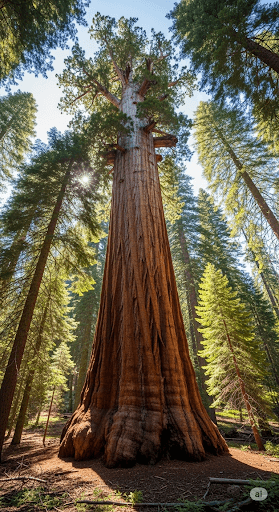
In the western slopes of the Sierra Nevada mountain range in western North America, Sequoiadendron giganteum—commonly known in Turkish as Dev sekoya—persists naturally in a limited number of groves and ranks among the largest-volume living organisms on Earth. This long-lived conifer, adapted to the continental variant of a temperate Mediterranean climate and growing on calcareous granitic bedrock, is a unique paleoendemic with distinctive ecological functions and historical-cultural significance. Its narrow geographic distribution, confined to a small number of groves, is the product of a complex phytogeographic process shaped by climatic oscillations and evolutionary pressures from fire regimes since the late Quaternary. Findings from modern conservation biology, genomics, and forestry are redefining the biological resilience of Dev sekoya ecosystems and linking the species’ future to the fragile balance between fire intensity and climate variability.
The genus Sequoiadendron, within the family Cupressaceae, is restricted to a single extant species following the Miocene. Morphological data indicate a speciation process extending into the late Quaternary, shared with its close relative Sequoia sempervirens through a common ancestor. Phylogenetic analyses supported by the most recent complete reference genome (26.5 Gbp) reveal that adaptive gene clusters are concentrated around disease-resistant NLR genes, and polyploid-derived repetitive sequences may contribute significantly to the species’ exceptional longevity and stress tolerance.
The trunk, averaging 80–90 meters in height and exceeding 8 meters in diameter, is protected by a fibrous, thick bark layer that serves as a natural shield against mechanical damage and fire. The high water content accumulated in the bark reduces thermal conductivity of flames, while the limited number of resin canals prevents post-fire flammable accumulation. Tracheid diameters enabling rapid vertical water transport facilitate high hydraulic conductivity; however, this is counterbalanced by increased xylem wall thickness to mitigate potential cavitation risk.

Stem, Branch, and Bark Structure (Generated by Artificial Intelligence)
Serotinous cones—triggered to open by fire—contain over 2,000 seeds; seed release typically peaks during the first two years following a fire. Embryonic development depends critically on thermal niches formed by charred organic layers on the soil surface during the first five years. Young seedlings exhibit low shade tolerance; however, their root systems grow rapidly enough to access soil moisture from deep layers.

Cone and Reproductive Phenology (Generated by Artificial Intelligence)
Low leaf needle water potential, maintained through a hydraulic lift mechanism, enables isohydric balance throughout the day. Even at heights approaching 100 meters, stomatal closure thresholds are calibrated to preserve photosynthetic capacity. Photosynthetic nitrogen use efficiency (PNUE) is high, and this is balanced by a long needle lifespan (4–5 years), which offsets structural carbon costs.
Today, fewer than 80 groves are known, distributed between elevations of 1,400 and 2,150 meters. The total natural range extends from the American River basin in the north to Deer Creek Grove in the south, covering only 144 km². Winters characterized by snowfall and springs marked by snowmelt are critical for seed germination, as timing and volume of meltwater directly determine success.
Historical fire cycles were characterized by low- to moderate-intensity fires occurring every 5–20 years. These fires thinned the shrub understory and exposed mineral soil, creating optimal seedbeds. Modern fire suppression policies have extended fire intervals, leading to dense fuel accumulation in groves. The 2020 SQF and 2021 KNP megafires caused mortality of up to 19% of mature trees. Post-high-intensity fire resprouting declines sharply, whereas seedling densities after moderate-intensity burns remain consistent with historical reference levels.

Internal Structure (Generated by Artificial Intelligence)
Rising average temperatures and declining snowpack equivalents in the region cause earlier seasonal soil moisture depletion. Long-term dendroclimatological analyses reveal that radial growth shows a positive correlation with April–June snowmelt water availability and a negative correlation with maximum June temperatures. Increasing vapor pressure deficit narrows hydraulic safety margins while simultaneously elevating fire intensity.
Dev sekoya groves form mosaics with other tree species such as Jeffrey pine (Pinus jeffreyi), sugar pine (P. lambertiana), and western juniper (Juniperus occidentalis); within the microhabitat understory, endemic lichen and bryophyte communities thrive. Cavernous trunk cavities provide nesting sites for bird species such as the red-breasted sapsucker (Dryobates tyro). The dense biomass of these groves is estimated to sequester an average of 12–15 metric tons of CO₂ equivalent annually from the atmosphere; total carbon storage per grove exceeds that of some tropical rainforest slopes.
Scott, A. D., Zimin, A. V., Puiu, D., Workman, R., Britton, M., Zaman, S., Caballero, M., Read, A. C., Bogdanove, A. J., Burns, E., Wegrzyn, J., Timp, W., Salzberg, S. L., & Neale, D. B. (2020). A reference genome sequence for Giant sequoia. *G3 Genes Genomes Genetics*, *10*(11), 3907–3919. https://doi.org/10.1534/g3.120.401612.
Soderberg, D. N., Das, A. J., Stephenson, N. L., Meyer, M. D., Brigham, C. A., and Flickinger, J. (2024). Assessing giant sequoia mortality and regeneration following high-severity wildfire. *Ecosphere*, *15*(3). https://doi.org/10.1002/ecs2.4789.
Stephenson, N. L., Caprio, A. C., Soderberg, D. N., Das, A. J., Lopez, E. L., & Williams, A. P. (2024). Post-fire reference densities for giant sequoia seedlings in a new era of high-severity wildfires. *Forest Ecology and Management*, *562*, 121916. https://doi.org/10.1016/j.foreco.2024.121916.
Williams, C. B., Næsborg, R. R., & Dawson, T. E. (2017). Coping with gravity: the foliar water relations of giant sequoia. *Tree Physiology*, *37*(10), 1312–1326. https://doi.org/10.1093/treephys/tpx074.

Henüz Tartışma Girilmemiştir
"Giant Sequoia (Sequoiadendron giganteum)" maddesi için tartışma başlatın
Biological and Morphological Characteristics
Taxonomy and Evolutionary Position
Stem, Branch, and Bark Structure
Cone and Reproductive Phenology
Physiological Adaptations
Ecological Distribution, Habitat Characteristics, and Environmental Interactions
Natural Range and Climatic Limits
Fire Regime and Regeneration Dynamics
Climate Change and Hydrological Stress
Biodiversity Context and Ecosystem Services