
Bu içerik Türkçe olarak yazılmış olup yapay zeka ile otomatik olarak İngilizceye çevrilmiştir.
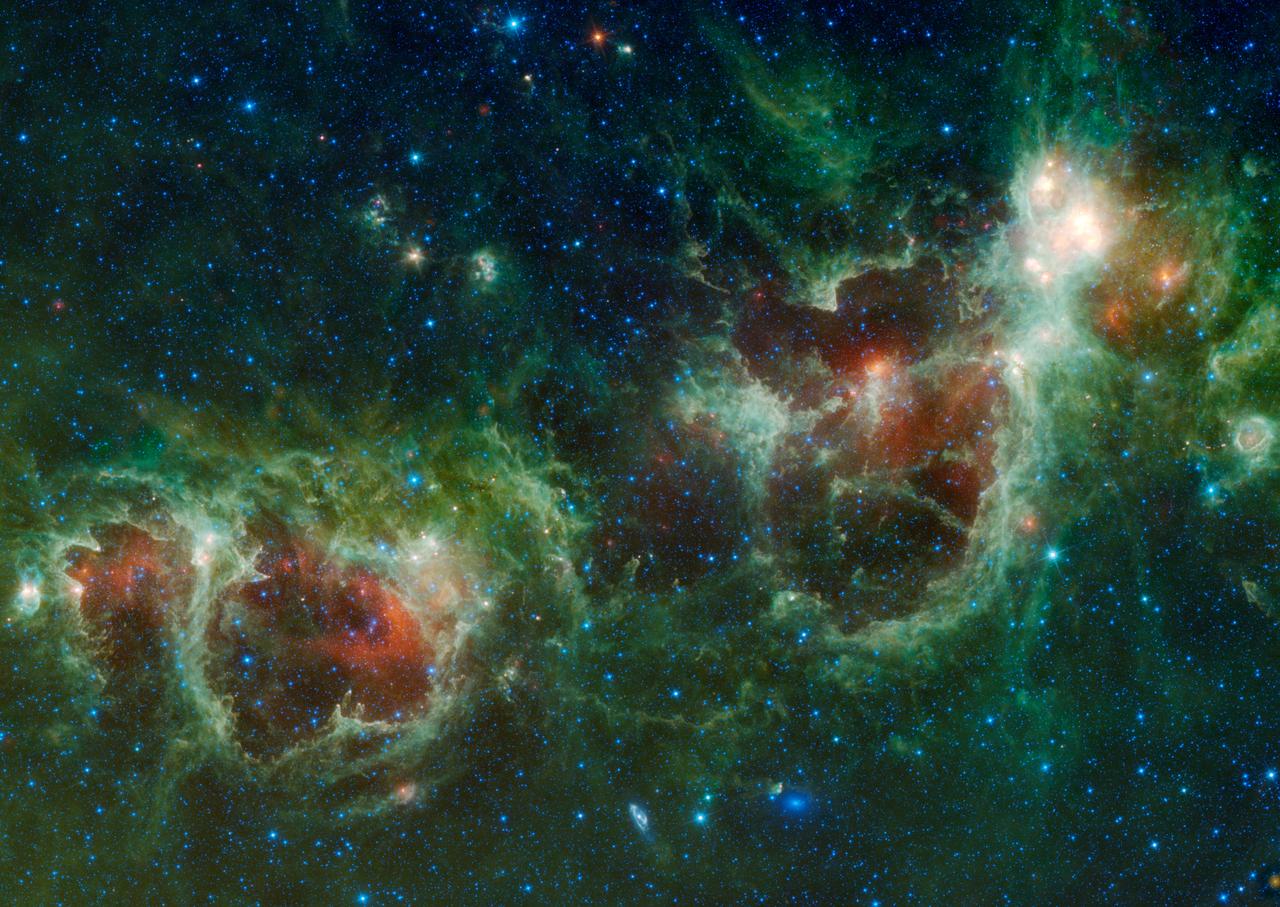
Heart Nebula (IC 1805) and Soul Nebula (IC 1848) are vast and active star-forming regions within the Milky Way Galaxy. Both nebulae are located in the direction of the Cassiopeia constellation and are frequently observed together. Due to their emission of hydrogen alpha (Hα) radiation, they exhibit a bright reddish appearance and are commonly studied in wide-field astrophotography.
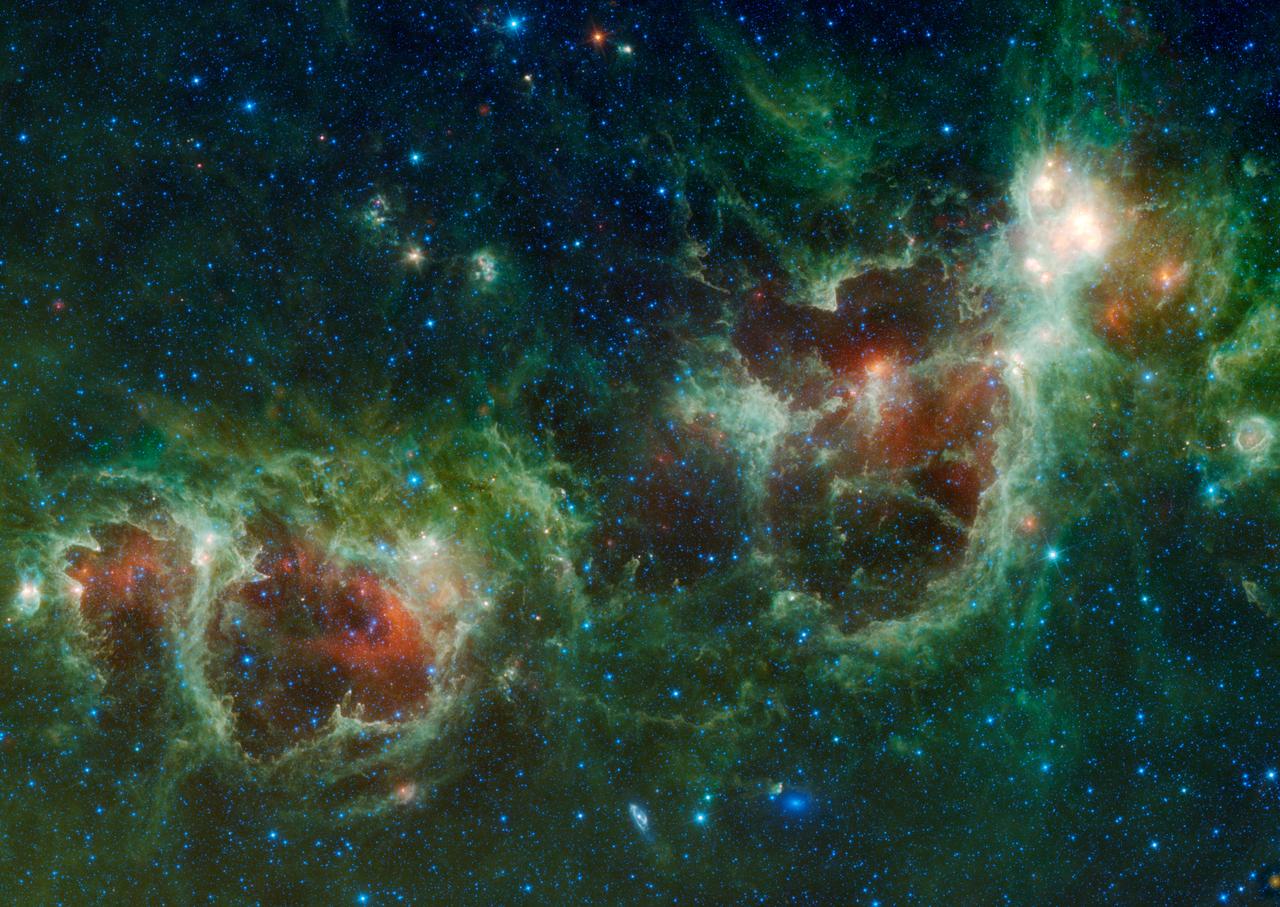
Heart and Soul Nebulae (NASA)
Both nebulae are large H II regions containing ionized hydrogen gas illuminated by young, hot stars. These stars emit radiation that excites the surrounding gas, producing bright emission. The majority of this emission originates from the Hα spectral line. The Heart and Soul Nebulae contain abundant ionized hydrogen (H⁺), dust, molecular gas, and plasma.
At the center of the Heart Nebula lies Melotte 15, a young open star cluster composed of O-type and B-type hot stars that play a key role in shaping the nebula. The Soul Nebula consists of several distinct regions and is commonly associated with the IC 1848 star cluster.
The Heart and Soul Nebulae are active regions of ongoing star formation. Dense clouds of gas and dust within these regions collapse under gravity to form new stars. Infrared observations are particularly important for detecting stars obscured by dust. Observations made with NASA’s Spitzer Space Telescope and the Wide-field Infrared Survey Explorer (WISE) have revealed numerous protostars and young stellar objects (YSOs) within these nebulae.
Both nebulae are observed through strong Hα emission lines. Their spectra also contain forbidden lines such as [O III], [S II], and [N II], which provide information about the physical conditions of the ionized gas. Electron temperatures typically range between 8,000 and 10,000 K.
Due to their large angular extent, the Heart and Soul Nebulae are well suited for observation with small-aperture telescopes or wide-field astrophotography systems. Narrowband filters such as Hα, O III, and S II are frequently used during imaging. Observations are typically conducted between September and March, when the Cassiopeia constellation is high in the sky.
IC 1805 (Heart Nebula) features twisted gas structures along its outer edges and dark dust columns in its interior. Its heart-like appearance arises from curved gas filaments extending outward from the center. IC 1848 (Soul Nebula), sometimes referred to as the Embryo Nebula, has a more fragmented structure with numerous dense condensations and cavities within its interior.
The Heart and Soul Nebulae are important research targets for studying how massive stars shape their surroundings and for understanding the processes of star formation. They also serve as key sites for investigating feedback mechanisms in large H II regions — such as radiation pressure, stellar winds, and supernova remnants — and how these processes influence further star formation.
The nebulae IC 1805 and IC 1848, listed in the Index Catalogue (IC), were discovered during systematic sky surveys conducted in the early 20th century. They were later included in the Sharpless Catalogue (Sh2), compiled by Stewart Sharpless, which catalogs H II regions. These nebulae are classified as regions containing ionized hydrogen and active star formation. Additionally, they appear in the Westerhout Catalogue (W), compiled by Hendrik C. Westerhout based on radio wavelength observations. This multi-catalog designation enables detailed study of their astrophysical properties across different wavelengths.
IC 1805 (Heart Nebula) and IC 1848 (Soul Nebula), located in the direction of the Cassiopeia constellation, are two significant H II regions where star formation remains active. These structures stand out for their morphological richness, including young open star clusters (e.g., Melotte 15), expanding ionized gas bubbles, protostellar cores, and columnar dust structures. These regions provide crucial insights into how massive stars influence their environments and serve as important observational laboratories for understanding multi-generational star formation processes. Multi-wavelength studies in optical, infrared, and radio bands have provided fundamental data on the internal dynamics, chemical composition, and interactions with the interstellar medium of these nebulae.
NASA. "Heart Nebula." *Astronomy Picture of the Day*, September 11, 2019. Accessed July 17, 2025. https://apod.nasa.gov/apod/ap190911.html.
NASA. "In the Heart of the Heart Nebula." *Astronomy Picture of the Day*, February 14, 2022. Accessed July 17, 2025. https://apod.nasa.gov/apod/ap220214.html.
NASA. "The Heart Nebula." *Astronomy Picture of the Day*, December 13, 2023. Accessed July 17, 2025. https://apod.nasa.gov/apod/ap231213.html.
NASA. “WISE Sees the Heart and Soul Nebulae.” *NASA Science.* Accessed July 17, 2025. https://science.nasa.gov/image-detail/heart-and-soul-nebula-as-seen-by-wise-3/.

Henüz Tartışma Girilmemiştir
"Heart and Soul Nebulae (IC 1805-1848)" maddesi için tartışma başlatın
General Properties
Physical Structure and Star Formation
Spectral Properties and Observational Data
Morphology and Astrophysical Significance
Catalog Development