

Bu içerik Türkçe olarak yazılmış olup yapay zeka ile otomatik olarak İngilizceye çevrilmiştir.
+1 Daha
Hinamatsuri (ひな祭り) is a traditional festival celebrated annually in Japan on March 3 to honor the health, happiness, and growth of girls. It is also known as “Girls’ Day” or “Doll’s Day”. The festival includes practices such as displaying special dolls, singing songs, and preparing traditional foods.
The dolls displayed during the celebrations consist of figures representing the Emperor, Empress, and court officials of the imperial palace. Families arrange these dolls in a specific order in their homes and gather on the festival day to offer prayers for the happiness and healthy development of their daughters.
Hinamatsuri draws inspiration from customs dating back to Japan’s Heian Period (794–1185). During this era, purification rituals performed on the snake day of the lunar calendar were conducted to ensure good fortune and health for the remainder of the year. Alongside offerings of food and prayers to the gods, dolls were also used to carry away misfortune, impurity, and bad luck from a person’s life.
As part of these rituals, paper dolls were tied to straw boats and set adrift in rivers, symbolizing the removal of misfortune and negativity. This practice is associated with the tradition known as hina-nagashi, or “floating dolls away.”【1】
Some elements of these Heian Period practices were revived and reinterpreted during the Edo Period (1603–1868) in the context of Hinamatsuri celebrations.【2】 Although the festival has undergone changes and adaptations over time, it has maintained its focus on Japanese history and preserved its traditional elements up to the present day. Thus, the Hinamatsuri dolls used today, even though produced in modern times, depict aristocratic figures from approximately a thousand years ago.
Hinamatsuri is a festival that celebrates the growth and healthy development of girls. Families gather on this day to offer prayers for the happiness and well-being of their daughters. The celebrations take place within a framework that honors the transition of girls from childhood to adulthood.
The dolls displayed during the festival represent the Emperor, Empress, and court officials of the imperial palace. This representation reflects the close relationship between the household and the state in traditional Japanese culture. The symbolic recreation of the imperial court and aristocratic environment within the home makes visible the connection between family structure and social order.【3】
Hinamatsuri also emphasizes the labor and roles of adult women within the family. While honoring the process by which girls become full members of society, the festival reflects the position of women within the family and culture. In this sense, Hinamatsuri is a cultural practice that addresses both individual development and traditional social structure.【4】
During Hinamatsuri, families come together to celebrate and pray for the happiness and healthy growth of their daughters. One of the most prominent customs is the display of Hinamatsuri dolls in the home. Most families take the dolls out of storage in mid-February and put them away again after the festival. There is also an old belief that delaying the removal of the dolls may lead to difficulties in a girl’s future relationships.【5】
A common tradition during the celebrations is to take a photograph of the daughter beside the doll display every year on March 3. This practice is typically continued until the girl reaches the age of twenty and is formally recognized as an adult.
Families consume traditional foods on the celebration day. Vinegar-seasoned rice dishes with vegetables, eggs, and raw seafood, known as chirashizushi, and clear clam soup, called hamaguri ushio-jiru, are widely eaten. As a dessert, sakura mochi stands out; crackers, cookies, and sweets are also consumed. In some doll displays, miniature versions of these foods are arranged in small containers. Songs also play an important role in the festivities. The most commonly sung song on this day is “Ureshii Hina Matsuri”, which is performed as a joyful celebration of the festival’s cheerful atmosphere.【6】
Ureshii Hina Matsuri Song (Japanese Folk Songs)
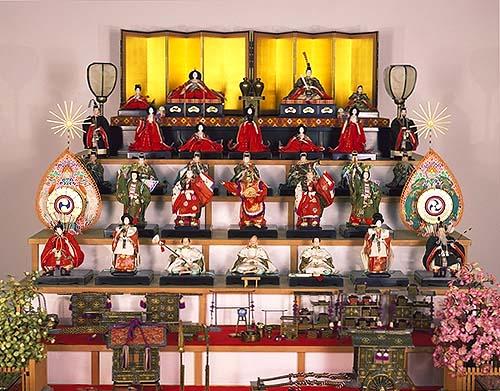
The dolls displayed during Hinamatsuri represent the Emperor and Empress along with court officials. The imperial couple, referred to as the dairi-bina, are placed at the center of the display, with other figures arranged around them to represent the imperial court. Various objects representing food, drink, plants, and household items that would have been presented in the palace are placed around the dolls.
Although Hinamatsuri dolls can be arranged in different ways, traditional displays are typically constructed on a stepped platform. These displays are most commonly five or seven tiers high. Regardless of the number of tiers, the imperial couple is always placed on the topmost level. The Emperor and Empress sit before a golden folding screen. Vases with peach branches are placed between them, and paper lanterns are positioned at each end.
On the second tier, ladies-in-waiting who serve the Empress are placed. These figures represent high-ranking women who accompanied the Empress. Small tables with sweets are arranged among them. The third tier is dedicated to five court musicians, typically arranged in the following order: taiko (barrel drum), otsuzumi (large drum), kotsuzumi (small drum), fue (flute), and a singer holding a sensu (folding fan).
On the fourth tier, the left and right attendants are placed. The left attendant is older and positioned on the right side, while the right attendant is younger and placed on the left side. Tables with covered bowls and diamond-shaped rice cakes are placed between these figures. On the fifth tier, a mandarin orange tree is placed on the right and a peach tree on the left. Between these trees are three figures representing intoxicated servants, each reflecting a different emotional state: one is sad, one is angry, and one is joyful.

Traditional Placement of Figures in a Multi-Tiered Hinamatsuri Display (Generated by AI)
Hinamatsuri dolls have evolved over time into various forms and styles. The earliest examples are known as Tachi-bina, or standing dolls. These dolls emerged before the Edo Period (1603–1868) and were adopted in early Hinamatsuri celebrations. Their bodies are tubular, made of paper or wood, and often painted or covered with textiles. Symbols of longevity such as pine trees and cranes appear among their visual features. Their simple forms are linked to the practice known as hina-nagashi, in which paper dolls were tied to straw boats and released into rivers.【8】

Representative Tachi-Bina Dolls (Kyoto National Museum)
The oldest seated doll style is the Kanei-bina style, which emerged in the early Edo Period during the Kanei Era (1624–1644). It features a more complex structure than earlier paper dolls. The bodies are more realistically shaped, and greater attention is paid to clothing. Garments are typically made of silk satin (shuchin) embroidered with gold and silver thread.【9】
Muromachi-bina dolls feature more realistic hair styling. The use of silk hair allowed for the depiction of various hairstyles. Although produced during the Edo Period, these dolls reflect the historical hair styles and clothing of the Muromachi Period (1336–1568).【10】
By the mid-18th century, Hinamatsuri dolls had become more ornate. Kyoho-bina, named after the Kyoho Era (1716–1735) in which it first appeared, became especially popular among merchants. The dolls’ costumes consist of elaborate and ornate garments that reflect historical conceptions of what the Emperor and Empress might have worn at court during the Heian Period.【11】
The Jirozaemon-bina style, developed by dollmaker Okada Jirozaemon in Kyoto, features figures with loosely folded hands or hands resting on their knees. The feet are rendered more realistically. This style influenced later doll types. The clothing is not overly ornate but combines elements of Heian Period style with a more subdued version of 18th-century court attire.【12】
Yusoku-bina style emerged in the mid-18th century and became popular among bureaucratic elites. It derives its name from a manual detailing aristocratic conduct and etiquette from the Heian Period. The dolls of this style are elaborately dressed to reflect the elegance and dress codes of the imperial elite.【13】

Representative Yusoku-Bina Dolls (Kyoto National Museum)
The Kokin-bina style, developed in Edo (Tokyo) by dollmaker Hara Shugetsu during the Meiwa Era (1764–1772), takes its name from the Heian Period poetry anthology Kokinshu. This style incorporates elements from earlier doll types. The Emperor typically wears a simple black ho (a type of black court garment) reminiscent of the Yusoku-bina style. The Empress wears a twelve-layered junihitoe (twelve-layered court robe) in the Heian style, along with a crown shaped like a mythical phoenix.【14】
The production method of Kokin-bina dolls also differed. Carefully sculpted heads were made in workshops in Edo, while simpler bodies were produced in Kyoto. Innovations such as glass eyes were introduced to the heads, which were then painted, assembled with the bodies, and dressed before being sent to Kyoto. This production method met growing demand. Over time, the Kokin-bina style replaced earlier styles and became the most common doll type today.【15】
Japanase Folk Songs. "Japanese Folk Song #38: The Joyful Dolls' Festival (うれしいひなまつり / Ureshii hinamatsuri)." YouTube. Accessed February 20, 2026. https://youtu.be/uFS9RZXu3YA?si=GchX5UcfKE0dn8D5
Kawakami, Shigeki. "All about Japanese Hina Dolls." Kyoto National Museum. Accessed February 20, 2026. https://www.kyohaku.go.jp/eng/learn/home/dictio/senshoku/hina/
Wake Forest University. "Early Hinamatsuri Dolls." lammuseum.wfu.edu. Accessed February 20, 2026.
Wake Forest University. "Heian-Style Dolls." lammuseum.wfu.edu. Accessed February 20, 2026.
Wake Forest University. "Hinamatsuri: Doll's Day in Japan." lammuseum.wfu.edu. Accessed February 20, 2026. https://lammuseum.wfu.edu/exhibits/virtual/hina-matsuri-dolls-day-in-japan/
Wake Forest University. "Modern Kokin-Bina Dolls." lammuseum.wfu.edu. Accessed February 20, 2026.
Wake Forest University. "The Hinamatsuri Doll Display." lammuseum.wfu.edu. Accessed February 20, 2026.
Wake Forest University. ''What Do People Do on Hinamatsuri?'' lammuseum.wfu.edu. Erişim tarihi: 20 Şubat 2026.
[1]
Wake Forest University, "Hinamatsuri: Doll's Day in Japan," lammuseum.wfu.edu, Erişim tarihi: 20 Şubat 2026, https://lammuseum.wfu.edu/exhibits/virtual/hina-matsuri-dolls-day-in-japan/
[2]
Wake Forest University, "Hinamatsuri: Doll's Day in Japan," lammuseum.wfu.edu, Erişim tarihi: 20 Şubat 2026, https://lammuseum.wfu.edu/exhibits/virtual/hina-matsuri-dolls-day-in-japan/
[3]
Wake Forest University, "Hinamatsuri: Doll's Day in Japan," lammuseum.wfu.edu, Erişim tarihi: 20 Şubat 2026, https://lammuseum.wfu.edu/exhibits/virtual/hina-matsuri-dolls-day-in-japan/
[4]
Wake Forest University, "Hinamatsuri: Doll's Day in Japan," lammuseum.wfu.edu, Erişim tarihi: 20 Şubat 2026, https://lammuseum.wfu.edu/exhibits/virtual/hina-matsuri-dolls-day-in-japan/
[5]
Wake Forest University, ''What Do People Do on Hinamatsuri?'' lammuseum.wfu.edu, Erişim tarihi: 20 Şubat 2026, https://lammuseum.wfu.edu/exhibits/virtual/hina-matsuri-dolls-day-in-japan/what-do-people-do-on-hina-matsuri/
[6]
Wake Forest University, ''What Do People Do on Hinamatsuri?'' lammuseum.wfu.edu, Erişim tarihi: 20 Şubat 2026, https://lammuseum.wfu.edu/exhibits/virtual/hina-matsuri-dolls-day-in-japan/what-do-people-do-on-hina-matsuri/
[7]
Wake Forest University, ''The Hinamatsuri Doll Display,'' lammuseum.wfu.edu, Erişim tarihi: 20 Şubat 2026,
[8]
Wake Forest University, ''Early Hinamatsuri Dolls,'' lammuseum.wfu.edu, Erişim tarihi: 20 Şubat 2026,
[9]
Wake Forest University, ''Early Hinamatsuri Dolls,'' lammuseum.wfu.edu, Erişim tarihi: 20 Şubat 2026,
[10]
Wake Forest University, ''Early Hinamatsuri Dolls,'' lammuseum.wfu.edu, Erişim tarihi: 20 Şubat 2026,
[11]
Wake Forest University, ''Heian-Style Dolls,'' lammuseum.wfu.edu, Erişim tarihi: 20 Şubat 2026,
[12]
Wake Forest University, ''Heian-Style Dolls,'' lammuseum.wfu.edu, Erişim tarihi: 20 Şubat 2026,
[13]
Wake Forest University, ''Heian-Style Dolls,'' lammuseum.wfu.edu, Erişim tarihi: 20 Şubat 2026,
[14]
Wake Forest University, ''Modern Kokin-Bina Dolls,'' lammuseum.wfu.edu, Erişim tarihi: 20 Şubat 2026,
[15]
Wake Forest University, ''Modern Kokin-Bina Dolls,'' lammuseum.wfu.edu, Erişim tarihi: 20 Şubat 2026,


Henüz Tartışma Girilmemiştir
"Hinamatsuri (Doll Festival)" maddesi için tartışma başlatın
Origins
Cultural and Social Significance
Family Celebration Traditions
Hinamatsuri Dolls and Display Arrangement【7】
Historical Development and Types of Hinamatsuri Dolls