


Bu içerik Türkçe olarak yazılmış olup yapay zeka ile otomatik olarak İngilizceye çevrilmiştir.
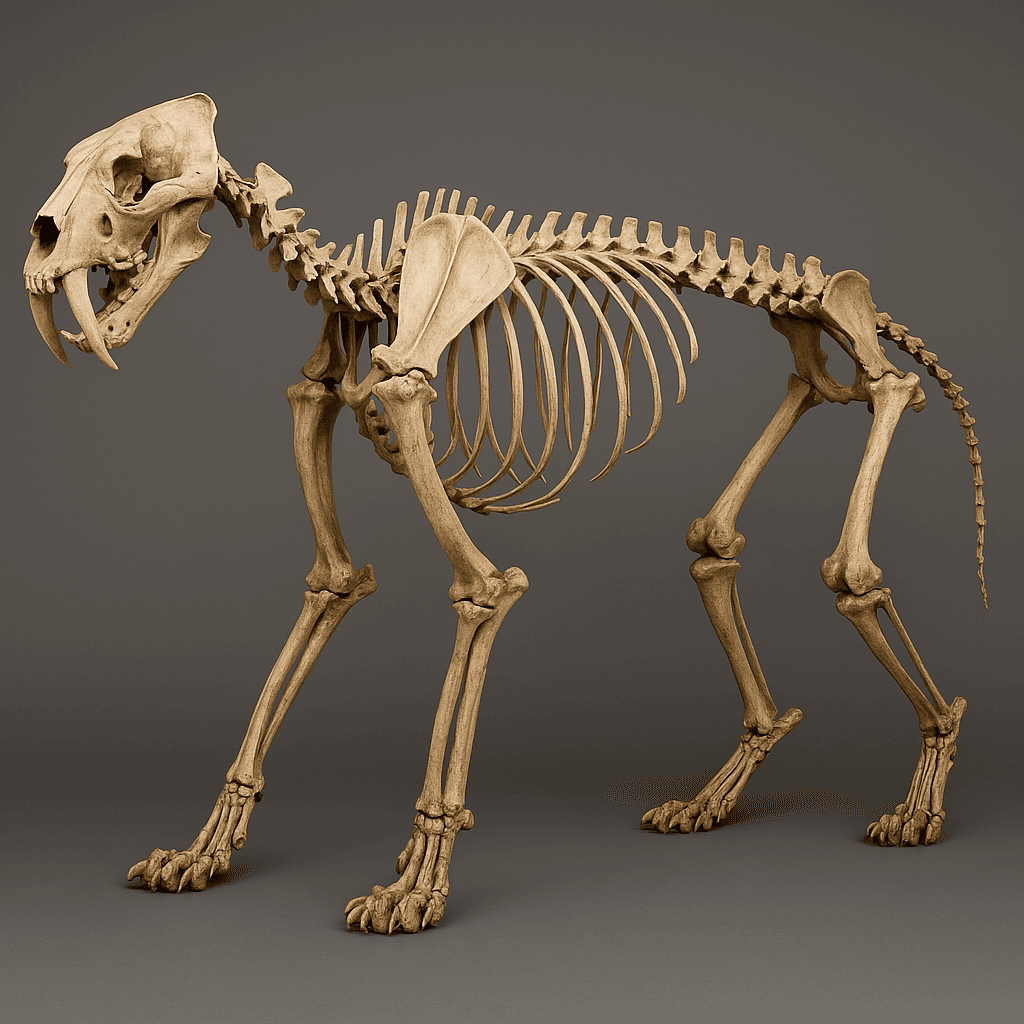
Homotherium is an extinct genus of saber-toothed cat belonging to the subfamily Machairodontinae within the family Felidae and the tribe Homotherini. This genus was first described by Fabrini in 1890. Homotherium persisted from the Pliocene until the end of the Pleistocene and was widely distributed across Eurasia, Africa, and North America. As one of the best-known machairodontine genera, Homotherium is commonly referred to as a saber-toothed cat, yet it possesses distinct and specialized morphological features differing from the classic saber-tooth structure of classical. The species Homotherium latidens is generally used as the basis for defining the genus, although some researchers argue for the presence of additional species within this genus. Nonetheless, fossil specimens from Eurasia are currently largely grouped under H. latidens.
The skeleton and tooth structure of Homotherium distinguish it from both modern large cats and other machairodonts. The skull and jaw morphology, dental anatomy, and postcranial skeletal elements clearly indicate its specialization for predation. Prominent sagittal crests and strong temporal case markings on the skull suggest a powerful bite force. The upper dog teeth are flattened and compressed laterally, differing from the more robust and rounded canines of Smilodon, the classic saber-toothed cats. The tips of these teeth are slightly curved and typically bear fine serrations; this adaptation is suited for slicing through the surface tissues of prey. A forward-projecting structure known as the mandibular flange is observed on the lower jaw and may have evolved to support the upper canines.
The lower incisors are arranged in a curved arc, with the third lower incisor (i3) significantly larger than the others. A long diastema exists between the lower incisors and canines, representing an adaptation for powerful jaw closure and prey immobilization. Lower premolars such as P3 and P4 are reduced or entirely absent; in particular, p2 is nearly always missing. Although the molars show high levels of wear, a distinct morphological differentiation is evident between the paracristid and protocristid.
The postcranial skeleton has also evolved to suit the animal’s predatory lifestyle. Long, muscular forelimbs combined with short, relatively weaker hindlimbs result in a dorsal slope from front to back. This body plan favors powerful and balanced lunges over high-speed pursuit. A short, thick tail further supports this biomechanical adaptation. The shoulder and neck musculature is highly developed, with bone attachments reflecting the size and strength of these muscles. Variability in the structure of the suprakondyloid foramen and the size of muscle attachment sites in humerus specimens from Alaska and Spain suggests considerable sexual dimorphism among individuals.

Homotherium latidens. (Flickr)
In 2020, a juvenile Homotherium latidens preserved in permafrost was discovered in Siberia (Yakutia), representing one of the most complete examples of soft tissue preservation for this genus. Estimated to be about three weeks old, the specimen shows anatomical similarities to modern lion juveniles but also possesses several distinctive features.
The muzzle and oral region are broad, the mouth opening is large, and the ears are small. The neck region is exceptionally muscular and voluminous; the forelimbs are long relative to body proportions. The pelage color is dark brown, with short but dense fur. The skull shape is rounded, the cranial volume relatively large, and the facial skeleton elongated and wide. The narrow and vertical infraorbital foramen indicates a different arrangement of facial muscles compared to other large cats. Both upper and lower incisors are conical and well-developed even at this early stage. These features suggest that Homotherium possessed strong biting and grasping capabilities from birth.

Frozen mummy of Homotherium latidens (Owen, 1846), specimen DMF AS RS no. Met-20-1, Russia, Sakha Republic (Yakutia), Indigirka River basin, Badyarikha River; Upper Pleistocene: (A) external view; (B) skeleton, CT scan, dorsal view. (ResearchGate)
Holotypes of Homotherium have been found across Africa, Eurasia, and North America. Key sites include Senèze in France, Incarcal in Spain, and Schöningen in Germany. The Schöningen finds are particularly notable for their well-documented archaeological stratigraphy. These include teeth and a partial humerus, with evidence of hominin (early human) modification on the humerus. This suggests that Homotherium was not merely an ecological predator but also a direct resource for Middle Paleolithic hominin communities.
In North America, the species Homotherium serum survived until the late Pleistocene. Specimens from Venezuela have been classified as a distinct species, Homotherium venezuelensis. In Europe, debates continue regarding the latest occurrences of Homotherium; while some specimens are dated to the late Pleistocene, these dates are treated with caution due to the lack of reliable stratigraphic context.
The evolutionary history of the genus Homotherium exhibits considerable temporal and geographic variation. Pliocene specimens from Europe, characterized by less derived jaw structures, have been associated with more primitive forms such as Homotherium cf. davitasvilii. However, from the Villafranchian onward, fossil specimens display significant morphological diversity. Some of this variation has been attributed to individual variation and sexual dimorphism, though some researchers argue for the existence of multiple distinct species. Currently, the prevailing view for Eurasian specimens is that all this variation falls within the species Homotherium latidens. In North America, however, distinct species such as H. serum and H. ischyrus are recognized.
The extinction of Homotherium was likely a multifactorial process. Increased predation pressure, climatic fluctuations during the late Pleistocene, and habitat changes reduced the species’ chances of survival. Alterations or loss of migration routes for large av herbivores may have disrupted the food chain for large predators like Homotherium. Additionally, competition from more advanced hominins such as Homo heidelbergensis and Homo sapiens during later stages of human evolution may have become a fatal factor. The latest Homotherium fossils in Europe are dated to around 300,000 years ago, while in North America the species persisted until approximately 12,000 years ago.

Henüz Tartışma Girilmemiştir
"Homotherium" maddesi için tartışma başlatın
Morphological Characteristics
Juvenile Morphology: The Badyarikha Mummy
Evolutionary History and Species Diversity
Extinction