


Bu içerik Türkçe olarak yazılmış olup yapay zeka ile otomatik olarak İngilizceye çevrilmiştir.
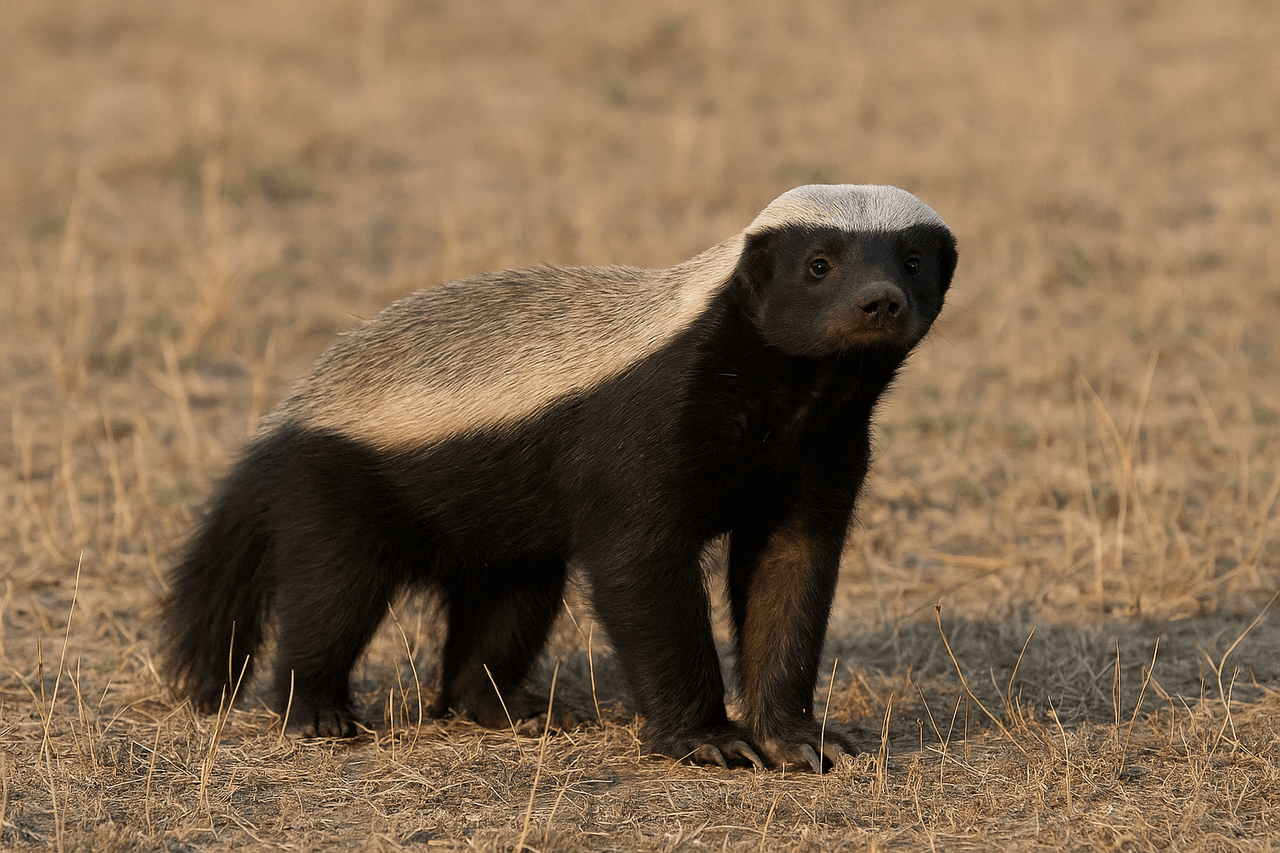
The honey badger (Mellivora capensis) is a robust and hardy carnivorous mammal native to Africa and South Asia, belonging to the weasel family (Mustelidae). Known in English as the “honey badger,” this species is particularly recognized for its habit of raiding beehives to consume honey and larvae. It draws attention with its thick, loose skin, a distinctive gray-white stripe along the upper body, powerful claws, and high level of aggression.

Honey Badger (Derek Keats, flickr)
The honey badger (Mellivora capensis) is a medium-sized carnivore known for its strong and resilient build. Its body is short, stocky, and low to the ground, providing advantages in digging and maneuvering through confined spaces. Shoulder height ranges from approximately 23 to 28 centimeters, while body length varies between 55 and 77 centimeters. Males are typically 30 percent larger than females, and this pronounced sexual dimorphism plays a significant role in the species’ spatial and ecological behavior. Average body weight ranges from 9 to 16 kilograms in males, while females are lighter. Tail length varies from 12 to 30 centimeters.
The fur is coarse, thick, and rugged; the underside of the body is matte black, while a broad gray-white stripe extends from the head to the tail along the back. This distinctive pattern is a key visual identifier for the species. The skin is notably loose, enabling the animal to twist and turn backward even when gripped by a predator, particularly around the neck and back regions. The skull is large, the jaws are powerful, and the sharp teeth are capable of breaking through thick bone. The long, strong claws on the forelimbs serve both for digging prey out of burrows and for defense. The anal gland at the base of the tail produces a strong, pungent secretion used both for marking territory and as a defensive mechanism during threats. All these morphological traits have made the honey badger an exceptionally adaptable predator capable of surviving across a wide range of habitats in Africa and Asia.
The honey badger (Mellivora capensis) exhibits a broad distribution across Africa and Asia. It is naturally found from sub-Saharan Africa northward to Morocco and Algeria, and eastward to Iran, Pakistan, Turkmenistan, India, and Nepal. The species has also been recorded in Middle Eastern countries such as Jordan, Israel, and Saudi Arabia. However, its presence in countries like Egypt and Syria remains unconfirmed. In South Asia, its distribution across the Indian subcontinent is patchy, especially limited in the northeastern regions. In Central Asia, it is restricted to the southern parts of Turkmenistan, Uzbekistan, and Kazakhstan.
Owing to its high ecological tolerance, the honey badger can inhabit a wide variety of environments. Primary habitats include rainforests, arid savannas, scrublands, semi-deserts, and desert ecosystems. It has been observed at elevations ranging from sea level up to 2,600 meters in Morocco and 4,000 meters in Ethiopia. It also persists in areas heavily impacted by human activity, such as miombo and mopane forests, rocky terrain, agricultural mosaics, and the peripheries of rural settlements.

Distribution and Habitat (IUCN Red List)
The honey badger (Mellivora capensis) is a agile and resilient carnivore renowned for its adaptations to harsh environmental conditions and predator-rich habitats, as well as its aggressive nature. Primarily solitary and terrestrial, it is an opportunistic predator. Ecologically, it is a generalist: its broad habitat tolerance, ability to consume a wide variety of food, and high mobility support this classification.
The honey badger is primarily nocturnal, but may be active during the day in areas with low human activity or cooler temperatures. In proximity to human settlements, nocturnal behavior is more pronounced. During sleep, it curls its body into a ball to protect its belly and head.
The species exhibits a solitary lifestyle, with clear sexual segregation. Males utilize significantly larger territories than females—up to 500 square kilometers—and may mate with multiple females. This structure indicates a polygamous and promiscuous mating system. The extensive range of males is linked to their strategies for locating mates.
The honey badger is not territorial, but it engages in scent-marking behavior. It marks its range with pungent secretions from its anal glands, which serve to attract the opposite sex and play a key role in its social recognition system.
The honey badger has an omnivorous diet. Its most well-known behavior is raiding beehives to consume honey and larvae, and it exhibits high resistance to bee stings. In addition, it feeds on small mammals, birds, reptiles (especially snakes), insects, eggs, fruits, and roots.
The honey badger obtains food not only through active hunting but also through scavenging and kleptoparasitism. It consumes remains of prey left by larger predators and has been documented stealing kills from smaller carnivores. It is particularly renowned for its ability to hunt snakes, including venomous species, which it kills and eats. It has been observed to withstand venomous bites, temporarily paralyzed yet recovering within a few hours.
The gestation period lasts between 7 and 10 weeks. Before giving birth, the female constructs a den, typically a dug-out tunnel system, an abandoned termite mound, a rock crevice, or an old burrow of another animal. The interior is usually lined with grass and soft vegetation. One pup is born most often; twins are rare.
Pups reach adult size by six months of age, but they do not become fully independent and leave their mother until between 14 months and two years. This extended period of maternal care allows the young to learn complex hunting techniques.
The International Union for Conservation of Nature (IUCN) classifies the honey badger as Least Concern. Nevertheless, threats such as habitat loss and illegal hunting affect local populations in certain regions.
One of the most common threats is conflict with beekeepers. Their habit of breaking into beehives to consume larvae has led local beekeepers to regard them as pests, resulting in direct killing through poisoning, trapping, or shooting. In addition, the honey badger’s bold and aggressive nature has granted it a mythical status in some traditional medicine practices; body parts such as claws, skin, and internal organs are hunted for cultural uses.
Do Linh San, E., Begg, C., Begg, K., and Abramov, A.V. 2016. "Mellivora capensis." *The IUCN Red List.* Accessed May 7, 2025. https://dx.doi.org/10.2305/IUCN.UK.2016-1.RLTS.T41629A45210107.en
Keats, Derek. “Honey badger, Mellivora capensis JPG.” Flickr. Accessed May 7, 2025. https://flic.kr/p/UVLvmV
National Geographic Society. "Honey Badger." National Geographic. Accessed April 28, 2025. https://www.nationalgeographic.com/animals/mammals/facts/honey-badger
Rosevear, Donovan Reginald. *The Carnivores of West Africa*. London: Trustees of the British Museum (Natural History), 1974. https://archive.org/details/carnivoresofwest00rose/page/n9/mode/2up
San Diego Zoo Wildlife Alliance. "Honey Badger (Ratel)." *San Diego Zoo Wildlife Alliance Animals and Plants*. Accessed April 28, 2025. https://animals.sandiegozoo.org/animals/honey-badger-ratel

Henüz Tartışma Girilmemiştir
"Honey Badger (Mellivora capensis)" maddesi için tartışma başlatın
Morphological Characteristics
Distribution and Habitat
Behavior and Ecology
Diet
Reproduction
Conservation Status