

Bu içerik Türkçe olarak yazılmış olup yapay zeka ile otomatik olarak İngilizceye çevrilmiştir.
IFF
Identification Friend and Foe | IFF | ||||||||
|---|---|---|---|---|---|---|---|---|---|
Radar (Receiver & Transmitter): Radar systems can be found internally within IFF or integrated externally by manufacturers. Radar systems come in two types: primary and secondary. The primary system operates passively, only receiving signals without transmitting. (Only receive) The secondary system operates actively and has the capability to transmit signals. (Both receiver and transmitter)
IFF Transponder (S-Mode Transponder): This hardware is a component installed on friendly systems. It responds to interrogation signals from radar with an encrypted reply indicating whether the system is friendly or hostile. The reply signal may contain identification and position information depending on the device’s sophistication. A transponder is not limited to a single mode. It can have different security levels and transmit military or civilian signals as required. Accordingly, it may incorporate combinations of different cryptographic modes.
Cryptographic Systems: They encrypt outgoing signals and decrypt incoming encrypted signals.
Signal Processing: It decodes, interrogates, and classifies incoming response signals as friendly or hostile.
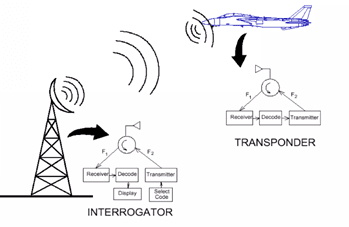
IFF Communication
Modern IFF systems are capable of supporting multiple operation modes. The mode can be changed according to mission requirements and operational scenarios. In necessary cases, the system can switch to lower or higher security modes.
Mode-1: Offers limited security and is not encrypted. It is typically used by older systems in basic military operations. It has both receiver and transmitter components and classifies incoming signals using a single method.
Mode-2: Involves the exchange of an identification code known only to military forces. It is not encrypted. It is used in more critical operations than Mode-1.
Mode-3A: Used in civil aviation for air traffic control. Communication is conducted via a code known as a “squawk code,” which corresponds to a specific aircraft or flight plan.
Mode-4: Encrypted military identification. The signal from the transponder is encrypted and can only be decrypted by authorized personnel. It uses two-way keying to resist spoofing. It is used in sensitive military operations and is currently employed by many military forces worldwide.
Mode-5: Advanced encrypted identification. It is the most sophisticated mode currently available. High-level encryption is used and it is resistant to both jamming and spoofing. It is typically used in combat aircraft. It is accessible to NATO, NATO allies, and countries participating in the F-35 JSF Program.
Other countries that partner with NATO or are close allies and use Mode 5 systems to ensure compatibility with NATO operations and secure identification include:
Collins Aerospace. (n.d.). Identification Friend or Foe (IFF).https://www.collinsaerospace.comhttps://www.collinsaerospace.com/what-we-do/industries/military-and-defense/communications/airborne-communications/iff
Svyd, I., Obod, I., Maltsev, O., Shtykh, I., & Zavolodko, G. (2019). Model and method for detecting request signals in identification friend or foe systems. 2019 IEEE 15th International Conference on the Experience of Designing and Application of CAD Systems (CADSM), 1–4. https://doi.org/10.1109/cadsm.2019.8779322

IFF
Identification Friend and Foe | IFF | ||||||||
|---|---|---|---|---|---|---|---|---|---|
Henüz Tartışma Girilmemiştir
"IFF - Friend or Foe Identification Systems and Modes" maddesi için tartışma başlatın
Hardware
Software
IFF Modes and Operating Principles