

Bu madde henüz onaylanmamıştır.

Jidoka is a production principle within the Toyota Production System (TPS) that refers to a mechanism enabling the detection of defects during the manufacturing process and stopping the process either automatically or through operator intervention. The term, originating from Japanese, is defined as “adding human intelligence to automation” or “automation with a human touch.” The Jidoka principle focuses on ensuring quality during production and provides a system that prevents processes from continuing in a faulty manner. Its historical roots trace back to the automatic stop mechanisms incorporated in the weaving looms developed by Sakichi Toyoda.
Jidoka relies on real-time quality control during the production process. When any deviation, malfunction, or quality issue is detected, the production operation is halted either manually or automatically. After stopping, the problem is analyzed and necessary corrective actions are applied. This method prevents the repetition of errors throughout the production chain. Operators working on the production line not only perform their production tasks but also monitor signs of defects and stop production when needed. Jidoka is a system where automatic machine functions work in conjunction with human intervention. Its implementation involves the use of sensors, control systems, and automatic stop mechanisms.
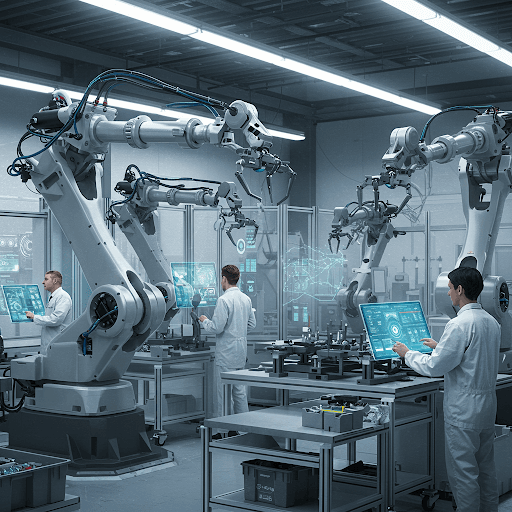
Production Line and Operators (Created by Artificial Intelligence)
Another commonly used approach alongside Jidoka is the Poka-Yoke (error-proofing) system. Poka-Yoke systems include technical or structural solutions designed to prevent errors from occurring. These solutions encompass mechanisms such as fixtures that allow parts to be installed only in a specific orientation. Such systems reduce human errors during the production process. When implemented together with Poka-Yoke, Jidoka enables the analysis of the root causes of detected problems and ensures that the process is brought back into compliance with standards before restarting. Within the Toyota Production System, Jidoka is defined by the “stop and fix” approach. According to this approach, whenever an anomaly is detected on the production line, the operator stops production and corrective actions are taken. This practice ensures quality control is performed at every stage of production.
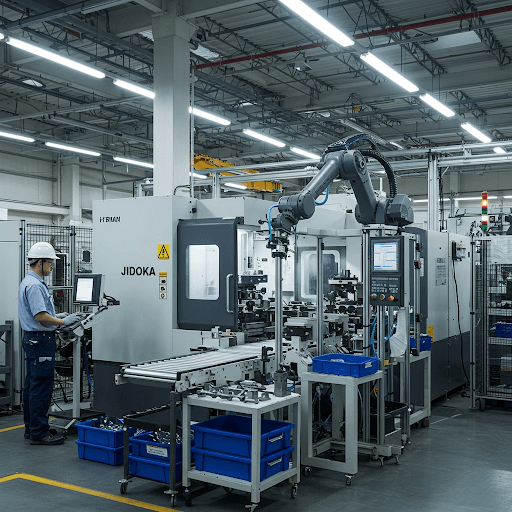
Jidoka Integrated Production System (Created by Artificial Intelligence)
Jidoka is used together with continuous improvement (Kaizen) practices within the lean production system. Continuous improvement aims to make the production process more efficient and error-free through small and regular enhancements. Jidoka functions as a feedback mechanism in the process; it facilitates the analysis of the causes of errors and the implementation of systemic adjustments that prevent the recurrence of similar problems. Reviews conducted after each interruption in the process include solving the current error and updating standards to prevent similar situations from occurring again. The implementation and sustainability of Jidoka are linked to internal organizational training, open communication, and managerial structures.
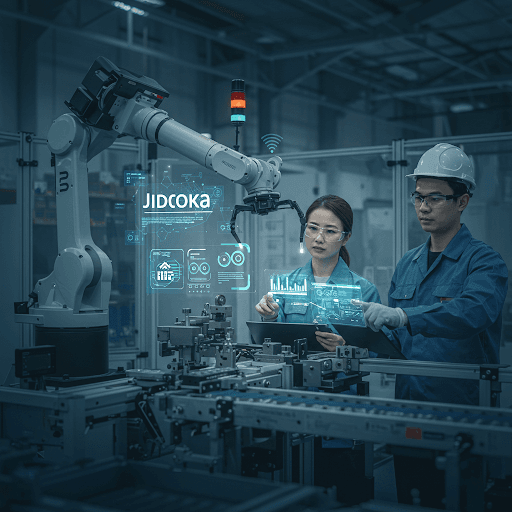
Autonomous Production Line (Created by Artificial Intelligence)
Bicheno, John, ve Matthias Holweg. The Lean Toolbox: The Essential Guide to Lean Transformation. 4th ed. Oxford: PICSIE Books, 2009.
Imai, Masaaki. Gemba Kaizen: A Commonsense, Low-Cost Approach to Management. 2nd ed. New York: McGraw-Hill, 2012.
Liker, J. K. The Toyota Way: 14 Management Principles from the World’s Greatest Manufacturer. New York: McGraw-Hill, 2004.
Ohno, Taiichi. Toyota Production System: Beyond Large-Scale Production. Portland: Productivity Press, 1988.
Shingo, Shigeo. Zero Quality Control: Source Inspection and the Poka-Yoke System. Cambridge: Productivity Press, 1986.

Henüz Tartışma Girilmemiştir
"Jidoka" maddesi için tartışma başlatın
Fundamental Principles and Implementation Methods
Error Prevention Systems
Continuous Improvement
Bu madde yapay zeka desteği ile üretilmiştir.