


This article was automatically translated from the original Turkish version.
Lean Production
Name(s) | Lean Manufacturing | ||||||||
|---|---|---|---|---|---|---|---|---|---|
History | Japan, Toyota Production System (TPS) | ||||||||
Method(s) | Value Stream Mapping (VSM) Just-in-Time Production (JIT) SMED Kanban 5S | ||||||||
Lean manufacturing was developed and implemented primarily by Toyota in Japan’s automotive industry during the 1990s. This production philosophy aims to eliminate waste and minimize all activities and resources that do not create value. Lean manufacturing not only reduces costs but also seeks to improve quality accelerate production processes and enhance flexibility.
With the rise of Industry 4.0 lean manufacturing techniques and principles have gained even greater importance. While Industry 4.0 encompasses innovative technologies such as digitalization automation and data analytics lean manufacturing provides pathways to integrate these technologies in a more efficient and sustainable manner. In this context evaluating lean manufacturing techniques from an Industry 4.0 perspective has become a critical step toward making production processes more efficient.

Lean Manufacturing (Association of Project and Investment Support Advisors)
Lean manufacturing is a production approach focused on creating customer value and eliminating waste. Its fundamental objective is to use resources as efficiently as possible and minimize unnecessary steps and waste in production processes. Lean manufacturing aims not only to reduce costs but also to improve quality and respond swiftly to customer demands.
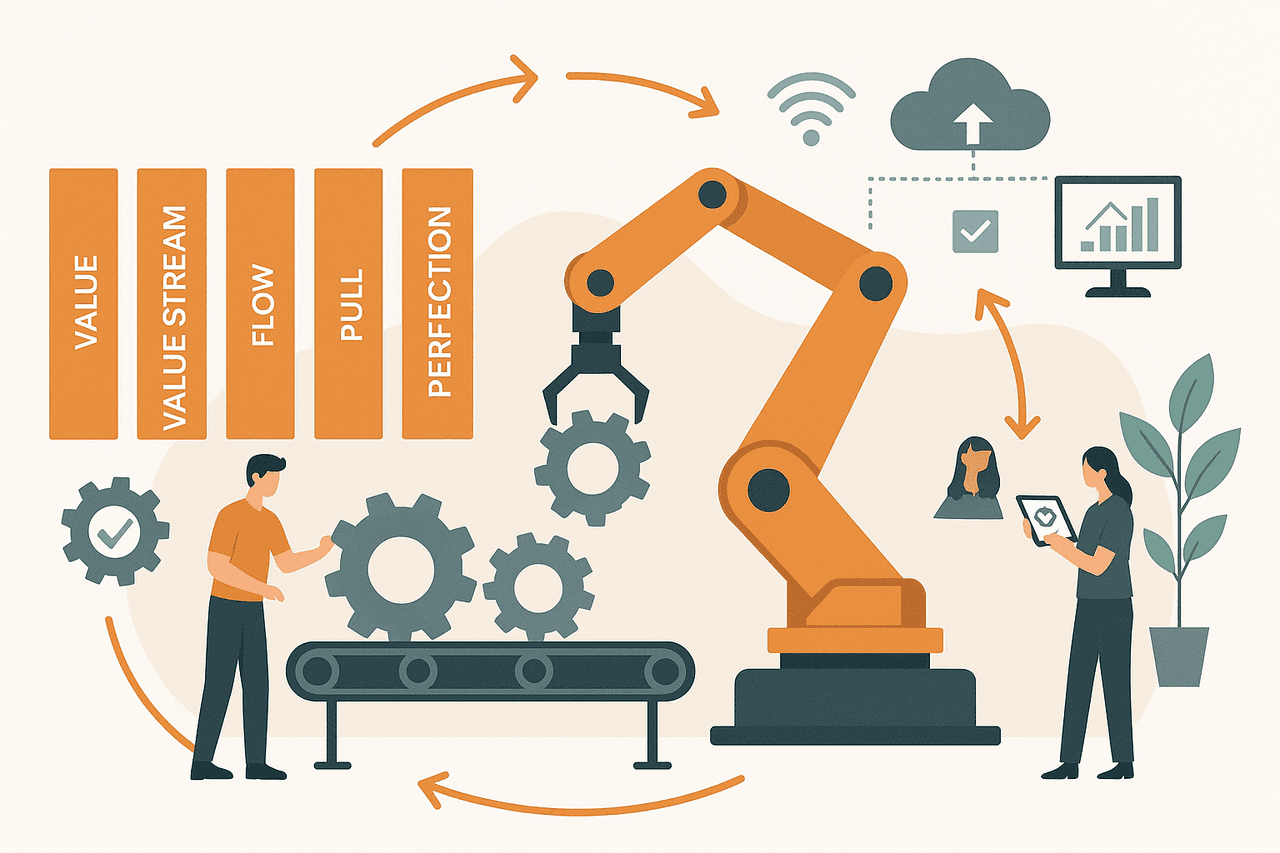
The core principles of lean manufacturing can be listed as Value Value Stream Flow Pull and Perfection. These principles serve as essential guides for optimizing production processes:
The first step in lean manufacturing is defining value from the customer’s perspective. Value is determined by what the customer wants and is willing to pay for. Therefore any activity that does not create value must be eliminated.
All steps in the production process must be analyzed and any non-value-adding activity must be removed. The value stream encompasses every stage from product design to final delivery. To ensure efficient operation every element that does not add value must be eliminated.
Removing obstacles in the production process and ensuring seamless workflow is one of the most important principles of lean manufacturing. A good flow minimizes stoppages delays and inventory on production lines.
The pull principle ensures that production is driven by demand. Production occurs only in response to customer orders. This prevents unnecessary inventory and overproduction. This principle aligns with the Just In Time (JIT) production model.
Lean manufacturing is based on the principle of continuous improvement. Companies strive to regularly review and enhance their production processes to become more efficient. This continuous improvement approach is one of the most important characteristics of lean manufacturing and ensures the long-term sustainability of the organization.
Lean manufacturing practices typically involve a wide range of tools and techniques including 5S Kaizen Kanban Value Stream Mapping and TPM (Total Productive Maintenance). These tools enable the effective implementation of lean manufacturing philosophy and the elimination of non-value-adding activities.
Industry 4.0 is an industrial revolution characterized by the integration of digitalization automation and intelligent technologies into production processes. This revolution aims to make production processes more efficient flexible and customizable. The relationship between lean manufacturing and Industry 4.0 lies in the shared focus of both approaches on increasing efficiency reducing waste and responding rapidly to customer demands.
Lean manufacturing primarily seeks to simplify production processes and eliminate waste. When combined with the digital technologies offered by Industry 4.0 these goals become even more effective. Industry 4.0 incorporates digital solutions such as big data analytics the Internet of Things (IoT) artificial intelligence (AI) robotics and autonomous systems into production processes. These technologies enhance efficiency reduce error rates and create more flexible production structures in alignment with lean manufacturing principles.
Lean manufacturing is a holistic approach composed of various techniques and tools designed to eliminate waste and increase value addition. These tools enable organizations to improve operational efficiency and establish a customer-centric structure. Below are the most commonly used techniques and tools in lean manufacturing.
The 5S system consists of five Japanese words beginning with the letter S: Seiri (Sort) Seiton (Set in Order) Seiso (Shine) Seiketsu (Standardize) and Shitsuke (Sustain). This system enhances efficiency and safety by optimizing workspaces.

5S (TEI)
Kaizen refers to continuous incremental improvements. It encourages active employee participation in the process to identify root causes of problems and develop lasting solutions.
Kanban is a pull system tool that visualizes production processes to manage material and information flow. It helps maintain minimal inventory levels and plan production according to demand.
Just In Time production focuses on manufacturing materials and products exactly when they are needed to reduce unnecessary inventory. This lowers storage costs and increases production agility.
Poka-yoke involves developing devices and systems that prevent human errors. This method enhances quality by preventing defective products from being produced.
This technique aims to reduce setup times. It increases machine efficiency by minimizing time losses between production transitions.
This technique enables analysis of all steps in the production process. Non-value-adding activities are identified and processes are restructured accordingly.
This balances production quantities to reduce demand fluctuations. This results in a more stable workflow.
This technique aims to involve all employees in the maintenance of machinery and equipment. The goal is to reduce downtime and increase productivity.
Industry 4.0 collects real-time data from sensors and IoT devices across production lines. This data enables continuous monitoring and rapid improvement of production processes. In lean manufacturing timely analysis of data and prompt action are essential to eliminate waste.
Industry 4.0 technologies make production systems more flexible. Robotics and artificial intelligence enable production lines to respond quickly to changes and customized demands. This supports the lean manufacturing pull principle by facilitating rapid responses to customer needs.
Robotics technologies introduced by Industry 4.0 reduce dependence on manual labor enabling faster and more accurate production. While lean manufacturing seeks to eliminate waste automation helps prevent waste related to labor and time losses.
Industry 4.0 provides technologies that optimize energy efficiency and resource utilization in production processes. This aligns with lean manufacturing’s sustainability goals. Monitoring and optimizing resource use on production lines minimizes waste and reduces costs.
Industry 4.0 technologies digitally support the continuous improvement principle of lean manufacturing. Collecting and analyzing data enables ongoing optimization of production processes. This allows companies to implement the core principles of lean manufacturing more effectively.
Lean manufacturing techniques are applied across various stages of industrial production to eliminate waste simplify processes and establish a customer-focused structure. These techniques can be flexibly adapted across many sectors from manufacturing to services. Major application areas are listed below:
Lean manufacturing finds its most widespread application in the automotive industry where it originated. This approach which forms the foundation of the Toyota Production System reduces unnecessary steps on the production line thereby minimizing labor time and material waste. Techniques such as the pull system JIT and Kanban are extensively used in the automotive sector.
In this sector frequent product variety and short product life cycles necessitate the flexible nature of lean manufacturing. Lean techniques are preferred for line balancing reducing setup times and preventing quality defects.
Since quality and safety are paramount in these fields lean manufacturing techniques ensure strict process control. Methods such as error prevention (poka-yoke) standardized work and visual control systems enhance efficiency in sectors requiring high precision.
In this sector where production continuity is critical lean manufacturing tools such as line balancing rapid changeover systems (SMED) and production planning are used to reduce waste while maintaining hygiene and quality standards.
In healthcare a key service sector lean approaches are applied to reduce patient waiting times improve resource utilization and accelerate processes. Lean-based applications have been developed for hospital material flow appointment scheduling and patient routing systems.
Lean manufacturing techniques are also applied in educational institutions and public services to improve processes. Lean tools are used to reduce bureaucratic procedures accelerate document flow and enhance time management.
In areas such as banking insurance and customer service lean manufacturing principles are used to simplify service processes reduce costs and increase customer satisfaction. Examples include redesigning workflows and reducing waiting times.
PROYAD (Proje ve Yatırım Destekleri Danışmanları Derneği). "Yalın Üretim Uygulamaları." PROYAD. Date Published December 24, 2022. Accessed May 10, 2025. https://www.proyad.org.tr/yalin-uretim-uygulamalari/.
Sarı, Emre Bilgin. “Yalın Üretim Teknikleri ve Uygulamaları.” *Afyon Kocatepe Üniversitesi İktisadi ve İdari Bilimler Fakültesi Dergisi* 20, no. 2 (2018): 123–136. Accessed May 10, 2025. https://dergipark.org.tr/en/download/article-file/511751.
TEI (TUSAŞ Motor Sanayi A.Ş.). "Yalın Üretim." TEI. Accessed May 10, 2025. https://www.tei.com.tr/faaliyet-alanlari/parca-ve-modul-uretimi/yalin-uretim.
Yılmaz, Eren. *Yalın Üretim Tekniklerinin Teorik Temelleri ve Uygulamalarına Yönelik Bir Araştırma*. Master's thesis, İstanbul Teknik Üniversitesi, 2008. Accessed May 10, 2025. https://polen.itu.edu.tr:8443/server/api/core/bitstreams/6f113700-d7f1-45f8-9982-5528eeea681f/content.
Öksüz, Mehmet Kürşat. *Yalın Üretim Tekniklerinin Endüstri 4.0 Perspektifinden Değerlendirilmesi*. October 2017. Accessed May 10, 2025. https://www.researchgate.net/publication/320800840_Yalin_Uretim_Tekniklerinin_Endustri_40_Perspektifinden_Degerlendirilmesi.

Lean Production
Name(s) | Lean Manufacturing | ||||||||
|---|---|---|---|---|---|---|---|---|---|
History | Japan, Toyota Production System (TPS) | ||||||||
Method(s) | Value Stream Mapping (VSM) Just-in-Time Production (JIT) SMED Kanban 5S | ||||||||
Lean Manufacturing Philosophy and Core Principles
Value
Value Stream
Flow
Pull
Perfection
Integration of Lean Manufacturing and Industry 4.0
Lean Manufacturing Techniques and Tools
5S System
Kaizen (Continuous Improvement)
Kanban
JIT (Just-In-Time)
Poka-Yoke (Error Prevention)
SMED (Single-Minute Exchange of Die)
Value Stream Mapping
Heijunka (Production Leveling)
TPM (Total Productive Maintenance)
Real-Time Data Analysis and Decision Making
Flexible Production and Rapid Response
Automation and Robotics
Efficient Resource Use and Energy Conservation
Lean Management and Continuous Improvement (Kaizen)
Application Areas of Lean Manufacturing Techniques
Automotive Industry
Electronics and White Goods Manufacturing
Defense and Aerospace Industry
Food and Beverage Industry
Healthcare Sector
Educational Institutions and Public Sector
Service Sector